

Sustainable Development Goals
This article contributes to the following United Nations Sustainable Development Goals.

Kata Kunci
Cara Mengutip




Ringkasan Publikasi

Edisi Mendatang
J-HyTEL welcomes original and rigorous scholarship advancing education, media technology, and computer science applications.
Rolling submissions are accepted throughout the year.
Abstrak
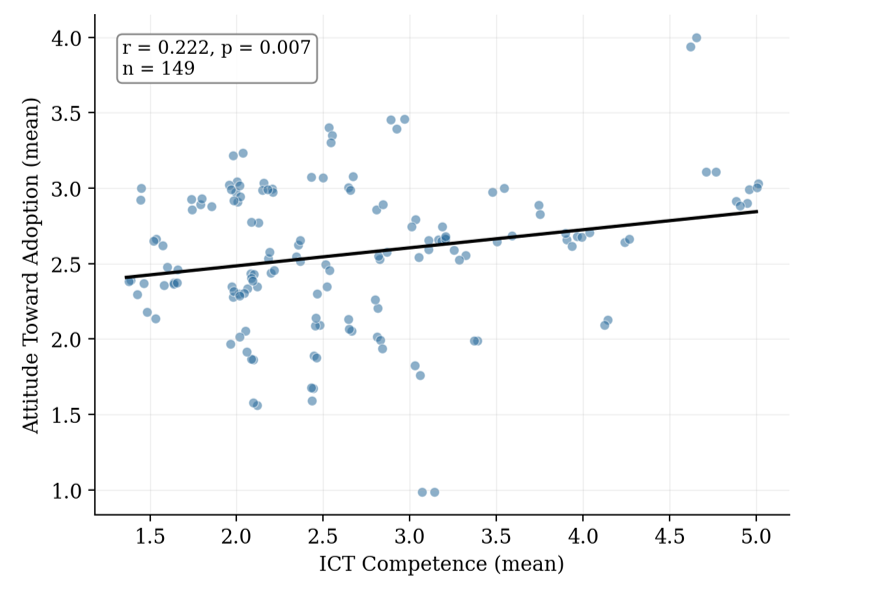
Penelitian ini mengkaji hubungan antara kompetensi digital dan sikap terhadap adopsi teknologi informasi dan komunikasi (TIK) di kalangan calon guru Pendidikan Bisnis di perguruan tinggi pendidikan di wilayah Barat Daya Nigeria. Integrasi TIK ke dalam pengajaran bergantung pada kompetensi dan disposisi calon guru, namun hubungan antara konstruk-konstruk ini jarang diukur secara kuantitatif untuk Pendidikan Bisnis di lingkungan dengan sumber daya terbatas. Berlandaskan pada model penerimaan teknologi dan teori kognitif sosial, penelitian ini menggunakan desain survei korelasional. Sebanyak 149 calon guru mengisi kuesioner terstruktur yang mengukur kompetensi digital, sikap terhadap adopsi TIK, dan sikap umum terhadap TIK, dengan koefisien Cronbach’s alpha masing-masing sebesar 0,84, 0,80, dan 0,85. Data dianalisis menggunakan statistik deskriptif, korelasi momen produk Pearson, dan regresi linier berganda. Responden melaporkan tingkat kompetensi yang moderat dan sikap yang cukup positif. Kompetensi digital berhubungan secara signifikan dan positif dengan sikap terhadap adopsi serta sikap umum terhadap TIK, sementara kedua aspek sikap tersebut sangat terkait satu sama lain. Kompetensi dan sikap umum secara bersama-sama menjelaskan 36,1% varians dalam sikap terhadap adopsi, meskipun kompetensi tidak lagi menjadi prediktor tunggal setelah sikap dikendalikan. Studi ini menyimpulkan bahwa disposisi sikap, bukan sekadar kompetensi, merupakan korelat yang lebih proksimal terhadap adopsi, dan merekomendasikan agar program persiapan guru mengintegrasikan pengembangan kompetensi dengan perhatian terhadap sikap.
RIS is compatible with Zotero, Mendeley, and EndNote. Immediate opening depends on the visitor's browser and reference-manager settings.
Pernyataan yang dilaporkan dalam artikel yang diterbitkan
Author Contributions
Festus Oladimeji Olafare: Conceptualization, Methodology, Investigation, Formal Analysis, Data Curation, Writing – Original Draft, Writing – Review & Editing, Visualization, and Project Administration. As the sole author, Festus Oladimeji Olafare conceived the study, designed the methodology, collected and analysed the data, and prepared and approved the final manuscript.
Acknowledgments
The author wishes to thank the management and staff of the participating colleges of education for their cooperation during data collection.
View statement in PDF · PDF page 7Ethics Approval
The manuscript does not report a formal ethics committee approval, exemption determination, or protocol reference.
View statement in PDF · PDF page 7Informed Consent
Written informed consent was obtained from all participants before data collection.
View statement in PDF · PDF page 7Consent for Publication
Not applicable. The article contains no identifiable individual participant information.
Digital Competence and Attitude Towards ICT Adoption … (Festus Oladimeji Olafare, 2026)
Pendanaan
This research received no specific grant from any funding agency in the public, commercial, or notfor-profit sectors.
View statement in PDF · PDF page 8Ketersediaan Data
The data supporting the findings of this study are available from the corresponding author upon reasonable request, subject to applicable ethical and confidentiality restrictions.
View statement in PDF · PDF page 8Konflik Kepentingan
The author declares no competing interests.
View statement in PDF · PDF page 8Generative AI Disclosure
During manuscript preparation and revision in 2026, the author used Claude (Anthropic) and ChatGPT (OpenAI) for language editing, structural refinement, and reference-format checking. These tools were not used to generate or modify the study data, statistical analyses, reported results, or conclusions. The author independently reviewed and revised all AI-assisted output, verified the references and substantive content, and accepts full responsibility for the accuracy, originality, analysis, and conclusions of the article.
View statement in PDF · PDF page 8Referensi
22 References[1] M. O. Yusuf, “Information and communication technology and education: Analysing the Nigerian national policy for information technology,” International Education Journal, vol. 6, no. 3, pp. 316–321, 2005.
[2] C. Buabeng-Andoh, “Factors influencing teachers’ adoption and integration of information and communication technology into teaching: A review of the literature,” International Journal of Education and Development using ICT, vol. 8, no. 1, pp. 136–155, 2012.
[3] F. D. Davis, “Perceived usefulness, perceived ease of use, and user acceptance of information technology,” MIS Quarterly, vol. 13, no. 3, pp. 319–340, 1989, doi: https://doi.org/10.2307/249008.
[4] D. R. Compeau and C. A. Higgins, “Computer self-efficacy: Development of a measure and initial test,” MIS Quarterly, vol. 19, no. 2, pp. 189–211, 1995, doi: https://doi.org/10.2307/249688.
[5] M. Fishbein and I. Ajzen, Belief, Attitude, Intention, and Behavior: An Introduction to Theory and Research. Reading, MA, USA: Addison-Wesley, 1975.
[6] T. Teo, “Modelling technology acceptance in education: A study of pre-service teachers,” Computers & Education, vol. 52, no. 2, pp. 302–312, 2009, doi: https://doi.org/10.1016/j.compedu.2008.08.006.
[7] T. Teo, “Factors influencing teachers’ intention to use technology: Model development and test,” Computers & Education, vol. 57, no. 4, pp. 2432–2440, 2011, doi: https://doi.org/10.1016/j.compedu.2011.06.008.
[8] A. Bandura, Social Foundations of Thought and Action: A Social Cognitive Theory. Englewood Cliffs, NJ, USA: Prentice-Hall, 1986.
[9] I. Ajzen, “The theory of planned behavior,” Organizational Behavior and Human Decision Processes, vol. 50, no. 2, pp. 179–211, 1991, doi: https://doi.org/10.1016/0749-5978(91)90020-T.
[10] V. Venkatesh, M. G. Morris, G. B. Davis, and F. D. Davis, “User acceptance of information technology: Toward a unified view,” MIS Quarterly, vol. 27, no. 3, pp. 425–478, 2003, doi: https://doi.org/10.2307/30036540.
[11] E. M. Rogers, Diffusion of Innovations, 5th ed. New York, NY, USA: Free Press, 2003.
[12] A. Albirini, “Teachers’ attitudes toward information and communication technologies: The case of Syrian EFL teachers,” Computers & Education, vol. 47, no. 4, pp. 373–398, 2006, doi: https://doi.org/10.1016/j.compedu.2004.10.013.
[13] M. O. Yusuf and M. R. Balogun, “Student-teachers’ competence and attitude towards information and communication technology: A case study in a Nigerian university,” Contemporary Educational Technology, vol. 2, no. 1, pp. 18–36, 2011, doi: https://doi.org/10.30935/cedtech/6041.
[14] G. Sang, M. Valcke, J. van Braak, and J. Tondeur, “Student teachers’ thinking processes and ICT integration: Predictors of prospective teaching behaviors with educational technology,” Computers & Education, vol. 54, no. 1, pp. 103–112, 2010, doi: https://doi.org/10.1016/j.compedu.2009.07.010.
[15] C. Player-Koro, “Factors influencing teachers’ use of ICT in education,” Education Inquiry, vol. 3, no. 1, pp. 93–108, 2012, doi: https://doi.org/10.3402/edui.v3i1.22015.
[16] A. Tella, A. Tella, O. M. Toyobo, L. O. Adika, and A. A. Adeyinka, “An assessment of secondary school teachers’ uses of ICTs: Implications for further development of ICT use in Nigerian secondary schools,” The Turkish Online Journal of Educational Technology, vol. 6, no. 3, pp. 5–17, 2007.
[17] J. C. Nunnally and I. H. Bernstein, Psychometric Theory, 3rd ed. New York, NY, USA: McGraw-Hill, 1994.
[18] J. Cohen, Statistical Power Analysis for the Behavioral Sciences, 2nd ed. Hillsdale, NJ, USA: Lawrence Erlbaum Associates, 1988.
[19] G. Falloon, “From digital literacy to digital competence: The teacher digital competency (TDC) framework,” Educational Technology Research and Development, vol. 68, no. 5, pp. 2449–2472, 2020, doi: https://doi.org/10.1007/s11423-020-09767-4.
[20] J. Tondeur, J. van Braak, G. Sang, J. Voogt, P. Fisser, and A. Ottenbreit-Leftwich, “Preparing pre-service teachers to integrate technology in education: A synthesis of qualitative evidence,” Computers & Education, vol. 59, no. 1, pp. 134–144, 2012, doi: https://doi.org/10.1016/j.compedu.2011.10.009.
[21] E. J. Instefjord and E. Munthe, “Educating digitally competent teachers: A study of integration of professional digital competence in teacher education,” Teaching and Teacher Education, vol. 67, pp. 37–45, 2017, doi: https://doi.org/10.1016/j.tate.2017.05.016.
[22] P. M. Podsakoff, S. B. MacKenzie, J.-Y. Lee, and N. P. Podsakoff, “Common method biases in behavioral research: A critical review of the literature and recommended remedies,” Journal of Applied Psychology, vol. 88, no. 5, pp. 879–903, 2003, doi: https://doi.org/10.1037/0021-9010.88.5.879.
Copyright and License

Artikel ini berlisensi Creative Commons Attribution 4.0 International License.
Hak Cipta (c) 2026 Olafare Festus Oladimeji