

Sustainable Development Goals
This article contributes to the following United Nations Sustainable Development Goals.

Keywords
How to Cite




Publication Snapshot
Upcoming Issue
J-HyTEL welcomes original and rigorous scholarship advancing education, media technology, and computer science applications.
Rolling submissions are accepted throughout the year.
Abstract
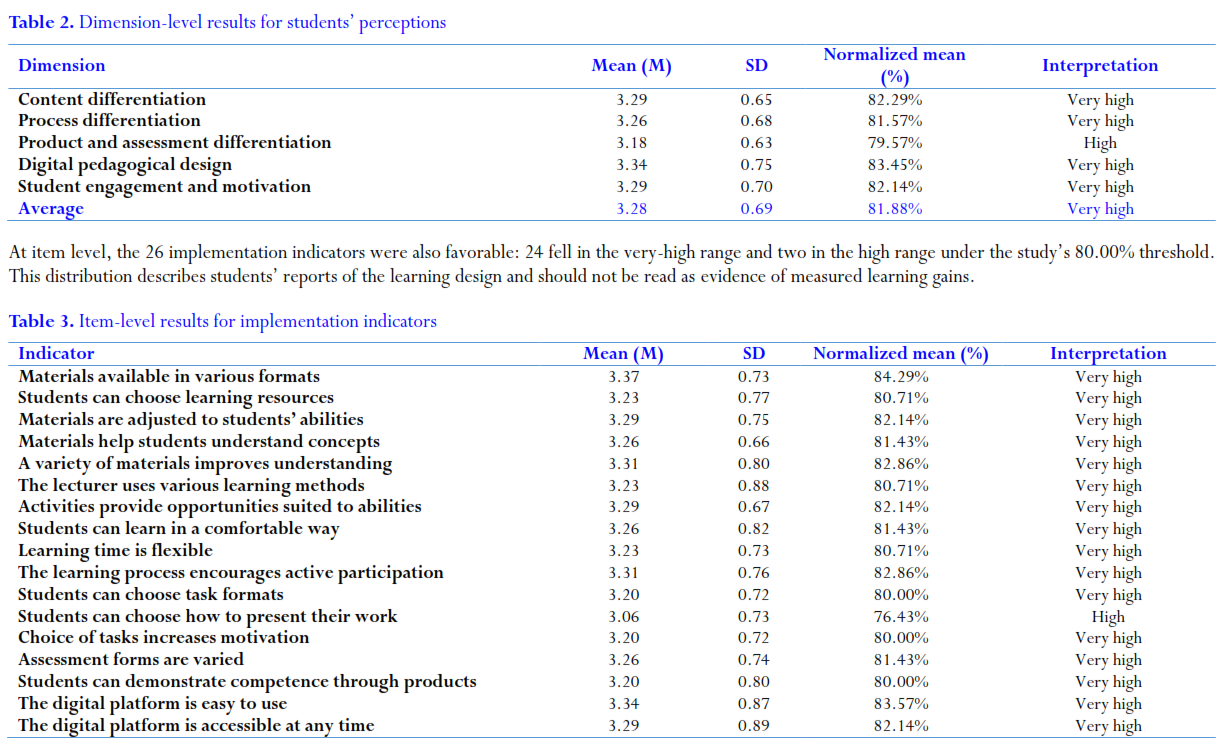
Student diversity poses a continuing challenge in higher education, particularly when common learning objectives must be maintained while providing flexibility in learning resources, activities, interaction, support, and assessment. This study examined students’ perceptions and acceptance of digitally supported differentiated learning in Information Technology Education. A quantitative cross-sectional descriptive survey was conducted with 35 students at Universitas Lampung, Indonesia, after the learning experience. Data were collected using a 31-item questionnaire rated on a four-point Likert scale, with reported high internal consistency (Cronbach’s α = 0.985), and were analyzed using means, standard deviations, and normalized mean scores. Students rated the five implementation dimensions favorably (M = 3.28, 81.88%). Digital pedagogical design received the highest rating (M = 3.34, 83.45%), whereas product and assessment differentiation received the lowest (M = 3.18, 79.57%). Technology-supported collaboration was the highest-rated individual item (M = 3.49, 87.14%), whereas choices in presentation formats and the timeliness of digital feedback received lower ratings. The secondary acceptance summary was similarly favorable (M = 3.31, 82.74%), with increased learning motivation receiving the highest rating. These findings identify digital support and collaboration as perceived strengths of the learning design, while flexibility in student products and the timeliness of feedback warrant further attention. Given the single-cohort, post-only design and absence of objective learning-outcome measures, the findings should be interpreted as context-specific evidence of students’ perceptions of implementation rather than evidence of causal effects on learning.
RIS is compatible with Zotero, Mendeley, and EndNote. Immediate opening depends on the visitor's browser and reference-manager settings.
Declarations reported in the published article
Author Contributions
Margaretha Karolina Sagala: Conceptualization; Methodology; Investigation; Writing – Original Draft. Afif Rahman Riyanda: Formal Analysis; Validation; Investigation; Writing – Original Draft; Writing – Review & Editing. Daniel Rinaldi: Investigation; Writing – Review & Editing. Ghea Chandra Surawan: Investigation; Methodology (instrument development); Writing – Review & Editing. All authors reviewed and approved the final manuscript and accepted responsibility for the work.
Acknowledgments
Not applicable.
View statement in PDF · PDF page 9Funding
DIPA BLU FKIP Universitas Lampung supported this research for fiscal year 2026.
View statement in PDF · PDF page 9Competing Interests
The authors declare no competing interests.
View statement in PDF · PDF page 10Ethics Approval
The study was conducted in accordance with the ethical principles and applicable institutional guidelines governing research involving human participants.
View statement in PDF · PDF page 10Informed Consent
Informed consent was obtained from all participants before participation. Participants were informed about the study purpose and procedures, the voluntary nature of participation, confidentiality, and their right to withdraw without consequence.
View statement in PDF · PDF page 10Consent for Publication
Not applicable. The study does not report identifiable participant data, images, or other information that could identify an individual. Study or Protocol Registration This descriptive survey was not prospectively registered in a study or protocol registry.
View statement in PDF · PDF page 10Data Availability
The data supporting the findings are not publicly available because of privacy and ethical considerations concerning the participants. They may be available from the corresponding author upon reasonable request, subject to applicable ethical and institutional requirements. Generative AI and AI-Assisted Technologies During manuscript preparation, the authors used ChatGPT solely for language editing, grammar correction, and readability. The authors reviewed and verified all AI-assisted suggestions, made the final substantive and scientific decisions, and take full responsibility for the content. Preprint and Prior Dissemination The authors declare that this manuscript has not been previously published or posted as a preprint, conference paper, conference abstract, working paper, thesis, dissertation, repository version, or other related publication.
View statement in PDF · PDF page 10References
31 References[1] R. Boelens, M. Voet, and B. De Wever, “The design of blended learning in response to student diversity in higher education: Instructors’ views and use of differentiated instruction in blended learning,” Comput. Educ., vol. 120, pp. 197–212, May 2018, doi: https://doi.org/10.1016/j.compedu.2018.02.009.
[2] P. Subban, M. N. Suprayogi, M. Preston, A. N. Liyani, and A. P. P. Ratri, “Differentiation is sometimes a hit and miss: Educator perceptions of differentiated instruction in the higher education sector,” Asia-Pac. Educ. Res., vol. 34, no. 3, pp. 873–884, Jun. 2025, doi: https://doi.org/10.1007/s40299-024-00904-8.
[3] M. Preston, P. Subban, M. N. Suprayogi, A. N. Liyani, and A. P. P. Ratri, “Differentiated instruction in higher education: The experience and perceptions of five academics,” J. Educ. Learn. (EduLearn), vol. 19, no. 3, pp. 1295–1306, Aug. 2025, doi: https://doi.org/10.11591/edulearn.v19i3.21760.
[4] A. E. Smale-Jacobse, A. Meijer, M. Helms-Lorenz, and R. Maulana, “Differentiated instruction in secondary education: A systematic review of research evidence,” Front. Psychol., vol. 10, Nov. 2019, Art. no. 2366, doi: https://doi.org/10.3389/fpsyg.2019.02366.
[5] M. I. Deunk, A. E. Smale-Jacobse, H. de Boer, S. Doolaard, and R. J. Bosker, “Effective differentiation practices: A systematic review and meta-analysis of studies on the cognitive effects of differentiation practices in primary education,” Educ. Res. Rev., vol. 24, pp. 31–54, Jun. 2018, doi: https://doi.org/10.1016/j.edurev.2018.02.002.
[6] M. J. Koehler, P. Mishra, and W. Cain, “What is technological pedagogical content knowledge (TPACK)?,” J. Educ., vol. 193, no. 3, pp. 13–19, 2013, doi: https://doi.org/10.1177/002205741319300303.
[7] J. O. Väätäjä and H. Ruokamo, “Conceptualizing dimensions and a model for digital pedagogy,” J. Pac. Rim Psychol., vol. 15, 2021, Art. no. 1834490921995395, doi: https://doi.org/10.1177/1834490921995395.
[8] S. Santoveña-Casal and S. R. López, “Mapping of digital pedagogies in higher education,” Educ. Inf. Technol., vol. 29, no. 2, pp. 2437–2458, 2024, doi: https://doi.org/10.1007/s10639-023-11888-1.
[9] R. F. Schmid et al., “The effects of technology use in postsecondary education: A meta-analysis of classroom applications,” Comput. Educ., vol. 72, pp. 271–291, Mar. 2014, doi: https://doi.org/10.1016/j.compedu.2013.11.002.
[10] E. Meşe and E. Mede, “Using digital differentiation to improve EFL achievement and self-regulation of tertiary learners: The Turkish context,” Innov. Lang. Learn. Teach., vol. 17, no. 2, pp. 340–353, Mar. 2023, doi: https://doi.org/10.1080/17501229.2022.2043872.
[11] T. T. Heng, “Using technology-enhanced differentiated instruction to support learning in higher education,” J. Glob. High. Educ., vol. 1, no. 1, pp. 186–201, 2025, doi: https://doi.org/10.25774/JGHE.V1I1.10.
[12] M. Tavakol and R. Dennick, “Making sense of Cronbach’s alpha,” Int. J. Med. Educ., vol. 2, pp. 53–55, 2011, doi: https://doi.org/10.5116/ijme.4dfb.8dfd.
[13] M. A. C. Sedanza and J. A. Abatayo, “Beyond the average: A systematic review and meta-analysis of differentiated instruction for diverse English learners,” Front. Educ., vol. 11, Aug. 2026, Art. no. 1906974, doi: https://doi.org/10.3389/feduc.2026.1906974.
[14] T. T. Heng and N. Lu, “International students’ experiences of technology-enhanced differentiated instruction in higher education: Promises, pitfalls, propositions,” Teach. High. Educ., vol. 31, no. 2, pp. 191–210, 2026, doi: https://doi.org/10.1080/13562517.2025.2565790.
[15] J. Frohn, M. Pozas, J. Lau, and J. Hundt, “Differentiated instruction through learning management systems: Insights from teachers in Germany,” Educ. Inf. Technol., vol. 31, pp. 5807–5826, 2026, doi: https://doi.org/10.1007/s10639-026-13997-z.
[16] M. Godsk and K. L. Møller, “Engaging students in higher education with educational technology,” Educ. Inf. Technol., vol. 30, no. 3, pp. 2941–2976, Feb. 2025, doi: https://doi.org/10.1007/s10639-024-12901-x.
[17] M. M. Amin and M. K. K. Abdullah, “Designing effective and practical learning activities in higher education digital pedagogy: A systematic review of theories and practices,” Int. J. Learn. Teach. Educ. Res., vol. 24, no. 2, pp. 242–262, Feb. 2025, doi: https://doi.org/10.26803/ijlter.24.2.13.
[18] J. A. Pratama, A. R. Riyanda, M. K. Sagala, and B. Saputra, “Persepsi siswa terhadap penggunaan generative AI sebagai alat bantu belajar di SMK Negeri 4 Bandar Lampung,” Journal Purnama Education and Learning Studies, vol. 1, no. 1, pp. 10–16, 2026. [Online]. Available: https://journal-purnama.com/index.php/pels/article/view/7
[19] F. Herliana, T. Hafinda, and R. Firmayanto, “Differentiated instruction through adaptive learning platform in science education: A systematic literature review,” J. Pendidik. MIPA, vol. 25, no. 2, pp. 914–931, 2024, doi: https://doi.org/10.23960/jpmipa/v25i2.pp914-931
[20] K. Asafa, E. D. Sari, R. P. Adijaya, and R. P. Rahayu, “Analisis antarmuka VClass Universitas Lampung: Evaluasi prinsip heuristik dan eksplorasi kebutuhan sistem pengingat batas waktu tugas,” Journal Purnama Teknologi Kejuruan, vol. 1, no. 1, pp. 40–48, 2026. [Online]. Available: https://journal-purnama.com/index.php/purnatek/article/view/28
[21] CAST, “Universal design for learning guidelines version 3.0.” CAST. Accessed: Sep. 7, 2026. [Online]. Available: https://udlguidelines.cast.org/
[22] J. Hattie and H. Timperley, “The power of feedback,” Rev. Educ. Res., vol. 77, no. 1, pp. 81–112, Mar. 2007, doi: https://doi.org/10.3102/003465430298487.
[23] R. M. Ryan and E. L. Deci, “Intrinsic and extrinsic motivation from a self-determination theory perspective: Definitions, theory, practices, and future directions,” Contemp. Educ. Psychol., vol. 61, Apr. 2020, Art. no. 101860, doi: https://doi.org/10.1016/j.cedpsych.2020.101860.
[24] J. A. Fredricks, P. C. Blumenfeld, and A. H. Paris, “School engagement: Potential of the concept, state of the evidence,” Rev. Educ. Res., vol. 74, no. 1, pp. 59–109, Mar. 2004, doi: https://doi.org/10.3102/00346543074001059.
[25] M. Bond, K. Buntins, S. Bedenlier, O. Zawacki-Richter, and M. Kerres, “Mapping research in student engagement and educational technology in higher education: A systematic evidence map,” Int. J. Educ. Technol. High. Educ., vol. 17, 2020, Art. no. 2, doi: https://doi.org/10.1186/s41239-019-0176-8.
[26] F. Martin and D. U. Bolliger, “Developing an online learner satisfaction framework in higher education through a systematic review of research,” Int. J. Educ. Technol. High. Educ., vol. 19, Sep. 2022, Art. no. 50, doi: https://doi.org/10.1186/s41239-022-00355-5.
[27] R. S. Jansen, A. van Leeuwen, J. Janssen, S. Jak, and L. Kester, “Self-regulated learning partially mediates the effect of self-regulated learning interventions on achievement in higher education: A meta-analysis,” Educ. Res. Rev., vol. 28, Nov. 2019, Art. no. 100292, doi: https://doi.org/10.1016/j.edurev.2019.100292.
[28] M. Theobald, “Self-regulated learning training programs enhance university students’ academic performance, self-regulated learning strategies, and motivation: A meta-analysis,” Contemp. Educ. Psychol., vol. 66, Jul. 2021, Art. no. 101976, doi: https://doi.org/10.1016/j.cedpsych.2021.101976.
[29] J. L. Robles Mucho et al., “Open learner models and pedagogical strategies in higher education: A meta-synthesis of approaches to self-regulated learning,” Front. Educ., vol. 10, Jan. 2026, Art. no. 1760183, doi: https://doi.org/10.3389/feduc.2025.1760183.
[30] E. A. Patall, H. Cooper, and S. R. Wynn, “The effectiveness and relative importance of choice in the classroom,” J. Educ. Psychol., vol. 102, no. 4, pp. 896–915, Nov. 2010, doi: https://doi.org/10.1037/a0019545.
[31] D. Hauk and A. Gröschner, “How effective is learner-controlled instruction under classroom conditions? A systematic review,” Learn. Motiv., vol. 80, Nov. 2022, Art. no. 101850, doi: https://doi.org/10.1016/j.lmot.2022.101850.
Copyright and License

This work is licensed under a Creative Commons Attribution 4.0 International License.
Copyright (c) 2026 Margaretha Karolina Sagala, Afif Rahman Riyanda, Daniel Rinaldi, Ghea Chandra Surawan