

Sustainable Development Goals
This article contributes to the following United Nations Sustainable Development Goals.

Palabras clave
Cómo citar




Resumen de la publicación

Próximo número
J-HyTEL welcomes original and rigorous scholarship advancing education, media technology, and computer science applications.
Rolling submissions are accepted throughout the year.
Resumen
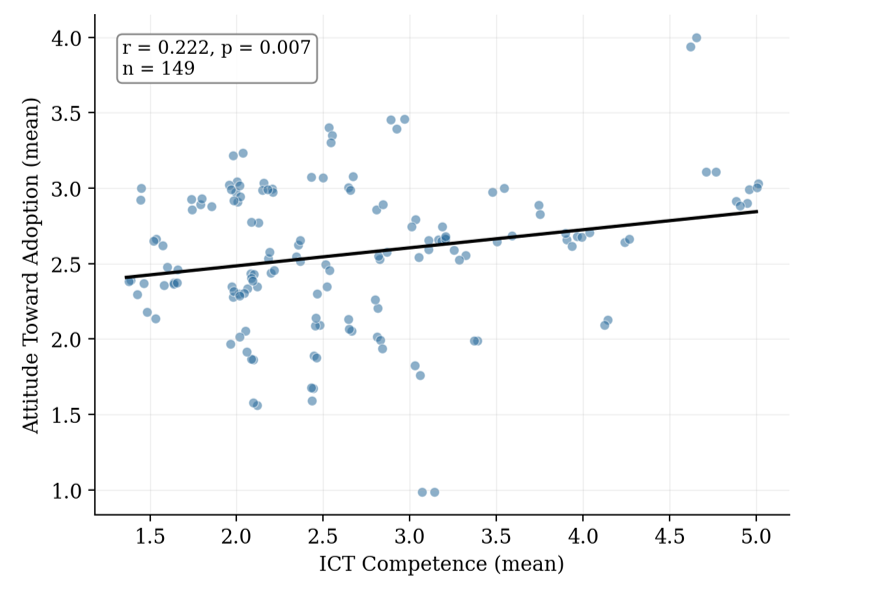
Este estudio examinó la relación entre la competencia digital y la actitud hacia la adopción de las tecnologías de la información y la comunicación (TIC) entre los futuros docentes de Educación Empresarial de las facultades de magisterio del suroeste de Nigeria. La integración de las TIC en la enseñanza depende de la competencia y la disposición de los futuros docentes; sin embargo, la asociación entre estos constructos rara vez se ha cuantificado en el ámbito de la Educación Empresarial en entornos con escasos recursos. Basándose en el modelo de aceptación de la tecnología y en la teoría cognitiva social, el estudio adoptó un diseño de encuesta correlacional. Una muestra de 149 futuros docentes completó un cuestionario estructurado que medía la competencia digital, la actitud hacia la adopción de las TIC y la actitud general hacia las TIC, con coeficientes alfa de Cronbach de 0,84, 0,80 y 0,85, respectivamente. Los datos se analizaron mediante estadísticas descriptivas, la correlación de momentos de Pearson y la regresión lineal múltiple. Los encuestados manifestaron niveles moderados de competencia y actitudes moderadamente positivas. La competencia digital se relacionó de forma significativa y positiva con la actitud hacia la adopción y con la actitud general hacia las TIC, mientras que ambas facetas actitudinales estaban fuertemente asociadas. La competencia y la actitud general explicaban conjuntamente el 36,1 % de la varianza en la actitud hacia la adopción, aunque la competencia dejaba de ser un predictor único una vez controlada la actitud. El estudio concluyó que la disposición actitudinal, más que la competencia por sí sola, era el correlato más próximo de la adopción, y recomendó que la formación del profesorado integrara el desarrollo de la competencia con una atención especial a la actitud.
RIS is compatible with Zotero, Mendeley, and EndNote. Immediate opening depends on the visitor's browser and reference-manager settings.
Declaraciones recogidas en el artículo publicado
Author Contributions
Festus Oladimeji Olafare: Conceptualization, Methodology, Investigation, Formal Analysis, Data Curation, Writing – Original Draft, Writing – Review & Editing, Visualization, and Project Administration. As the sole author, Festus Oladimeji Olafare conceived the study, designed the methodology, collected and analysed the data, and prepared and approved the final manuscript.
Acknowledgments
The author wishes to thank the management and staff of the participating colleges of education for their cooperation during data collection.
View statement in PDF · PDF page 7Ethics Approval
The manuscript does not report a formal ethics committee approval, exemption determination, or protocol reference.
View statement in PDF · PDF page 7Informed Consent
Written informed consent was obtained from all participants before data collection.
View statement in PDF · PDF page 7Consent for Publication
Not applicable. The article contains no identifiable individual participant information.
Digital Competence and Attitude Towards ICT Adoption … (Festus Oladimeji Olafare, 2026)
Financiación
This research received no specific grant from any funding agency in the public, commercial, or notfor-profit sectors.
View statement in PDF · PDF page 8Disponibilidad de Datos
The data supporting the findings of this study are available from the corresponding author upon reasonable request, subject to applicable ethical and confidentiality restrictions.
View statement in PDF · PDF page 8Conflictos de Intereses
The author declares no competing interests.
View statement in PDF · PDF page 8Generative AI Disclosure
During manuscript preparation and revision in 2026, the author used Claude (Anthropic) and ChatGPT (OpenAI) for language editing, structural refinement, and reference-format checking. These tools were not used to generate or modify the study data, statistical analyses, reported results, or conclusions. The author independently reviewed and revised all AI-assisted output, verified the references and substantive content, and accepts full responsibility for the accuracy, originality, analysis, and conclusions of the article.
View statement in PDF · PDF page 8Citas
22 References[1] M. O. Yusuf, “Information and communication technology and education: Analysing the Nigerian national policy for information technology,” International Education Journal, vol. 6, no. 3, pp. 316–321, 2005.
[2] C. Buabeng-Andoh, “Factors influencing teachers’ adoption and integration of information and communication technology into teaching: A review of the literature,” International Journal of Education and Development using ICT, vol. 8, no. 1, pp. 136–155, 2012.
[3] F. D. Davis, “Perceived usefulness, perceived ease of use, and user acceptance of information technology,” MIS Quarterly, vol. 13, no. 3, pp. 319–340, 1989, doi: https://doi.org/10.2307/249008.
[4] D. R. Compeau and C. A. Higgins, “Computer self-efficacy: Development of a measure and initial test,” MIS Quarterly, vol. 19, no. 2, pp. 189–211, 1995, doi: https://doi.org/10.2307/249688.
[5] M. Fishbein and I. Ajzen, Belief, Attitude, Intention, and Behavior: An Introduction to Theory and Research. Reading, MA, USA: Addison-Wesley, 1975.
[6] T. Teo, “Modelling technology acceptance in education: A study of pre-service teachers,” Computers & Education, vol. 52, no. 2, pp. 302–312, 2009, doi: https://doi.org/10.1016/j.compedu.2008.08.006.
[7] T. Teo, “Factors influencing teachers’ intention to use technology: Model development and test,” Computers & Education, vol. 57, no. 4, pp. 2432–2440, 2011, doi: https://doi.org/10.1016/j.compedu.2011.06.008.
[8] A. Bandura, Social Foundations of Thought and Action: A Social Cognitive Theory. Englewood Cliffs, NJ, USA: Prentice-Hall, 1986.
[9] I. Ajzen, “The theory of planned behavior,” Organizational Behavior and Human Decision Processes, vol. 50, no. 2, pp. 179–211, 1991, doi: https://doi.org/10.1016/0749-5978(91)90020-T.
[10] V. Venkatesh, M. G. Morris, G. B. Davis, and F. D. Davis, “User acceptance of information technology: Toward a unified view,” MIS Quarterly, vol. 27, no. 3, pp. 425–478, 2003, doi: https://doi.org/10.2307/30036540.
[11] E. M. Rogers, Diffusion of Innovations, 5th ed. New York, NY, USA: Free Press, 2003.
[12] A. Albirini, “Teachers’ attitudes toward information and communication technologies: The case of Syrian EFL teachers,” Computers & Education, vol. 47, no. 4, pp. 373–398, 2006, doi: https://doi.org/10.1016/j.compedu.2004.10.013.
[13] M. O. Yusuf and M. R. Balogun, “Student-teachers’ competence and attitude towards information and communication technology: A case study in a Nigerian university,” Contemporary Educational Technology, vol. 2, no. 1, pp. 18–36, 2011, doi: https://doi.org/10.30935/cedtech/6041.
[14] G. Sang, M. Valcke, J. van Braak, and J. Tondeur, “Student teachers’ thinking processes and ICT integration: Predictors of prospective teaching behaviors with educational technology,” Computers & Education, vol. 54, no. 1, pp. 103–112, 2010, doi: https://doi.org/10.1016/j.compedu.2009.07.010.
[15] C. Player-Koro, “Factors influencing teachers’ use of ICT in education,” Education Inquiry, vol. 3, no. 1, pp. 93–108, 2012, doi: https://doi.org/10.3402/edui.v3i1.22015.
[16] A. Tella, A. Tella, O. M. Toyobo, L. O. Adika, and A. A. Adeyinka, “An assessment of secondary school teachers’ uses of ICTs: Implications for further development of ICT use in Nigerian secondary schools,” The Turkish Online Journal of Educational Technology, vol. 6, no. 3, pp. 5–17, 2007.
[17] J. C. Nunnally and I. H. Bernstein, Psychometric Theory, 3rd ed. New York, NY, USA: McGraw-Hill, 1994.
[18] J. Cohen, Statistical Power Analysis for the Behavioral Sciences, 2nd ed. Hillsdale, NJ, USA: Lawrence Erlbaum Associates, 1988.
[19] G. Falloon, “From digital literacy to digital competence: The teacher digital competency (TDC) framework,” Educational Technology Research and Development, vol. 68, no. 5, pp. 2449–2472, 2020, doi: https://doi.org/10.1007/s11423-020-09767-4.
[20] J. Tondeur, J. van Braak, G. Sang, J. Voogt, P. Fisser, and A. Ottenbreit-Leftwich, “Preparing pre-service teachers to integrate technology in education: A synthesis of qualitative evidence,” Computers & Education, vol. 59, no. 1, pp. 134–144, 2012, doi: https://doi.org/10.1016/j.compedu.2011.10.009.
[21] E. J. Instefjord and E. Munthe, “Educating digitally competent teachers: A study of integration of professional digital competence in teacher education,” Teaching and Teacher Education, vol. 67, pp. 37–45, 2017, doi: https://doi.org/10.1016/j.tate.2017.05.016.
[22] P. M. Podsakoff, S. B. MacKenzie, J.-Y. Lee, and N. P. Podsakoff, “Common method biases in behavioral research: A critical review of the literature and recommended remedies,” Journal of Applied Psychology, vol. 88, no. 5, pp. 879–903, 2003, doi: https://doi.org/10.1037/0021-9010.88.5.879.
Copyright and License

Esta obra está bajo una licencia internacional Creative Commons Atribución 4.0.
Derechos de autor 2026 Olafare Festus Oladimeji