

1. Introduction
The integration of information and communication technology (ICT) into teaching and learning is now a central expectation of contemporary education systems. Nigeria's national information-technology policy envisaged technology use across all levels of education [1]. Realising that ambition, however, requires more than hardware provision: adoption is also shaped by users' capabilities, beliefs, access to support, and the conditions in which technology is introduced [2]. Student-teachers are therefore a consequential group because the knowledge and dispositions developed during initial teacher preparation can influence whether technology is later used purposefully in classroom practice.
Business Education occupies a strategic position within this agenda because it prepares graduates for digitally mediated office, accounting, marketing, and entrepreneurial work. The technology acceptance model (TAM) identifies attitude as a proximal determinant of behavioural intention, while external variables influence acceptance through perceived usefulness and ease of use [3]. In the present study, digital competence refers to participants' self-reported knowledge and skill; it is related to, but not equivalent to, computer self-efficacy [4]. Attitude refers to an evaluative disposition towards an object or behaviour [5]. Educational extensions of TAM similarly show that capability-related beliefs and perceptions can shape prospective teachers' willingness to use technology [6], [7].
Research in Nigeria has documented student-teachers' competence and attitudes, but studies often report these constructs separately or treat attitude as a single undifferentiated outcome. Evidence specific to Business Education student-teachers in colleges of education in South-West Nigeria remains limited, and it is unclear whether perceived competence contributes uniquely to attitude towards ICT adoption once a broader ICT attitude is considered. This study addresses that gap by estimating construct levels, bivariate associations, and the joint prediction of adoption attitude by self-reported competence and general ICT attitude. Its contribution is contextual and explanatory rather than causal: the analysis clarifies the relative strength of the observed relationships without equating attitude with actual technology use.
1.1. Theoretical Framework and Related Studies
The study draws on two complementary theoretical traditions. TAM proposes that perceived usefulness and perceived ease of use shape attitude and behavioural intention, while external variables influence acceptance indirectly through these perceptions [3]. Social cognitive theory contributes self-efficacy, defined as belief in one's capability to organise and execute the actions required to attain an outcome [8]. The theory of planned behaviour [9], the unified theory of acceptance and use of technology [10], and diffusion of innovations [11] likewise emphasise evaluative beliefs, perceived capability, and facilitating conditions in adoption. In this study, self-reported competence is treated as a capability-related correlate and the two attitude scales as evaluative outcomes; the cross-sectional design does not test mediation, temporal ordering, or behavioural intention.
Empirical evidence generally supports a positive relationship between capability-related beliefs and ICT attitudes. Albirini found computer competence to be among the strongest correlates of favourable ICT attitudes [12], while a Nigerian study reported positive associations between student-teachers' competence, attitude, and prior exposure [13]. Research with pre-service teachers also identifies attitude as a central component of technology acceptance, with skill-related variables often operating through perceived usefulness, ease of use, or related beliefs [6], [7], [14]. Nevertheless, self-efficacy, attitude, and actual use are conceptually distinct and may respond differently to contextual constraints [15]. Nigerian evidence further suggests that favourable attitudes can coexist with limited skill, access, or opportunities for use [16]. Taken together, these studies support positive associations but leave the unique contribution of perceived competence to adoption attitude uncertain.
1.2. Research Questions and Hypotheses
The study addressed five research questions: (1) What are the levels of self-reported digital competence, attitude towards ICT adoption, and general attitude towards ICT? (2) What is the relationship between digital competence and attitude towards ICT adoption? (3) What is the relationship between digital competence and general attitude towards ICT? (4) What is the relationship between the two attitude measures? and (5) To what extent do digital competence and general ICT attitude jointly predict attitude towards ICT adoption? Four two-tailed null hypotheses were tested at α = .05: H01, no significant relationship between digital competence and attitude towards ICT adoption; H02, no significant relationship between digital competence and general ICT attitude; H03, no significant relationship between the two attitude measures; and H04, no significant joint prediction of attitude towards ICT adoption by digital competence and general ICT attitude.
2. Methods
2.1. Research Design
The study adopted a correlational survey design, which is appropriate where the aim is to determine the existence, direction and magnitude of relationships among variables as they occur naturally, without manipulation. Because the study sought to establish how competence relates to attitudinal dispositions rather than to infer causation, the correlational approach was the most suitable.
2.2. Population and Sample
The target population comprised Business Education student-teachers enrolled in colleges of education in South-West Nigeria. A sample of 149 student-teachers participated, distributed across the Marketing Education, Accounting Education, Office Technology and Management Education, and Entrepreneurial Education options. The demographic profile of the sample is presented in Table 1.
2.3. Research Instruments
Data were collected using a structured questionnaire organised into a demographic section and three measurement scales. The digital competence scale comprised 11 items rated on a five-point scale ranging from not knowledgeable to knowledgeable. The attitude towards ICT adoption scale comprised 9 items, and the general attitude towards ICT scale comprised 15 items, both rated on a four-point scale ranging from strongly disagree to strongly agree. Composite scores were computed as the mean of the constituent items, so that higher scores denote greater competence and more favourable attitudes.
2.4. Validity and Reliability
The instrument was subjected to face and content validation by specialists in educational technology and business education. Internal consistency reliability was estimated using Cronbach's alpha. The coefficients obtained, .84 for digital competence, .80 for attitude towards adoption and .85 for general attitude, all exceed the conventional threshold of .70 [17], indicating that the scales are reliable for research purposes.
2.5. Data Analysis Techniques
Data were analysed using descriptive statistics, Pearson product-moment correlation and multiple linear regression. Mean composite scores were interpreted against the respective scale midpoints to characterise the levels of each construct. Pearson correlation tested the bivariate hypotheses, and standard multiple regression estimated the joint predictive contribution of competence and general attitude to attitude towards adoption. The assumptions of linearity, normality of residuals and absence of multicollinearity were examined and found tenable. All inferential tests were evaluated at the .05 level, and effect sizes were interpreted following established conventions [18].
3. Results
|
Variable |
Category |
Frequency |
Percent |
|---|---|---|---|
|
Gender |
Female |
92 |
61.7 |
|
Male |
57 |
38.3 |
|
|
Course of study |
Marketing Education |
67 |
45.0 |
|
Accounting Education |
65 |
43.6 |
|
|
Entrepreneurial Education |
10 |
6.7 |
|
|
Office Technology and Management |
7 |
4.7 |
|
|
Academic level |
Year 2 |
91 |
61.1 |
|
Year 3 |
30 |
20.1 |
|
|
Year 1 |
28 |
18.8 |
|
|
Awareness of ICT |
Aware |
130 |
87.2 |
|
Not aware |
19 |
12.8 |
As shown in Table 2, digital competence recorded a mean of 2.67 against a five-point midpoint of 3.00, indicating a moderate but slightly below-midpoint level. Attitude towards adoption (M = 2.57) and general attitude (M = 2.61) both fell marginally above the four-point midpoint of 2.50, indicating moderately positive dispositions.
|
Construct |
Items |
Mean |
SD |
Cronbach α |
|---|---|---|---|---|
|
Digital competence |
11 |
2.67 |
0.90 |
.84 |
|
Attitude towards ICT adoption |
9 |
2.57 |
0.49 |
.80 |
|
Attitude towards ICT (general) |
15 |
2.61 |
0.46 |
.85 |
|
Variable |
1 |
2 |
3 |
|---|---|---|---|
|
1. Digital competence |
— |
||
|
2. Attitude towards ICT adoption |
.22** |
— |
|
|
3. Attitude towards ICT (general) |
.20* |
.59*** |
— |
*p < .05, **p < .01, ***p < .001 (two-tailed).
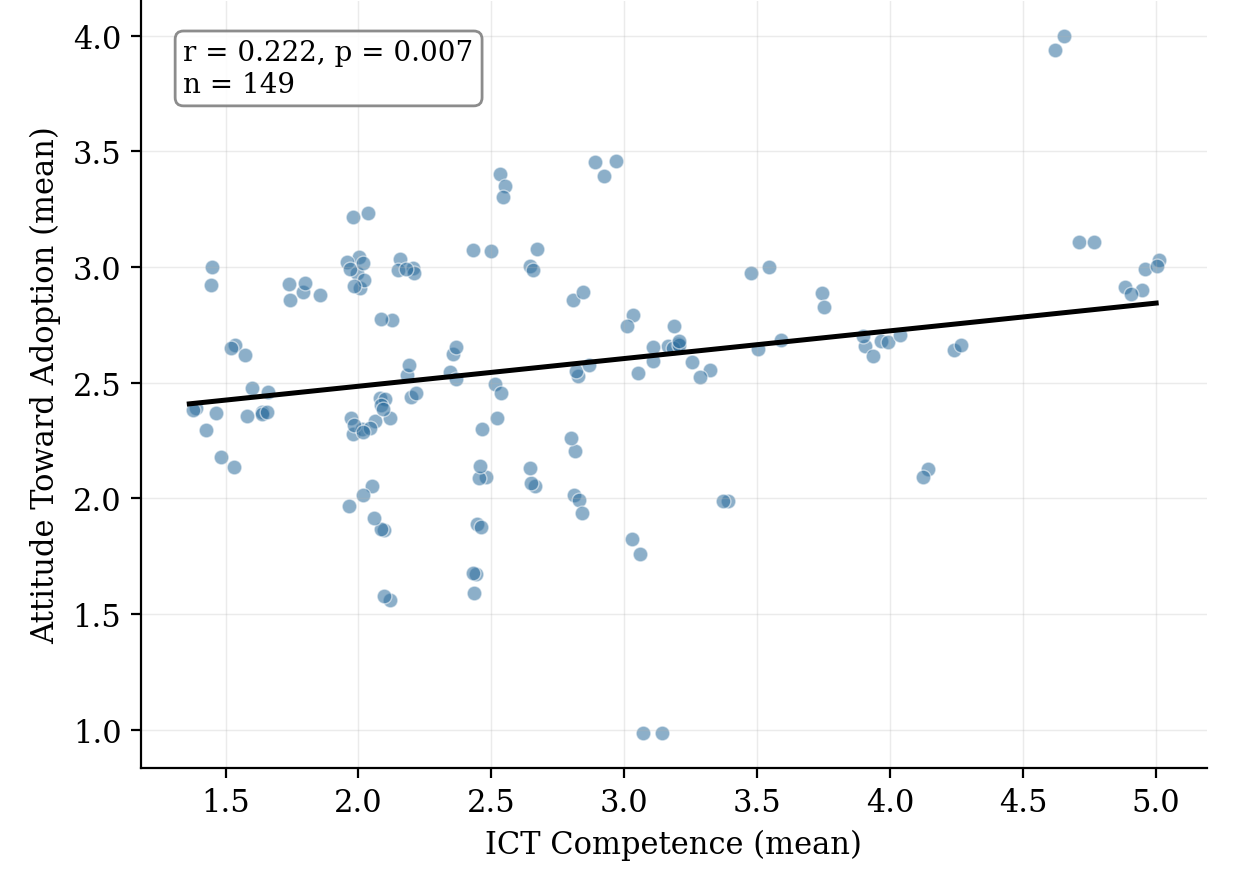
To address the joint prediction, attitude towards adoption was regressed on competence and general attitude. The model was significant, F(2, 146) = 41.21, p < .001, and accounted for 36.1% of the variance (adjusted R² = .35). As shown in Table 4, general attitude was a strong unique predictor (β = .57, p < .001), whereas competence was not (β = .11, p = .104) once attitude was controlled; H04 was rejected on the strength of the overall model.
|
Predictor |
B |
β |
t |
p |
|---|---|---|---|---|
|
Constant |
0.83 |
— |
4.25 |
< .001 |
|
Digital competence |
0.06 |
.11 |
1.64 |
.104 |
|
Attitude towards ICT (general) |
0.60 |
.57 |
8.44 |
< .001 |
Dependent variable: attitude towards ICT adoption. R² = .36; F(2, 146) = 41.21, p < .001.
4. Discussion
Three findings are central. First, all three construct means were close to their scale midpoints: self-reported competence was slightly below its midpoint, and both attitude scores were only slightly above theirs. This pattern is consistent with Nigerian evidence that favourable views of ICT may coexist with limited competence, access, or use [13], [16]. The midpoint comparisons are descriptive rather than criterion-referenced, so they cannot establish whether participants met a professionally meaningful standard. Performance-based benchmarks would be needed for that purpose.
Second, digital competence showed only small positive correlations with the two attitude measures. The direction of these relationships is compatible with TAM and social cognitive accounts linking capability-related beliefs with evaluative perceptions [3], [8], and it accords with earlier evidence connecting competence or self-efficacy to prospective technology integration [12], [14]. Their small magnitude, however, indicates that perceived competence explained little of the variation in attitude when considered alone. This should not be taken to mean that competence is unimportant. The 11-item scale assessed perceived knowledge and did not capture the wider pedagogical, professional, ethical, and contextual dimensions included in contemporary teacher digital-competence frameworks [19].
Third, the strongest relationship was between general ICT attitude and attitude towards ICT adoption. General attitude remained strongly associated with the outcome in the regression model, while digital competence did not make a statistically significant unique contribution. This result is theoretically plausible because a broad evaluative disposition may be closer to adoption attitude than perceived skill. It also warrants caution: both variables were attitudinal self-reports administered in the same questionnaire, so their association may partly reflect overlapping content and common-method variance [22]. The model consequently supports covariation between related attitudes; it does not establish mediation, causal ordering, behavioural intention, or actual ICT use.
The practical implication is not to replace competence development with attitude-focused activities, but to design experiences in which the two reinforce one another. Business Education programmes could integrate spreadsheet-based accounting, digital office workflows, online marketing, and entrepreneurship applications into authentic coursework and practicum tasks. Guided low-stakes practice, feedback, reflection on pedagogical value, and visible modelling by teacher educators may help students connect capability with purposeful use. This approach is consistent with evidence that effective preparation integrates technology, pedagogy, practicum, collaboration, and institutional support rather than relying on isolated skills courses [20], [21]. Adequate access, facilitation, and organisational conditions remain necessary because positive dispositions alone do not remove contextual barriers [2], [15].
Several limitations constrain the interpretation and generalisability of the findings. The cross-sectional design precludes temporal and causal inference, all focal variables were collected through one questionnaire, and no observed or logged measure of ICT use was included. The two attitude scales may overlap conceptually, yet no measurement model was reported to establish discriminant validity. The sample was modest and unevenly distributed across programme options, while the number of participating institutions, sampling frame, recruitment procedure, and response rate were not specified. These omissions make representativeness difficult to assess. Future research should validate the measurement structure, combine self-report with performance-based competence and behavioural indicators, recruit stratified multi-institutional samples, and use longitudinal, experimental, or structural models when testing temporal or mediational processes [22].
5. Conclusion
This study found small positive associations between digital competence and two ICT-attitude measures. General attitude was strongly associated with attitude towards adoption and was the only significant unique predictor in the two-predictor regression model. Because the two attitude scales may share conceptual and measurement content, and because the design was cross-sectional, the results do not show that attitude causes adoption, that competence operates through attitude, or that participants actually use ICT in teaching. Business Education programmes should combine authentic, discipline-relevant digital competence development with teacher modelling, guided practice, reflection, and institutional support. Future research should validate the measurement structure, include performance and behavioural indicators, recruit more representative multi-institutional samples, and use longitudinal or experimental designs to examine temporal and causal processes.
Declarations
Author Contributions
Festus Oladimeji Olafare: Conceptualization, Methodology, Investigation, Formal Analysis, Data Curation, Writing – Original Draft, Writing – Review & Editing, Visualization, and Project Administration. As the sole author, Festus Oladimeji Olafare conceived the study, designed the methodology, collected and analysed the data, and prepared and approved the final manuscript.
Acknowledgments
The author wishes to thank the management and staff of the participating colleges of education for their cooperation during data collection.
Ethics Approval
The manuscript does not report a formal ethics committee approval, exemption determination, or protocol reference.
Informed Consent
Written informed consent was obtained from all participants before data collection.
Consent for Publication
Not applicable. The article contains no identifiable individual participant information.
Funding
This research received no specific grant from any funding agency in the public, commercial, or not-for-profit sectors.
Data Availability Statement
The data supporting the findings of this study are available from the corresponding author upon reasonable request, subject to applicable ethical and confidentiality restrictions.
Competing Interests
The author declares no competing interests.
Generative AI and AI-Assisted Technologies Statement
During manuscript preparation and revision in 2026, the author used Claude (Anthropic) and ChatGPT (OpenAI) for language editing, structural refinement, and reference-format checking. These tools were not used to generate or modify the study data, statistical analyses, reported results, or conclusions. The author independently reviewed and revised all AI-assisted output, verified the references and substantive content, and accepts full responsibility for the accuracy, originality, analysis, and conclusions of the article.
References
- M. O. Yusuf, “Information and communication technology and education: Analysing the Nigerian national policy for information technology,” International Education Journal, vol. 6, no. 3, pp. 316–321, 2005
- C. Buabeng-Andoh, “Factors influencing teachers’ adoption and integration of information and communication technology into teaching: A review of the literature,” International Journal of Education and Development Using ICT, vol. 8, no. 1, pp. 136–155, 2012
- F. D. Davis, “Perceived usefulness, perceived ease of use, and user acceptance of information technology,” MIS Quarterly, vol. 13, no. 3, pp. 319–340, 1989, doi: 10.2307/249008.
- D. R. Compeau and C. A. Higgins, “Computer self-efficacy: Development of a measure and initial test,” MIS Quarterly, vol. 19, no. 2, pp. 189–211, 1995, doi: 10.2307/249688.
- M. Fishbein and I. Ajzen, Belief, Attitude, Intention, and Behavior: An Introduction to Theory and Research. Reading, MA, USA: Addison-Wesley, 1975.
- T. Teo, “Modelling technology acceptance in education: A study of pre-service teachers,” Computers & Education, vol. 52, no. 2, pp. 302–312, 2009, doi: 10.1016/j.compedu.2008.08.006.
- T. Teo, “Factors influencing teachers’ intention to use technology: Model development and test,” Computers & Education, vol. 57, no. 4, pp. 2432–2440, 2011, doi: 10.1016/j.compedu.2011.06.008.
- A. Bandura, Social Foundations of Thought and Action: A Social Cognitive Theory. Englewood Cliffs, NJ, USA: Prentice-Hall, 1986.
- I. Ajzen, “The theory of planned behavior,” Organizational Behavior and Human Decision Processes, vol. 50, no. 2, pp. 179–211, 1991, doi: 10.1016/0749-5978(91)90020-T.
- V. Venkatesh, M. G. Morris, G. B. Davis, and F. D. Davis, “User acceptance of information technology: Toward a unified view,” MIS Quarterly, vol. 27, no. 3, pp. 425–478, 2003, doi: 10.2307/30036540.
- E. M. Rogers, Diffusion of Innovations, 5th ed. New York, NY, USA: Free Press, 2003.
- A. Albirini, “Teachers’ attitudes toward information and communication technologies: The case of Syrian EFL teachers,” Computers & Education, vol. 47, no. 4, pp. 373–398, 2006, doi: 10.1016/j.compedu.2004.10.013.
- M. O. Yusuf and M. R. Balogun, “Student-teachers’ competence and attitude towards information and communication technology: A case study in a Nigerian university,” Contemporary Educational Technology, vol. 2, no. 1, pp. 18–36, 2011, doi: 10.30935/cedtech/6041.
- G. Sang, M. Valcke, J. van Braak, and J. Tondeur, “Student teachers’ thinking processes and ICT integration: Predictors of prospective teaching behaviors with educational technology,” Computers & Education, vol. 54, no. 1, pp. 103–112, 2010, doi: 10.1016/j.compedu.2009.07.010.
- C. Player-Koro, “Factors influencing teachers’ use of ICT in education,” Education Inquiry, vol. 3, no. 1, pp. 93–108, 2012, doi: 10.3402/edui.v3i1.22015.
- A. Tella, A. Tella, O. M. Toyobo, L. O. Adika, and A. A. Adeyinka, “An assessment of secondary school teachers’ uses of ICTs: Implications for further development of ICT use in Nigerian secondary schools,” The Turkish Online Journal of Educational Technology, vol. 6, no. 3, pp. 5–17, 2007.
- J. C. Nunnally and I. H. Bernstein, Psychometric Theory, 3rd ed. New York, NY, USA: McGraw-Hill, 1994.
- J. Cohen, Statistical Power Analysis for the Behavioral Sciences, 2nd ed. Hillsdale, NJ, USA: Lawrence Erlbaum Associates, 1988.
- G. Falloon, “From digital literacy to digital competence: The teacher digital competency (TDC) framework,” Educational Technology Research and Development, vol. 68, no. 5, pp. 2449–2472, 2020, doi: 10.1007/s11423-020-09767-4.
- J. Tondeur, J. van Braak, G. Sang, J. Voogt, P. Fisser, and A. Ottenbreit-Leftwich, “Preparing pre-service teachers to integrate technology in education: A synthesis of qualitative evidence,” Computers & Education, vol. 59, no. 1, pp. 134–144, 2012, doi: 10.1016/j.compedu.2011.10.009.
- E. J. Instefjord and E. Munthe, “Educating digitally competent teachers: A study of integration of professional digital competence in teacher education,” Teaching and Teacher Education, vol. 67, pp. 37–45, 2017, doi: 10.1016/j.tate.2017.05.016.
- P. M. Podsakoff, S. B. MacKenzie, J.-Y. Lee, and N. P. Podsakoff, “Common method biases in behavioral research: A critical review of the literature and recommended remedies,” Journal of Applied Psychology, vol. 88, no. 5, pp. 879–903, 2003, doi: 10.1037/0021-9010.88.5.879.
Author Biographies

Festus Oladimeji Olafare is a Senior Lecturer in Educational Technology at the University of Lagos, Nigeria, with a Ph.D. from the University of Ilorin obtained in 2014. He has extensive experience in university teaching and research, with interests in computer-based testing, e-learning, and technology integration in education. Dr. Olafare has published over 35 journal articles and book chapters in these areas. He teaches undergraduate and postgraduate courses and serves as a Postgraduate Coordinator in his department. He is also actively involved in professional associations and supervises both master's and doctoral students.


Publisher’s and Journal’s Note
Sagamedia Teknologi Nusantara, as the publisher of the Journal of Hypermedia & Technology-Enhanced Learning (J-HyTEL), upholds the highest ethical standards in academic publishing. The journal remains neutral with regard to jurisdictional claims in published maps and institutional affiliations. Authors are fully responsible for the originality, accuracy, and integrity of their work. Post-publication ethical concerns will be addressed through corrections, clarifications, or retractions as necessary. The content of this publication has not been approved by the United Nations and does not reflect the views of the United Nations or its officials or Member States. https://www.un.org/sustainabledevelopment
Copyright & License

© 2026 Olafare Festus Oladimeji. Authors retain copyright.
This article is licensed under a Creative Commons Attribution 4.0 International License, which permits use, sharing, adaptation, distribution, and reproduction in any medium or format, provided that appropriate credit is given to the original author(s) and the source, a link to the Creative Commons license is provided, and any modifications are indicated. Unless otherwise specified in a credit line, this article’s images or other third-party material are included under the Creative Commons license. If certain material is not covered by the article’s Creative Commons license and its intended use is not permitted by statutory regulation or exceeds the allowed usage, permission must be obtained directly from the copyright holder. http://creativecommons.org/licenses/by/4.0/.
Read the licence terms