

Sustainable Development Goals
This article contributes to the following United Nations Sustainable Development Goals.

关键词
引用方式




出版物概览

下一期
J-HyTEL welcomes original and rigorous scholarship advancing education, media technology, and computer science applications.
Rolling submissions are accepted throughout the year.
摘要
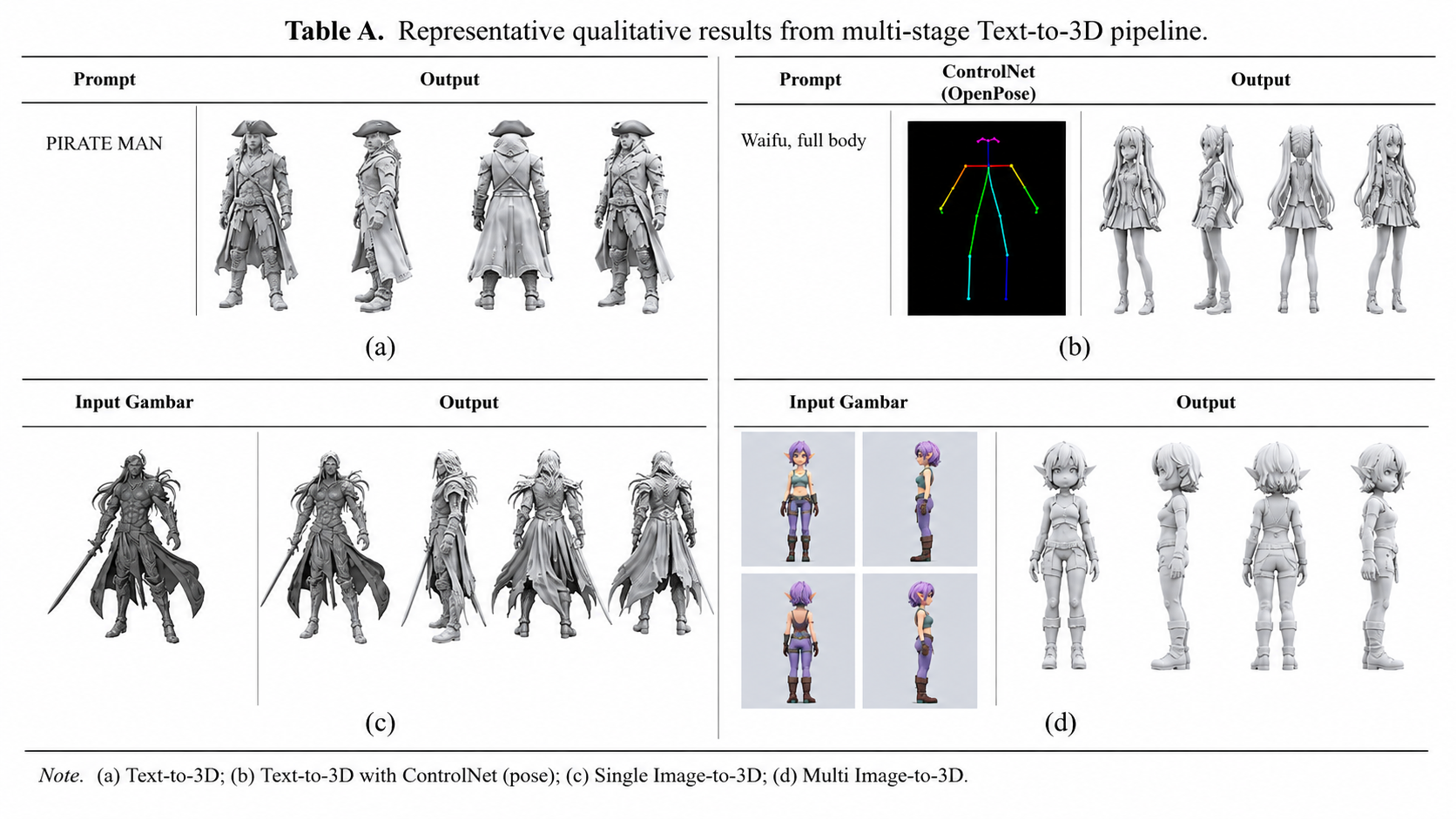
基于提示词和图像的3D生成技术可以降低数字资产创作的交互门槛,但模型层面的进步并不能证明非专业人士能否操作完整的创作工作流。 本研究设计并评估了一个基于Web的人机协作原型,该原型集成了React界面、FastAPI服务、ComfyUI工作流协调、异步任务处理、持久化资产存储以及基于浏览器的3D可视化功能。 我们实现了四种模式:文本转3D、基于ControlNet的文本转3D、单张图像转3D以及多张图像转3D。 评估结合了14个基于需求衍生出的黑盒场景、在三个查看环境中的跨查看器GLB兼容性检查、35个已完成的生成任务、基于任务的观察(7名参与者完成了84次任务执行)、 来自另一组12名学生的系统可用性量表(SUS)反馈,以及针对实现效果和输出质量的专家评估。所有14个功能场景均产生了预期结果,且经过测试的GLB输出文件均可在集成查看器、Blender和3dviewer.net中正常打开。 服务器端平均处理时间为66.15秒;探索性克鲁斯卡尔-瓦利斯检验表明,观察到的负载分布之间存在差异(H(3) = 10.52, p = .015, ε² = .243),但未支持关于速度的因果关系或成对比较的论断。 所有观察到的任务最终均已完成,但在84次执行中仅有61次(72.62%)为独立完成;任务5(进入Studio)和任务10(在“我的项目”中查找生成的模型)各自有7名参与者中的5名需要协助。 SUS平均分为81.67(标准差 = 9.25;95% 置信区间 [75.79, 87.55]),而生成的模型质量获得了诊断专家3.50/5的评分。 本研究提出了一种端到端的人工智能协同创作架构,以及一种多维度评估逻辑,该逻辑将功能符合性、部署周转时间、跨查看器兼容性、观察到的交互、感知可用性和输出质量区分开来。研究结果支持了易于访问的基于 Web 的生成式 3D 创作的可行性,同时指出了可发现性和几何质量方面的限制。
RIS is compatible with Zotero, Mendeley, and EndNote. Immediate opening depends on the visitor's browser and reference-manager settings.
已发表文章中报告的声明
Author Contributions
Ray Fadly Hadi: Conceptualization; Methodology; Software; Investigation; Data Curation; Formal Analysis; Visualization; Writing – Original Draft. Randi Proska Sandra: Supervision; Validation; Writing – Review & Editing. Sri Rejeki: Writing – Review & Editing. All authors have read and approved the final version of the manuscript.
Acknowledgments
The authors thank the expert for validation and the Informatics Study Program, Department of Electronics Engineering, Faculty of Engineering, Universitas Negeri Padang, for academic and technical support.
View statement in PDF · PDF page 14资助
This research received no specific grant from any funding agency in the public, commercial, or not-forprofit sectors.
View statement in PDF · PDF page 14利益冲突
The authors declare no competing interests.
View statement in PDF · PDF page 14Ethics Approval
The study involved non-sensitive software-usability activities. According to the institutional requirements reported in the research record, formal ethical clearance was not required for this evaluation; participation was voluntary, and no medical, biological, or psychological intervention was conducted.
View statement in PDF · PDF page 14Informed Consent
Informed consent was obtained from all participants before task-based usability testing or completion of the System Usability Scale, as applicable.
View statement in PDF · PDF page 14Consent for Publication
Not applicable. The article does not report identifiable participant images or confidential personal records.
View statement in PDF · PDF page 14数据可用性
Aggregate evaluation results are reported in the article. The corresponding author may provide anonymized participant-level records, de-identified job measurements, and supporting system documentation upon reasonable request, subject to institutional and privacy requirements.
View statement in PDF · PDF page 14Generative AI Disclosure
During manuscript preparation, the authors used ChatGPT (OpenAI) and Claude (Anthropic) for language refinement. These tools were not used to generate, modify, or analyze the research data, usability scores, performance measurements, or expert assessments. All AI-assisted text was checked against the thesis record and cited sources, and the authors accept full responsibility for the final manuscript. Preprint and Prior Dissemination Statement This article is derived from the first author's undergraduate thesis and is not under consideration elsewhere.
View statement in PDF · PDF page 15参考
36 References[1] B. Shneiderman, “Human-centered artificial intelligence: Reliable, safe & trustworthy,” Int. J. Hum.-Comput. Interact., vol. 36, no. 6, pp. 495–504, 2020, doi: https://doi.org/10.1080/10447318.2020.1741118.
[2] S. Amershi et al., “Guidelines for human–AI interaction,” in Proc. 2019 CHI Conf. Human Factors Comput. Syst., Glasgow, U.K., 2019, pp. 1–13, doi: https://doi.org/10.1145/3290605.3300233.
[3] Q. Yang, A. Steinfeld, C. Rosé, and J. Zimmerman, “Re-examining whether, why, and how human–AI interaction is uniquely difficult to design,” in Proc. 2020 CHI Conf. Human Factors Comput. Syst., Honolulu, HI, USA, 2020, pp. 1–13, doi: https://doi.org/10.1145/3313831.3376301.
[4] J. Ho, A. Jain, and P. Abbeel, “Denoising diffusion probabilistic models,” in Advances in Neural Information Processing Systems, vol. 33, pp. 6840–6851, 2020.
[5] R. Rombach, A. Blattmann, D. Lorenz, P. Esser, and B. Ommer, “High-resolution image synthesis with latent diffusion models,” in Proc. IEEE/CVF Conf. Comput. Vis. Pattern Recognit., New Orleans, LA, USA, 2022, pp. 10674–10685, doi: https://doi.org/10.1109/CVPR52688.2022.01042.
[6] A. Radford et al., “Learning transferable visual models from natural language supervision,” in Proc. 38th Int. Conf. Mach. Learn., vol. 139, pp. 8748–8763, 2021.
[7] B. Poole, A. Jain, J. T. Barron, and B. Mildenhall, “DreamFusion: Text-to-3D using 2D diffusion,” in Proc. Int. Conf. Learn. Representations, 2023.
[8] C.-H. Lin et al., “Magic3D: High-resolution text-to-3D content creation,” in Proc. IEEE/CVF Conf. Comput. Vis. Pattern Recognit., Vancouver, BC, Canada, 2023, pp. 300–309, doi: https://doi.org/10.1109/CVPR52729.2023.00037.
[9] Z. Wang et al., “ProlificDreamer: High-fidelity and diverse text-to-3D generation with variational score distillation,” in Advances in Neural Information Processing Systems, vol. 36, pp. 8406–8441, 2023, doi: https://doi.org/10.52202/075280-0368.
[10] Y. Chen, Y. Pan, H. Yang, T. Yao, and T. Mei, “VP3D: Unleashing 2D visual prompt for text-to-3D generation,” in Proc. IEEE/CVF Conf. Comput. Vis. Pattern Recognit. (CVPR), Seattle, WA, USA, 2024, pp. 4896–4905, doi: https://doi.org/10.1109/CVPR52733.2024.00468.
[11] R. Liu, R. Wu, B. Van Hoorick, P. Tokmakov, S. Zakharov, and C. Vondrick, “Zero-1-to-3: Zero-shot one image to 3D object,” in Proc. IEEE/CVF Int. Conf. Comput. Vis., Paris, France, 2023, pp. 9264–9275, doi: https://doi.org/10.1109/ICCV51070.2023.00853.
[12] A. Yu, V. Ye, M. Tancik, and A. Kanazawa, “pixelNeRF: Neural radiance fields from one or few images,” in Proc. IEEE/CVF Conf. Comput. Vis. Pattern Recognit., Nashville, TN, USA, 2021, pp. 4576–4585, doi: https://doi.org/10.1109/CVPR46437.2021.00455.
[13] S. Saito, Z. Huang, R. Natsume, S. Morishima, H. Li, and A. Kanazawa, “PIFu: Pixel-aligned implicit function for high-resolution clothed human digitization,” in Proc. IEEE/CVF Int. Conf. Comput. Vis., Seoul, South Korea, 2019, pp. 2304–2314, doi: https://doi.org/10.1109/ICCV.2019.00239.
[14] C. B. Choy, D. Xu, J. Y. Gwak, K. Chen, and S. Savarese, “3D-R2N2: A unified approach for single and multi-view 3D object reconstruction,” in Computer Vision – ECCV 2016, Cham, Switzerland: Springer, 2016, pp. 628–644, doi: https://doi.org/10.1007/978-3-319-46484-8_38.
[15] X. Long et al., “Wonder3D: Single image to 3D using cross-domain diffusion,” in Proc. IEEE/CVF Conf. Comput. Vis. Pattern Recognit., Seattle, WA, USA, 2024, pp. 9970–9980, doi: https://doi.org/10.1109/CVPR52733.2024.00951.
[16] L. Qiu et al., “RichDreamer: A generalizable normal-depth diffusion model for detail richness in text-to-3D,” in Proc. IEEE/CVF Conf. Comput. Vis. Pattern Recognit., Seattle, WA, USA, 2024, pp. 9914–9925, doi: https://doi.org/10.1109/CVPR52733.2024.00946.
[17] C. Volioti, V. Martsis, A. Ampatzoglou, E. Keramopoulos, and A. Chatzigeorgiou, “Codeless3D: Design and usability evaluation of a low-code tool for 3-D game generation,” IEEE Trans. Games, vol. 17, no. 2, pp. 296–307, 2025, doi: https://doi.org/10.1109/TG.2024.3424894.
[18] R. Kurai, T. Hiraki, Y. Hiroi, Y. Hirao, M. Perusquía-Hernández, H. Uchiyama, and K. Kiyokawa, “MagicCraft: Natural language-driven generation of dynamic and interactive 3D objects for commercial metaverse platforms,” IEEE Access, vol. 13, pp. 132459–132474, 2025, doi: https://doi.org/10.1109/ACCESS.2025.3587232.
[19] X. Xue, Z. Lu, D. Huang, Z. Wang, W. Ouyang, and L. Bai, “ComfyBench: Benchmarking LLM-based agents in ComfyUI for autonomously designing collaborative AI systems,” in Proc. IEEE/CVF Conf. Comput. Vis. Pattern Recognit., Nashville, TN, USA, 2025, pp. 24614–24624, doi: https://doi.org/10.1109/CVPR52734.2025.02292.
[20] R. S. Pressman and B. R. Maxim, Software Engineering: A Practitioner’s Approach, 8th ed. New York, NY, USA: McGraw-Hill Education, 2014.
[21] L. Zhang, A. Rao, and M. Agrawala, “Adding conditional control to text-to-image diffusion models,” in Proc. IEEE/CVF Int. Conf. Comput. Vis., Paris, France, 2023, pp. 3813–3824, doi: https://doi.org/10.1109/ICCV51070.2023.00355.
[22] L. Mescheder, M. Oechsle, M. Niemeyer, S. Nowozin, and A. Geiger, “Occupancy networks: Learning 3D reconstruction in function space,” in Proc. IEEE/CVF Conf. Comput. Vis. Pattern Recognit., Long Beach, CA, USA, 2019, pp. 4455–4465, doi: https://doi.org/10.1109/CVPR.2019.00459.
[23] J. J. Park, P. Florence, J. Straub, R. Newcombe, and S. Lovegrove, “DeepSDF: Learning continuous signed distance functions for shape representation,” in Proc. IEEE/CVF Conf. Comput. Vis. Pattern Recognit., Long Beach, CA, USA, 2019, pp. 165–174, doi: https://doi.org/10.1109/CVPR.2019.00025.
[24] M. Niemeyer, L. Mescheder, M. Oechsle, and A. Geiger, “Differentiable volumetric rendering: Learning implicit 3D representations without 3D supervision,” in Proc. IEEE/CVF Conf. Comput. Vis. Pattern Recognit., Seattle, WA, USA, 2020, pp. 3501–3512, doi: https://doi.org/10.1109/CVPR42600.2020.00356.
[25] M. Niemeyer, J. T. Barron, B. Mildenhall, M. S. M. Sajjadi, A. Geiger, and N. Radwan, “RegNeRF: Regularizing neural radiance fields for view synthesis from sparse inputs,” in Proc. IEEE/CVF Conf. Comput. Vis. Pattern Recognit., New Orleans, LA, USA, 2022, pp. 5470–5480, doi: https://doi.org/10.1109/CVPR52688.2022.00540.
[26] H. Kato, Y. Ushiku, and T. Harada, “Neural 3D mesh renderer,” in Proc. IEEE/CVF Conf. Comput. Vis. Pattern Recognit., Salt Lake City, UT, USA, 2018, pp. 3907–3916, doi: https://doi.org/10.1109/CVPR.2018.00411.
[27] T. Müller, A. Evans, C. Schied, and A. Keller, “Instant neural graphics primitives with a multiresolution hash encoding,” ACM Trans. Graph., vol. 41, no. 4, Art. no. 102, pp. 1–15, 2022, doi: https://doi.org/10.1145/3528223.3530127.
[28] S. Tulsiani, T. Zhou, A. A. Efros, and J. Malik, “Multi-view supervision for single-view reconstruction via differentiable ray consistency,” IEEE Trans. Pattern Anal. Mach. Intell., vol. 44, no. 12, pp. 8754–8765, 2022, doi: https://doi.org/10.1109/TPAMI.2019.2898859.
[29] R. A. Virzi, “Refining the test phase of usability evaluation: How many subjects is enough?,” Hum. Factors, vol. 34, no. 4, pp. 457–468, 1992, doi: https://doi.org/10.1177/001872089203400407.
[30] L. Faulkner, “Beyond the five-user assumption: Benefits of increased sample sizes in usability testing,” Behav. Res. Methods Instrum. Comput., vol. 35, no. 3, pp. 379–383, 2003, doi: https://doi.org/10.3758/BF03195514.
[31] J. Brooke, “SUS: A ‘quick and dirty’ usability scale,” in Usability Evaluation in Industry, P. W. Jordan, B. Thomas, B. A. Weerdmeester, and I. L. McClelland, Eds. London, U.K.: Taylor & Francis, 1996, pp. 189–194, doi: https://doi.org/10.1201/9781498710411-35.
[32] J. R. Lewis, “The System Usability Scale: Past, present, and future,” Int. J. Hum.-Comput. Interact., vol. 34, no. 7, pp. 577–590, 2018, doi: https://doi.org/10.1080/10447318.2018.1455307.
[33] Z. Li et al., “Neuralangelo: High-fidelity neural surface reconstruction,” in Proc. IEEE/CVF Conf. Comput. Vis. Pattern Recognit., Vancouver, BC, Canada, 2023, pp. 8456–8465, doi: https://doi.org/10.1109/CVPR52729.2023.00817.
[34] M. Oechsle, L. Mescheder, M. Niemeyer, T. Strauss, and A. Geiger, “Texture fields: Learning texture representations in function space,” in Proc. IEEE/CVF Int. Conf. Comput. Vis., Seoul, South Korea, 2019, pp. 4530–4539, doi: https://doi.org/10.1109/ICCV.2019.00463.
[35] P. Wang, L. Liu, Y. Liu, C. Theobalt, T. Komura, and W. Wang, “NeuS: Learning neural implicit surfaces by volume rendering for multi-view reconstruction,” in Advances in Neural Information Processing Systems, vol. 34, pp. 27171–27183, 2021.
[36] K. Schwarz, Y. Liao, M. Niemeyer, and A. Geiger, “GRAF: Generative radiance fields for 3D-aware image synthesis,” in Advances in Neural Information Processing Systems, vol. 33, pp. 20154–20166, 2020.
Copyright and License

This work is licensed under a Creative Commons Attribution 4.0 International License.
Copyright (c) 2026 Ray Fadly Hadi, Randi Proska Sandra, Sri Rejeki