

Sustainable Development Goals
This article contributes to the following United Nations Sustainable Development Goals.

키워드
인용 방법




출판물 개요

차기호
J-HyTEL welcomes original and rigorous scholarship advancing education, media technology, and computer science applications.
Rolling submissions are accepted throughout the year.
초록
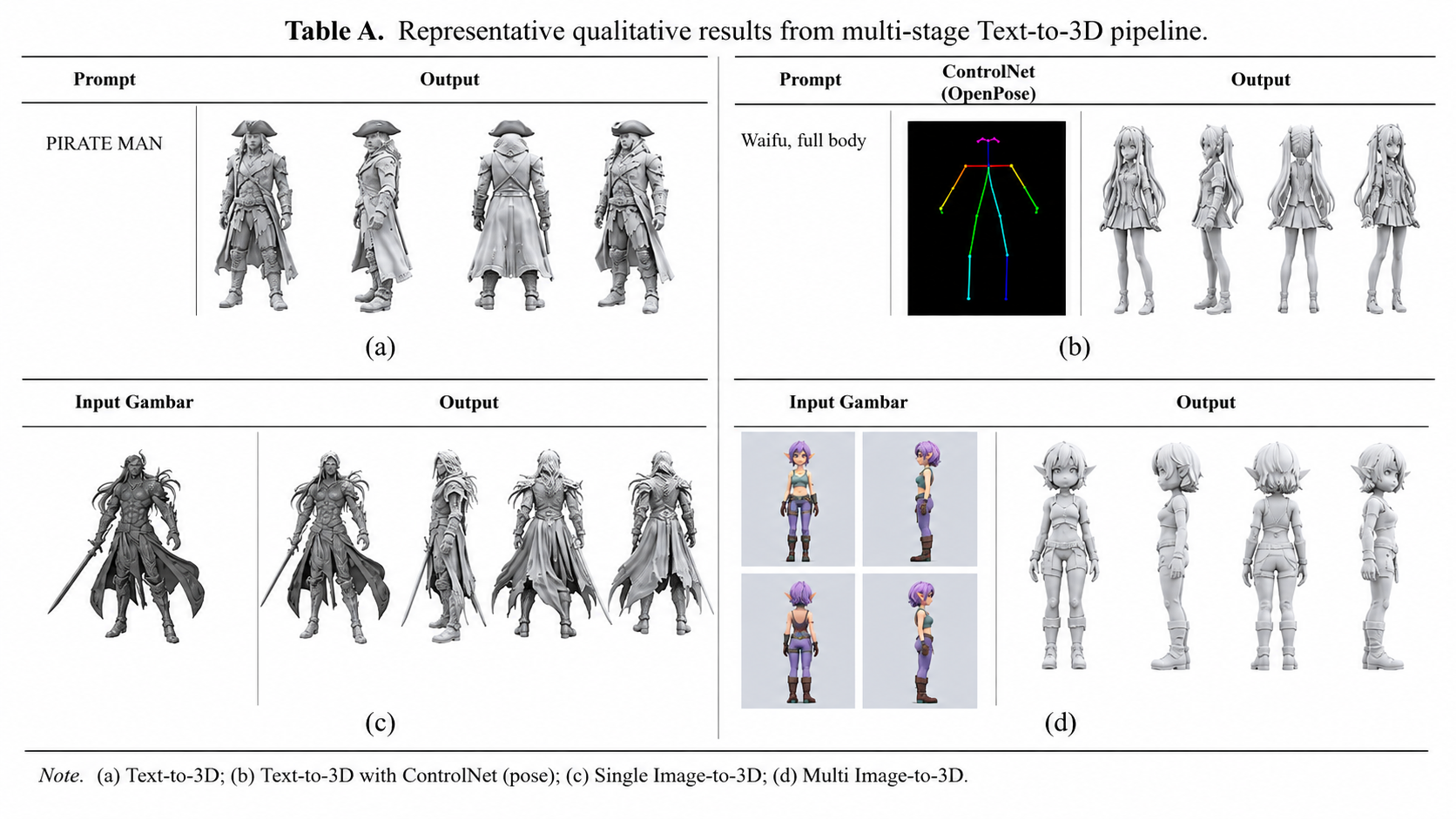
프롬프트 및 이미지 기반 3D 생성은 디지털 자산 제작에 대한 상호작용 장벽을 낮출 수 있으나, 모델 수준의 발전만으로는 비전문가가 완전한 제작 워크플로우를 운영할 수 있는지 여부를 판단할 수 없다. 본 연구에서는 React 인터페이스, FastAPI 서비스, ComfyUI 워크플로우 오케스트레이션, 비동기 작업 처리, 영구 자산 저장소 및 브라우저 기반 3D 시각화를 통합한 웹 기반 인간-AI 프로토타입을 설계하고 평가하였다. 우리는 ‘텍스트-3D’, ‘ControlNet을 활용한 텍스트-3D’, ‘단일 이미지-3D’, ‘다중 이미지-3D’의 네 가지 모드를 구현했다. 평가에는 요구사항에서 도출된 14개의 블랙박스 시나리오, 세 가지 뷰어 환경에서의 GLB 호환성 검사, 35건의 완료된 생성 작업, 7명의 참가자가 84건의 작업 실행을 완료한 과제 기반 관찰, 별도의 12명 학생 그룹으로부터 수집한 시스템 사용성 척도(SUS) 응답, 그리고 구현 및 출력 품질에 대한 전문가 평가 1건을 포함했습니다. 14개의 기능 시나리오 모두 예상된 결과를 산출했으며, 테스트된 GLB 출력물은 통합 뷰어, Blender 및 3dviewer.net에서 정상적으로 열렸습니다. 서버 측 평균 처리 시간은 66.15초였으며, 탐색적 크루스칼-월리스 검정 결과 관찰된 워크로드 분포 간에 차이가 있는 것으로 나타났으나(H(3) = 10.52, p = .015, ε² = .243), 인과적 또는 쌍별 속도 주장을 뒷받침하지는 못했습니다. 관찰된 모든 작업은 결국 완료되었으나, 84회의 실행 중 61회(72.62%)만이 독립적으로 수행되었다. 작업 5(Studio 진입)와 10(‘내 프로젝트’에서 생성된 모델 찾기)의 경우, 참가자 7명 중 5명씩이 각각 도움을 필요로 했다. 평균 SUS 점수는 81.67(표준편차 = 9.25; 95% 신뢰구간 [75.79, 87.55])이었으며, 생성된 모델의 품질은 진단 전문가로부터 5점 만점에 3.50점을 받았다. 본 연구는 엔드투엔드 인간-AI 저작 아키텍처와 기능적 적합성, 배포 소요 시간, 뷰어 간 호환성, 관찰된 상호작용, 지각된 사용성, 출력 품질을 구분하는 다차원 평가 논리를 제시한다. 연구 결과는 접근성이 뛰어난 웹 기반 생성형 3D 저작의 실현 가능성을 뒷받침하는 한편, 검색 가능성과 기하학적 품질에 대한 제약 사항을 밝혀냈다.
RIS is compatible with Zotero, Mendeley, and EndNote. Immediate opening depends on the visitor's browser and reference-manager settings.
게재된 논문에 보고된 선언 사항
Author Contributions
Ray Fadly Hadi: Conceptualization; Methodology; Software; Investigation; Data Curation; Formal Analysis; Visualization; Writing – Original Draft. Randi Proska Sandra: Supervision; Validation; Writing – Review & Editing. Sri Rejeki: Writing – Review & Editing. All authors have read and approved the final version of the manuscript.
Acknowledgments
The authors thank the expert for validation and the Informatics Study Program, Department of Electronics Engineering, Faculty of Engineering, Universitas Negeri Padang, for academic and technical support.
View statement in PDF · PDF page 14연구비 지원
This research received no specific grant from any funding agency in the public, commercial, or not-forprofit sectors.
View statement in PDF · PDF page 14이해 상충
The authors declare no competing interests.
View statement in PDF · PDF page 14Ethics Approval
The study involved non-sensitive software-usability activities. According to the institutional requirements reported in the research record, formal ethical clearance was not required for this evaluation; participation was voluntary, and no medical, biological, or psychological intervention was conducted.
View statement in PDF · PDF page 14Informed Consent
Informed consent was obtained from all participants before task-based usability testing or completion of the System Usability Scale, as applicable.
View statement in PDF · PDF page 14Consent for Publication
Not applicable. The article does not report identifiable participant images or confidential personal records.
View statement in PDF · PDF page 14데이터 가용성
Aggregate evaluation results are reported in the article. The corresponding author may provide anonymized participant-level records, de-identified job measurements, and supporting system documentation upon reasonable request, subject to institutional and privacy requirements.
View statement in PDF · PDF page 14Generative AI Disclosure
During manuscript preparation, the authors used ChatGPT (OpenAI) and Claude (Anthropic) for language refinement. These tools were not used to generate, modify, or analyze the research data, usability scores, performance measurements, or expert assessments. All AI-assisted text was checked against the thesis record and cited sources, and the authors accept full responsibility for the final manuscript. Preprint and Prior Dissemination Statement This article is derived from the first author's undergraduate thesis and is not under consideration elsewhere.
View statement in PDF · PDF page 15References
36 References[1] B. Shneiderman, “Human-centered artificial intelligence: Reliable, safe & trustworthy,” Int. J. Hum.-Comput. Interact., vol. 36, no. 6, pp. 495–504, 2020, doi: https://doi.org/10.1080/10447318.2020.1741118.
[2] S. Amershi et al., “Guidelines for human–AI interaction,” in Proc. 2019 CHI Conf. Human Factors Comput. Syst., Glasgow, U.K., 2019, pp. 1–13, doi: https://doi.org/10.1145/3290605.3300233.
[3] Q. Yang, A. Steinfeld, C. Rosé, and J. Zimmerman, “Re-examining whether, why, and how human–AI interaction is uniquely difficult to design,” in Proc. 2020 CHI Conf. Human Factors Comput. Syst., Honolulu, HI, USA, 2020, pp. 1–13, doi: https://doi.org/10.1145/3313831.3376301.
[4] J. Ho, A. Jain, and P. Abbeel, “Denoising diffusion probabilistic models,” in Advances in Neural Information Processing Systems, vol. 33, pp. 6840–6851, 2020.
[5] R. Rombach, A. Blattmann, D. Lorenz, P. Esser, and B. Ommer, “High-resolution image synthesis with latent diffusion models,” in Proc. IEEE/CVF Conf. Comput. Vis. Pattern Recognit., New Orleans, LA, USA, 2022, pp. 10674–10685, doi: https://doi.org/10.1109/CVPR52688.2022.01042.
[6] A. Radford et al., “Learning transferable visual models from natural language supervision,” in Proc. 38th Int. Conf. Mach. Learn., vol. 139, pp. 8748–8763, 2021.
[7] B. Poole, A. Jain, J. T. Barron, and B. Mildenhall, “DreamFusion: Text-to-3D using 2D diffusion,” in Proc. Int. Conf. Learn. Representations, 2023.
[8] C.-H. Lin et al., “Magic3D: High-resolution text-to-3D content creation,” in Proc. IEEE/CVF Conf. Comput. Vis. Pattern Recognit., Vancouver, BC, Canada, 2023, pp. 300–309, doi: https://doi.org/10.1109/CVPR52729.2023.00037.
[9] Z. Wang et al., “ProlificDreamer: High-fidelity and diverse text-to-3D generation with variational score distillation,” in Advances in Neural Information Processing Systems, vol. 36, pp. 8406–8441, 2023, doi: https://doi.org/10.52202/075280-0368.
[10] Y. Chen, Y. Pan, H. Yang, T. Yao, and T. Mei, “VP3D: Unleashing 2D visual prompt for text-to-3D generation,” in Proc. IEEE/CVF Conf. Comput. Vis. Pattern Recognit. (CVPR), Seattle, WA, USA, 2024, pp. 4896–4905, doi: https://doi.org/10.1109/CVPR52733.2024.00468.
[11] R. Liu, R. Wu, B. Van Hoorick, P. Tokmakov, S. Zakharov, and C. Vondrick, “Zero-1-to-3: Zero-shot one image to 3D object,” in Proc. IEEE/CVF Int. Conf. Comput. Vis., Paris, France, 2023, pp. 9264–9275, doi: https://doi.org/10.1109/ICCV51070.2023.00853.
[12] A. Yu, V. Ye, M. Tancik, and A. Kanazawa, “pixelNeRF: Neural radiance fields from one or few images,” in Proc. IEEE/CVF Conf. Comput. Vis. Pattern Recognit., Nashville, TN, USA, 2021, pp. 4576–4585, doi: https://doi.org/10.1109/CVPR46437.2021.00455.
[13] S. Saito, Z. Huang, R. Natsume, S. Morishima, H. Li, and A. Kanazawa, “PIFu: Pixel-aligned implicit function for high-resolution clothed human digitization,” in Proc. IEEE/CVF Int. Conf. Comput. Vis., Seoul, South Korea, 2019, pp. 2304–2314, doi: https://doi.org/10.1109/ICCV.2019.00239.
[14] C. B. Choy, D. Xu, J. Y. Gwak, K. Chen, and S. Savarese, “3D-R2N2: A unified approach for single and multi-view 3D object reconstruction,” in Computer Vision – ECCV 2016, Cham, Switzerland: Springer, 2016, pp. 628–644, doi: https://doi.org/10.1007/978-3-319-46484-8_38.
[15] X. Long et al., “Wonder3D: Single image to 3D using cross-domain diffusion,” in Proc. IEEE/CVF Conf. Comput. Vis. Pattern Recognit., Seattle, WA, USA, 2024, pp. 9970–9980, doi: https://doi.org/10.1109/CVPR52733.2024.00951.
[16] L. Qiu et al., “RichDreamer: A generalizable normal-depth diffusion model for detail richness in text-to-3D,” in Proc. IEEE/CVF Conf. Comput. Vis. Pattern Recognit., Seattle, WA, USA, 2024, pp. 9914–9925, doi: https://doi.org/10.1109/CVPR52733.2024.00946.
[17] C. Volioti, V. Martsis, A. Ampatzoglou, E. Keramopoulos, and A. Chatzigeorgiou, “Codeless3D: Design and usability evaluation of a low-code tool for 3-D game generation,” IEEE Trans. Games, vol. 17, no. 2, pp. 296–307, 2025, doi: https://doi.org/10.1109/TG.2024.3424894.
[18] R. Kurai, T. Hiraki, Y. Hiroi, Y. Hirao, M. Perusquía-Hernández, H. Uchiyama, and K. Kiyokawa, “MagicCraft: Natural language-driven generation of dynamic and interactive 3D objects for commercial metaverse platforms,” IEEE Access, vol. 13, pp. 132459–132474, 2025, doi: https://doi.org/10.1109/ACCESS.2025.3587232.
[19] X. Xue, Z. Lu, D. Huang, Z. Wang, W. Ouyang, and L. Bai, “ComfyBench: Benchmarking LLM-based agents in ComfyUI for autonomously designing collaborative AI systems,” in Proc. IEEE/CVF Conf. Comput. Vis. Pattern Recognit., Nashville, TN, USA, 2025, pp. 24614–24624, doi: https://doi.org/10.1109/CVPR52734.2025.02292.
[20] R. S. Pressman and B. R. Maxim, Software Engineering: A Practitioner’s Approach, 8th ed. New York, NY, USA: McGraw-Hill Education, 2014.
[21] L. Zhang, A. Rao, and M. Agrawala, “Adding conditional control to text-to-image diffusion models,” in Proc. IEEE/CVF Int. Conf. Comput. Vis., Paris, France, 2023, pp. 3813–3824, doi: https://doi.org/10.1109/ICCV51070.2023.00355.
[22] L. Mescheder, M. Oechsle, M. Niemeyer, S. Nowozin, and A. Geiger, “Occupancy networks: Learning 3D reconstruction in function space,” in Proc. IEEE/CVF Conf. Comput. Vis. Pattern Recognit., Long Beach, CA, USA, 2019, pp. 4455–4465, doi: https://doi.org/10.1109/CVPR.2019.00459.
[23] J. J. Park, P. Florence, J. Straub, R. Newcombe, and S. Lovegrove, “DeepSDF: Learning continuous signed distance functions for shape representation,” in Proc. IEEE/CVF Conf. Comput. Vis. Pattern Recognit., Long Beach, CA, USA, 2019, pp. 165–174, doi: https://doi.org/10.1109/CVPR.2019.00025.
[24] M. Niemeyer, L. Mescheder, M. Oechsle, and A. Geiger, “Differentiable volumetric rendering: Learning implicit 3D representations without 3D supervision,” in Proc. IEEE/CVF Conf. Comput. Vis. Pattern Recognit., Seattle, WA, USA, 2020, pp. 3501–3512, doi: https://doi.org/10.1109/CVPR42600.2020.00356.
[25] M. Niemeyer, J. T. Barron, B. Mildenhall, M. S. M. Sajjadi, A. Geiger, and N. Radwan, “RegNeRF: Regularizing neural radiance fields for view synthesis from sparse inputs,” in Proc. IEEE/CVF Conf. Comput. Vis. Pattern Recognit., New Orleans, LA, USA, 2022, pp. 5470–5480, doi: https://doi.org/10.1109/CVPR52688.2022.00540.
[26] H. Kato, Y. Ushiku, and T. Harada, “Neural 3D mesh renderer,” in Proc. IEEE/CVF Conf. Comput. Vis. Pattern Recognit., Salt Lake City, UT, USA, 2018, pp. 3907–3916, doi: https://doi.org/10.1109/CVPR.2018.00411.
[27] T. Müller, A. Evans, C. Schied, and A. Keller, “Instant neural graphics primitives with a multiresolution hash encoding,” ACM Trans. Graph., vol. 41, no. 4, Art. no. 102, pp. 1–15, 2022, doi: https://doi.org/10.1145/3528223.3530127.
[28] S. Tulsiani, T. Zhou, A. A. Efros, and J. Malik, “Multi-view supervision for single-view reconstruction via differentiable ray consistency,” IEEE Trans. Pattern Anal. Mach. Intell., vol. 44, no. 12, pp. 8754–8765, 2022, doi: https://doi.org/10.1109/TPAMI.2019.2898859.
[29] R. A. Virzi, “Refining the test phase of usability evaluation: How many subjects is enough?,” Hum. Factors, vol. 34, no. 4, pp. 457–468, 1992, doi: https://doi.org/10.1177/001872089203400407.
[30] L. Faulkner, “Beyond the five-user assumption: Benefits of increased sample sizes in usability testing,” Behav. Res. Methods Instrum. Comput., vol. 35, no. 3, pp. 379–383, 2003, doi: https://doi.org/10.3758/BF03195514.
[31] J. Brooke, “SUS: A ‘quick and dirty’ usability scale,” in Usability Evaluation in Industry, P. W. Jordan, B. Thomas, B. A. Weerdmeester, and I. L. McClelland, Eds. London, U.K.: Taylor & Francis, 1996, pp. 189–194, doi: https://doi.org/10.1201/9781498710411-35.
[32] J. R. Lewis, “The System Usability Scale: Past, present, and future,” Int. J. Hum.-Comput. Interact., vol. 34, no. 7, pp. 577–590, 2018, doi: https://doi.org/10.1080/10447318.2018.1455307.
[33] Z. Li et al., “Neuralangelo: High-fidelity neural surface reconstruction,” in Proc. IEEE/CVF Conf. Comput. Vis. Pattern Recognit., Vancouver, BC, Canada, 2023, pp. 8456–8465, doi: https://doi.org/10.1109/CVPR52729.2023.00817.
[34] M. Oechsle, L. Mescheder, M. Niemeyer, T. Strauss, and A. Geiger, “Texture fields: Learning texture representations in function space,” in Proc. IEEE/CVF Int. Conf. Comput. Vis., Seoul, South Korea, 2019, pp. 4530–4539, doi: https://doi.org/10.1109/ICCV.2019.00463.
[35] P. Wang, L. Liu, Y. Liu, C. Theobalt, T. Komura, and W. Wang, “NeuS: Learning neural implicit surfaces by volume rendering for multi-view reconstruction,” in Advances in Neural Information Processing Systems, vol. 34, pp. 27171–27183, 2021.
[36] K. Schwarz, Y. Liao, M. Niemeyer, and A. Geiger, “GRAF: Generative radiance fields for 3D-aware image synthesis,” in Advances in Neural Information Processing Systems, vol. 33, pp. 20154–20166, 2020.
Copyright and License

This work is licensed under a Creative Commons Attribution 4.0 International License.
Copyright (c) 2026 Ray Fadly Hadi, Randi Proska Sandra, Sri Rejeki