

Sustainable Development Goals
This article contributes to the following United Nations Sustainable Development Goals.

Keywords
How to Cite




Publication Snapshot

Upcoming Issue
J-HyTEL welcomes original and rigorous scholarship advancing education, media technology, and computer science applications.
Rolling submissions are accepted throughout the year.
Abstract
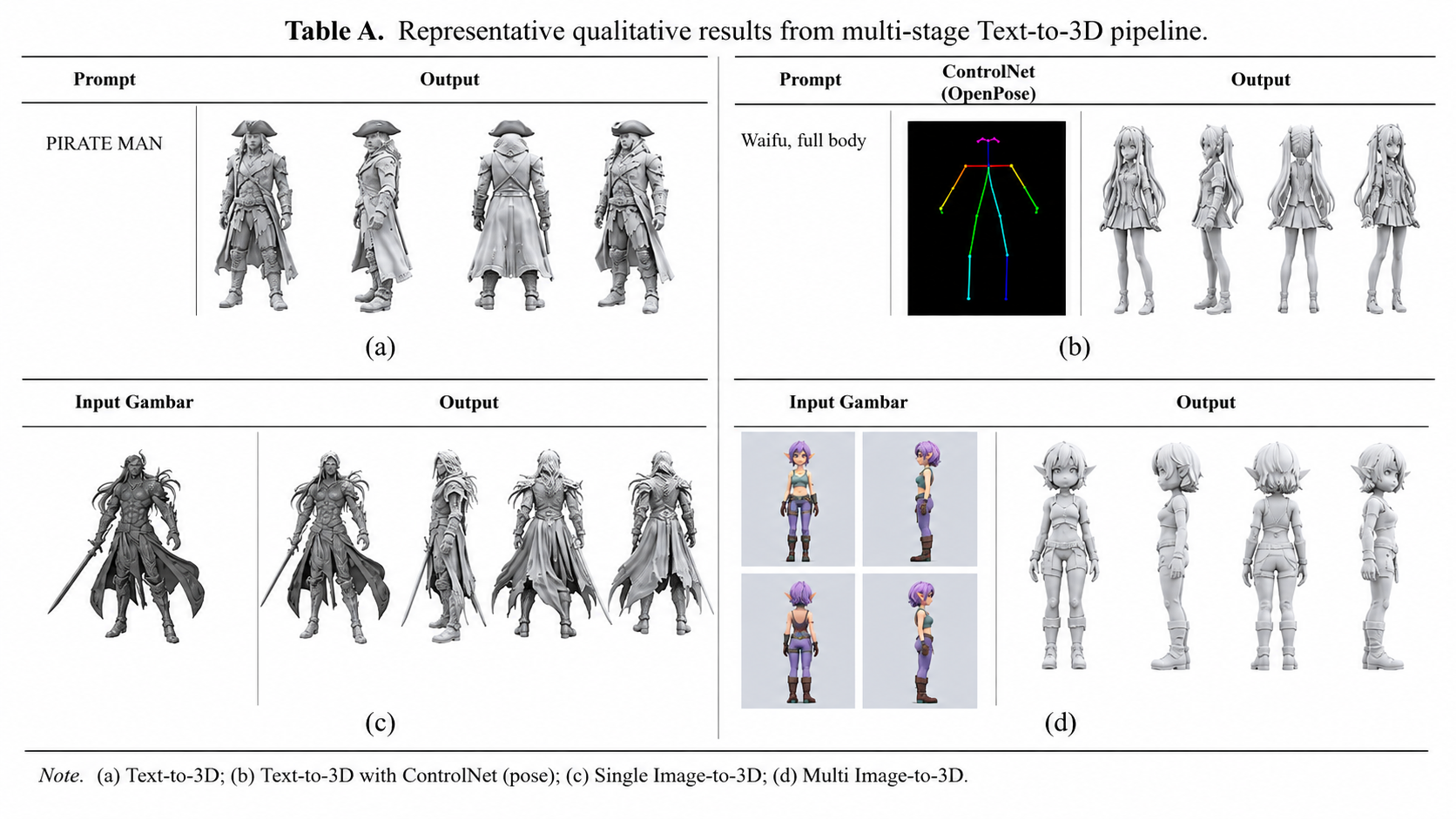
Prompt- and image-driven 3D generation can lower the interaction barrier to digital asset creation, yet model-level advances do not establish whether non-specialists can operate a complete authoring workflow. This study designed and evaluated a web-based human–AI prototype integrating a React interface, FastAPI services, ComfyUI workflow orchestration, asynchronous job processing, persistent asset storage, and browser-based 3D visualization. We implemented four modes: Text-to-3D, Text-to-3D with ControlNet, Single Image-to-3D, and Multi Image-to-3D. Evaluation combined 14 requirement-derived black-box scenarios, cross-viewer GLB compatibility checks in three viewing environments, 35 completed generation jobs, task-based observation with seven participants completing 84 task executions, System Usability Scale (SUS) responses from a separate group of 12 students, and one expert assessment of implementation and output quality. All 14 functional scenarios produced the expected outcomes, and the tested GLB outputs opened in the integrated viewer, Blender, and 3dviewer.net. Mean server-side turnaround was 66.15 s; an exploratory Kruskal–Wallis test indicated differences among the observed workload distributions (H(3) = 10.52, p = .015, ε² = .243), but did not support causal or pairwise speed claims. All observed tasks were eventually completed, but only 61 of 84 executions (72.62%) were independent; Tasks 5 (enter Studio) and 10 (find the generated model in My Projects) each required assistance for five of seven participants. Mean SUS was 81.67 (SD = 9.25; 95% CI [75.79, 87.55]), while generated-model quality received a diagnostic expert score of 3.50/5. The study contributes an end-to-end human–AI authoring architecture and a multidimensional evaluation logic that separates functional conformance, deployment turnaround, cross-viewer compatibility, observed interaction, perceived usability, and output quality. Findings support the feasibility of accessible web-based generative 3D authoring while identifying discoverability and geometric-quality constraints.
RIS is compatible with Zotero, Mendeley, and EndNote. Immediate opening depends on the visitor's browser and reference-manager settings.
Declarations reported in the published article
Author Contributions
Ray Fadly Hadi: Conceptualization; Methodology; Software; Investigation; Data Curation; Formal Analysis; Visualization; Writing – Original Draft. Randi Proska Sandra: Supervision; Validation; Writing – Review & Editing. Sri Rejeki: Writing – Review & Editing. All authors have read and approved the final version of the manuscript.
Acknowledgments
The authors thank the expert for validation and the Informatics Study Program, Department of Electronics Engineering, Faculty of Engineering, Universitas Negeri Padang, for academic and technical support.
View statement in PDF · PDF page 14Funding
This research received no specific grant from any funding agency in the public, commercial, or not-forprofit sectors.
View statement in PDF · PDF page 14Competing Interests
The authors declare no competing interests.
View statement in PDF · PDF page 14Ethics Approval
The study involved non-sensitive software-usability activities. According to the institutional requirements reported in the research record, formal ethical clearance was not required for this evaluation; participation was voluntary, and no medical, biological, or psychological intervention was conducted.
View statement in PDF · PDF page 14Informed Consent
Informed consent was obtained from all participants before task-based usability testing or completion of the System Usability Scale, as applicable.
View statement in PDF · PDF page 14Consent for Publication
Not applicable. The article does not report identifiable participant images or confidential personal records.
View statement in PDF · PDF page 14Data Availability
Aggregate evaluation results are reported in the article. The corresponding author may provide anonymized participant-level records, de-identified job measurements, and supporting system documentation upon reasonable request, subject to institutional and privacy requirements.
View statement in PDF · PDF page 14Generative AI Disclosure
During manuscript preparation, the authors used ChatGPT (OpenAI) and Claude (Anthropic) for language refinement. These tools were not used to generate, modify, or analyze the research data, usability scores, performance measurements, or expert assessments. All AI-assisted text was checked against the thesis record and cited sources, and the authors accept full responsibility for the final manuscript. Preprint and Prior Dissemination Statement This article is derived from the first author's undergraduate thesis and is not under consideration elsewhere.
View statement in PDF · PDF page 15References
36 References[1] B. Shneiderman, “Human-centered artificial intelligence: Reliable, safe & trustworthy,” Int. J. Hum.-Comput. Interact., vol. 36, no. 6, pp. 495–504, 2020, doi: https://doi.org/10.1080/10447318.2020.1741118.
[2] S. Amershi et al., “Guidelines for human–AI interaction,” in Proc. 2019 CHI Conf. Human Factors Comput. Syst., Glasgow, U.K., 2019, pp. 1–13, doi: https://doi.org/10.1145/3290605.3300233.
[3] Q. Yang, A. Steinfeld, C. Rosé, and J. Zimmerman, “Re-examining whether, why, and how human–AI interaction is uniquely difficult to design,” in Proc. 2020 CHI Conf. Human Factors Comput. Syst., Honolulu, HI, USA, 2020, pp. 1–13, doi: https://doi.org/10.1145/3313831.3376301.
[4] J. Ho, A. Jain, and P. Abbeel, “Denoising diffusion probabilistic models,” in Advances in Neural Information Processing Systems, vol. 33, pp. 6840–6851, 2020.
[5] R. Rombach, A. Blattmann, D. Lorenz, P. Esser, and B. Ommer, “High-resolution image synthesis with latent diffusion models,” in Proc. IEEE/CVF Conf. Comput. Vis. Pattern Recognit., New Orleans, LA, USA, 2022, pp. 10674–10685, doi: https://doi.org/10.1109/CVPR52688.2022.01042.
[6] A. Radford et al., “Learning transferable visual models from natural language supervision,” in Proc. 38th Int. Conf. Mach. Learn., vol. 139, pp. 8748–8763, 2021.
[7] B. Poole, A. Jain, J. T. Barron, and B. Mildenhall, “DreamFusion: Text-to-3D using 2D diffusion,” in Proc. Int. Conf. Learn. Representations, 2023.
[8] C.-H. Lin et al., “Magic3D: High-resolution text-to-3D content creation,” in Proc. IEEE/CVF Conf. Comput. Vis. Pattern Recognit., Vancouver, BC, Canada, 2023, pp. 300–309, doi: https://doi.org/10.1109/CVPR52729.2023.00037.
[9] Z. Wang et al., “ProlificDreamer: High-fidelity and diverse text-to-3D generation with variational score distillation,” in Advances in Neural Information Processing Systems, vol. 36, pp. 8406–8441, 2023, doi: https://doi.org/10.52202/075280-0368.
[10] Y. Chen, Y. Pan, H. Yang, T. Yao, and T. Mei, “VP3D: Unleashing 2D visual prompt for text-to-3D generation,” in Proc. IEEE/CVF Conf. Comput. Vis. Pattern Recognit. (CVPR), Seattle, WA, USA, 2024, pp. 4896–4905, doi: https://doi.org/10.1109/CVPR52733.2024.00468.
[11] R. Liu, R. Wu, B. Van Hoorick, P. Tokmakov, S. Zakharov, and C. Vondrick, “Zero-1-to-3: Zero-shot one image to 3D object,” in Proc. IEEE/CVF Int. Conf. Comput. Vis., Paris, France, 2023, pp. 9264–9275, doi: https://doi.org/10.1109/ICCV51070.2023.00853.
[12] A. Yu, V. Ye, M. Tancik, and A. Kanazawa, “pixelNeRF: Neural radiance fields from one or few images,” in Proc. IEEE/CVF Conf. Comput. Vis. Pattern Recognit., Nashville, TN, USA, 2021, pp. 4576–4585, doi: https://doi.org/10.1109/CVPR46437.2021.00455.
[13] S. Saito, Z. Huang, R. Natsume, S. Morishima, H. Li, and A. Kanazawa, “PIFu: Pixel-aligned implicit function for high-resolution clothed human digitization,” in Proc. IEEE/CVF Int. Conf. Comput. Vis., Seoul, South Korea, 2019, pp. 2304–2314, doi: https://doi.org/10.1109/ICCV.2019.00239.
[14] C. B. Choy, D. Xu, J. Y. Gwak, K. Chen, and S. Savarese, “3D-R2N2: A unified approach for single and multi-view 3D object reconstruction,” in Computer Vision – ECCV 2016, Cham, Switzerland: Springer, 2016, pp. 628–644, doi: https://doi.org/10.1007/978-3-319-46484-8_38.
[15] X. Long et al., “Wonder3D: Single image to 3D using cross-domain diffusion,” in Proc. IEEE/CVF Conf. Comput. Vis. Pattern Recognit., Seattle, WA, USA, 2024, pp. 9970–9980, doi: https://doi.org/10.1109/CVPR52733.2024.00951.
[16] L. Qiu et al., “RichDreamer: A generalizable normal-depth diffusion model for detail richness in text-to-3D,” in Proc. IEEE/CVF Conf. Comput. Vis. Pattern Recognit., Seattle, WA, USA, 2024, pp. 9914–9925, doi: https://doi.org/10.1109/CVPR52733.2024.00946.
[17] C. Volioti, V. Martsis, A. Ampatzoglou, E. Keramopoulos, and A. Chatzigeorgiou, “Codeless3D: Design and usability evaluation of a low-code tool for 3-D game generation,” IEEE Trans. Games, vol. 17, no. 2, pp. 296–307, 2025, doi: https://doi.org/10.1109/TG.2024.3424894.
[18] R. Kurai, T. Hiraki, Y. Hiroi, Y. Hirao, M. Perusquía-Hernández, H. Uchiyama, and K. Kiyokawa, “MagicCraft: Natural language-driven generation of dynamic and interactive 3D objects for commercial metaverse platforms,” IEEE Access, vol. 13, pp. 132459–132474, 2025, doi: https://doi.org/10.1109/ACCESS.2025.3587232.
[19] X. Xue, Z. Lu, D. Huang, Z. Wang, W. Ouyang, and L. Bai, “ComfyBench: Benchmarking LLM-based agents in ComfyUI for autonomously designing collaborative AI systems,” in Proc. IEEE/CVF Conf. Comput. Vis. Pattern Recognit., Nashville, TN, USA, 2025, pp. 24614–24624, doi: https://doi.org/10.1109/CVPR52734.2025.02292.
[20] R. S. Pressman and B. R. Maxim, Software Engineering: A Practitioner’s Approach, 8th ed. New York, NY, USA: McGraw-Hill Education, 2014.
[21] L. Zhang, A. Rao, and M. Agrawala, “Adding conditional control to text-to-image diffusion models,” in Proc. IEEE/CVF Int. Conf. Comput. Vis., Paris, France, 2023, pp. 3813–3824, doi: https://doi.org/10.1109/ICCV51070.2023.00355.
[22] L. Mescheder, M. Oechsle, M. Niemeyer, S. Nowozin, and A. Geiger, “Occupancy networks: Learning 3D reconstruction in function space,” in Proc. IEEE/CVF Conf. Comput. Vis. Pattern Recognit., Long Beach, CA, USA, 2019, pp. 4455–4465, doi: https://doi.org/10.1109/CVPR.2019.00459.
[23] J. J. Park, P. Florence, J. Straub, R. Newcombe, and S. Lovegrove, “DeepSDF: Learning continuous signed distance functions for shape representation,” in Proc. IEEE/CVF Conf. Comput. Vis. Pattern Recognit., Long Beach, CA, USA, 2019, pp. 165–174, doi: https://doi.org/10.1109/CVPR.2019.00025.
[24] M. Niemeyer, L. Mescheder, M. Oechsle, and A. Geiger, “Differentiable volumetric rendering: Learning implicit 3D representations without 3D supervision,” in Proc. IEEE/CVF Conf. Comput. Vis. Pattern Recognit., Seattle, WA, USA, 2020, pp. 3501–3512, doi: https://doi.org/10.1109/CVPR42600.2020.00356.
[25] M. Niemeyer, J. T. Barron, B. Mildenhall, M. S. M. Sajjadi, A. Geiger, and N. Radwan, “RegNeRF: Regularizing neural radiance fields for view synthesis from sparse inputs,” in Proc. IEEE/CVF Conf. Comput. Vis. Pattern Recognit., New Orleans, LA, USA, 2022, pp. 5470–5480, doi: https://doi.org/10.1109/CVPR52688.2022.00540.
[26] H. Kato, Y. Ushiku, and T. Harada, “Neural 3D mesh renderer,” in Proc. IEEE/CVF Conf. Comput. Vis. Pattern Recognit., Salt Lake City, UT, USA, 2018, pp. 3907–3916, doi: https://doi.org/10.1109/CVPR.2018.00411.
[27] T. Müller, A. Evans, C. Schied, and A. Keller, “Instant neural graphics primitives with a multiresolution hash encoding,” ACM Trans. Graph., vol. 41, no. 4, Art. no. 102, pp. 1–15, 2022, doi: https://doi.org/10.1145/3528223.3530127.
[28] S. Tulsiani, T. Zhou, A. A. Efros, and J. Malik, “Multi-view supervision for single-view reconstruction via differentiable ray consistency,” IEEE Trans. Pattern Anal. Mach. Intell., vol. 44, no. 12, pp. 8754–8765, 2022, doi: https://doi.org/10.1109/TPAMI.2019.2898859.
[29] R. A. Virzi, “Refining the test phase of usability evaluation: How many subjects is enough?,” Hum. Factors, vol. 34, no. 4, pp. 457–468, 1992, doi: https://doi.org/10.1177/001872089203400407.
[30] L. Faulkner, “Beyond the five-user assumption: Benefits of increased sample sizes in usability testing,” Behav. Res. Methods Instrum. Comput., vol. 35, no. 3, pp. 379–383, 2003, doi: https://doi.org/10.3758/BF03195514.
[31] J. Brooke, “SUS: A ‘quick and dirty’ usability scale,” in Usability Evaluation in Industry, P. W. Jordan, B. Thomas, B. A. Weerdmeester, and I. L. McClelland, Eds. London, U.K.: Taylor & Francis, 1996, pp. 189–194, doi: https://doi.org/10.1201/9781498710411-35.
[32] J. R. Lewis, “The System Usability Scale: Past, present, and future,” Int. J. Hum.-Comput. Interact., vol. 34, no. 7, pp. 577–590, 2018, doi: https://doi.org/10.1080/10447318.2018.1455307.
[33] Z. Li et al., “Neuralangelo: High-fidelity neural surface reconstruction,” in Proc. IEEE/CVF Conf. Comput. Vis. Pattern Recognit., Vancouver, BC, Canada, 2023, pp. 8456–8465, doi: https://doi.org/10.1109/CVPR52729.2023.00817.
[34] M. Oechsle, L. Mescheder, M. Niemeyer, T. Strauss, and A. Geiger, “Texture fields: Learning texture representations in function space,” in Proc. IEEE/CVF Int. Conf. Comput. Vis., Seoul, South Korea, 2019, pp. 4530–4539, doi: https://doi.org/10.1109/ICCV.2019.00463.
[35] P. Wang, L. Liu, Y. Liu, C. Theobalt, T. Komura, and W. Wang, “NeuS: Learning neural implicit surfaces by volume rendering for multi-view reconstruction,” in Advances in Neural Information Processing Systems, vol. 34, pp. 27171–27183, 2021.
[36] K. Schwarz, Y. Liao, M. Niemeyer, and A. Geiger, “GRAF: Generative radiance fields for 3D-aware image synthesis,” in Advances in Neural Information Processing Systems, vol. 33, pp. 20154–20166, 2020.
Copyright and License

This work is licensed under a Creative Commons Attribution 4.0 International License.
Copyright (c) 2026 Ray Fadly Hadi, Randi Proska Sandra, Sri Rejeki