

Sustainable Development Goals
This article contributes to the following United Nations Sustainable Development Goals.

Kata Kunci
Cara Mengutip




Ringkasan Publikasi

Edisi Mendatang
J-HyTEL welcomes original and rigorous scholarship advancing education, media technology, and computer science applications.
Rolling submissions are accepted throughout the year.
Abstrak
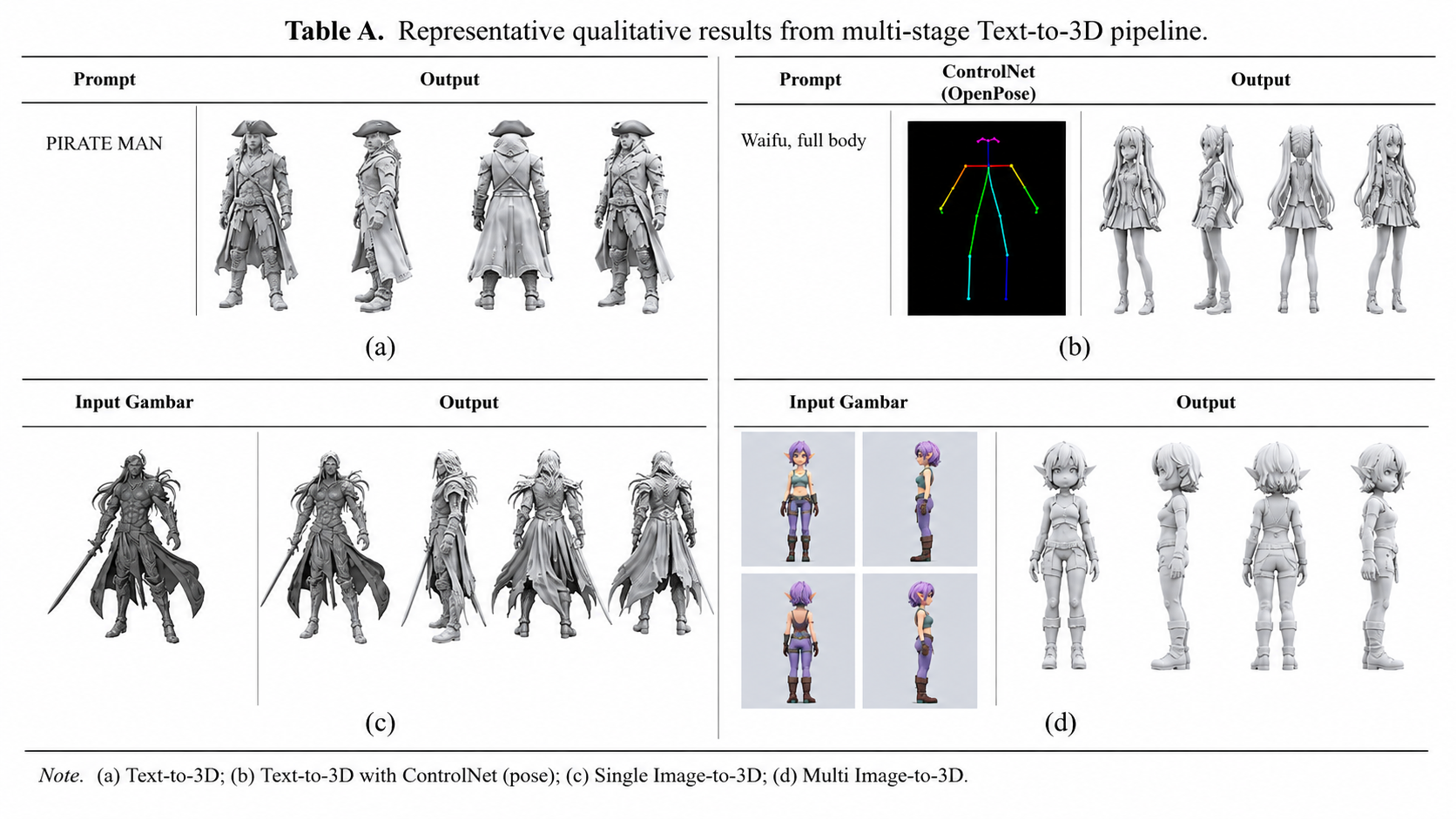
Pembuatan 3D berbasis prompt dan gambar dapat menurunkan hambatan interaksi dalam pembuatan aset digital, namun kemajuan pada tingkat model belum memastikan apakah non-spesialis dapat menjalankan alur kerja penulisan yang lengkap. Penelitian ini merancang dan mengevaluasi prototipe interaksi manusia-AI berbasis web yang mengintegrasikan antarmuka React, layanan FastAPI, orkestrasi alur kerja ComfyUI, pemrosesan tugas asinkron, penyimpanan aset persisten, dan visualisasi 3D berbasis browser. Kami mengimplementasikan empat mode: Teks-ke-3D, Teks-ke-3D dengan ControlNet, Gambar Tunggal-ke-3D, dan Gambar Ganda-ke-3D. Evaluasi ini menggabungkan 14 skenario black-box yang diturunkan dari persyaratan, pemeriksaan kompatibilitas GLB lintas penampil di tiga lingkungan tampilan, 35 pekerjaan generasi yang diselesaikan, pengamatan berbasis tugas dengan tujuh peserta yang menyelesaikan 84 eksekusi tugas, tanggapan Skala Kegunaan Sistem (SUS) dari kelompok terpisah yang terdiri dari 12 mahasiswa, serta satu penilaian ahli terhadap implementasi dan kualitas keluaran. Ke-14 skenario fungsional tersebut menghasilkan hasil yang diharapkan, dan keluaran GLB yang diuji dapat dibuka di penampil terintegrasi, Blender, dan 3dviewer.net. Waktu penyelesaian rata-rata di sisi server adalah 66,15 detik; uji Kruskal–Wallis eksploratori menunjukkan adanya perbedaan di antara distribusi beban kerja yang diamati (H(3) = 10,52, p = 0,015, ε² = 0,243), namun tidak mendukung klaim kausal atau perbandingan kecepatan berpasangan. Semua tugas yang diamati akhirnya diselesaikan, tetapi hanya 61 dari 84 eksekusi (72,62%) yang bersifat mandiri; Tugas 5 (masuk ke Studio) dan 10 (menemukan model yang dihasilkan di My Projects) masing-masing memerlukan bantuan bagi lima dari tujuh peserta. Nilai rata-rata SUS adalah 81,67 (SD = 9,25; 95% CI [75,79, 87,55]), sedangkan kualitas model yang dihasilkan mendapat skor 3,50/5 dari ahli diagnostik. Penelitian ini menyajikan arsitektur pembuatan konten kolaboratif manusia-AI dari awal hingga akhir serta logika evaluasi multidimensi yang memisahkan kesesuaian fungsional, waktu penyelesaian implementasi, kompatibilitas antar-penampil, interaksi yang diamati, kegunaan yang dirasakan, dan kualitas hasil. Temuan ini mendukung kelayakan pembuatan konten 3D generatif berbasis web yang mudah diakses sekaligus mengidentifikasi kendala terkait keterlihatan dan kualitas geometris.
RIS is compatible with Zotero, Mendeley, and EndNote. Immediate opening depends on the visitor's browser and reference-manager settings.
Pernyataan yang dilaporkan dalam artikel yang diterbitkan
Author Contributions
Ray Fadly Hadi: Conceptualization; Methodology; Software; Investigation; Data Curation; Formal Analysis; Visualization; Writing – Original Draft. Randi Proska Sandra: Supervision; Validation; Writing – Review & Editing. Sri Rejeki: Writing – Review & Editing. All authors have read and approved the final version of the manuscript.
Acknowledgments
The authors thank the expert for validation and the Informatics Study Program, Department of Electronics Engineering, Faculty of Engineering, Universitas Negeri Padang, for academic and technical support.
View statement in PDF · PDF page 14Pendanaan
This research received no specific grant from any funding agency in the public, commercial, or not-forprofit sectors.
View statement in PDF · PDF page 14Konflik Kepentingan
The authors declare no competing interests.
View statement in PDF · PDF page 14Ethics Approval
The study involved non-sensitive software-usability activities. According to the institutional requirements reported in the research record, formal ethical clearance was not required for this evaluation; participation was voluntary, and no medical, biological, or psychological intervention was conducted.
View statement in PDF · PDF page 14Informed Consent
Informed consent was obtained from all participants before task-based usability testing or completion of the System Usability Scale, as applicable.
View statement in PDF · PDF page 14Consent for Publication
Not applicable. The article does not report identifiable participant images or confidential personal records.
View statement in PDF · PDF page 14Ketersediaan Data
Aggregate evaluation results are reported in the article. The corresponding author may provide anonymized participant-level records, de-identified job measurements, and supporting system documentation upon reasonable request, subject to institutional and privacy requirements.
View statement in PDF · PDF page 14Generative AI Disclosure
During manuscript preparation, the authors used ChatGPT (OpenAI) and Claude (Anthropic) for language refinement. These tools were not used to generate, modify, or analyze the research data, usability scores, performance measurements, or expert assessments. All AI-assisted text was checked against the thesis record and cited sources, and the authors accept full responsibility for the final manuscript. Preprint and Prior Dissemination Statement This article is derived from the first author's undergraduate thesis and is not under consideration elsewhere.
View statement in PDF · PDF page 15Referensi
36 References[1] B. Shneiderman, “Human-centered artificial intelligence: Reliable, safe & trustworthy,” Int. J. Hum.-Comput. Interact., vol. 36, no. 6, pp. 495–504, 2020, doi: https://doi.org/10.1080/10447318.2020.1741118.
[2] S. Amershi et al., “Guidelines for human–AI interaction,” in Proc. 2019 CHI Conf. Human Factors Comput. Syst., Glasgow, U.K., 2019, pp. 1–13, doi: https://doi.org/10.1145/3290605.3300233.
[3] Q. Yang, A. Steinfeld, C. Rosé, and J. Zimmerman, “Re-examining whether, why, and how human–AI interaction is uniquely difficult to design,” in Proc. 2020 CHI Conf. Human Factors Comput. Syst., Honolulu, HI, USA, 2020, pp. 1–13, doi: https://doi.org/10.1145/3313831.3376301.
[4] J. Ho, A. Jain, and P. Abbeel, “Denoising diffusion probabilistic models,” in Advances in Neural Information Processing Systems, vol. 33, pp. 6840–6851, 2020.
[5] R. Rombach, A. Blattmann, D. Lorenz, P. Esser, and B. Ommer, “High-resolution image synthesis with latent diffusion models,” in Proc. IEEE/CVF Conf. Comput. Vis. Pattern Recognit., New Orleans, LA, USA, 2022, pp. 10674–10685, doi: https://doi.org/10.1109/CVPR52688.2022.01042.
[6] A. Radford et al., “Learning transferable visual models from natural language supervision,” in Proc. 38th Int. Conf. Mach. Learn., vol. 139, pp. 8748–8763, 2021.
[7] B. Poole, A. Jain, J. T. Barron, and B. Mildenhall, “DreamFusion: Text-to-3D using 2D diffusion,” in Proc. Int. Conf. Learn. Representations, 2023.
[8] C.-H. Lin et al., “Magic3D: High-resolution text-to-3D content creation,” in Proc. IEEE/CVF Conf. Comput. Vis. Pattern Recognit., Vancouver, BC, Canada, 2023, pp. 300–309, doi: https://doi.org/10.1109/CVPR52729.2023.00037.
[9] Z. Wang et al., “ProlificDreamer: High-fidelity and diverse text-to-3D generation with variational score distillation,” in Advances in Neural Information Processing Systems, vol. 36, pp. 8406–8441, 2023, doi: https://doi.org/10.52202/075280-0368.
[10] Y. Chen, Y. Pan, H. Yang, T. Yao, and T. Mei, “VP3D: Unleashing 2D visual prompt for text-to-3D generation,” in Proc. IEEE/CVF Conf. Comput. Vis. Pattern Recognit. (CVPR), Seattle, WA, USA, 2024, pp. 4896–4905, doi: https://doi.org/10.1109/CVPR52733.2024.00468.
[11] R. Liu, R. Wu, B. Van Hoorick, P. Tokmakov, S. Zakharov, and C. Vondrick, “Zero-1-to-3: Zero-shot one image to 3D object,” in Proc. IEEE/CVF Int. Conf. Comput. Vis., Paris, France, 2023, pp. 9264–9275, doi: https://doi.org/10.1109/ICCV51070.2023.00853.
[12] A. Yu, V. Ye, M. Tancik, and A. Kanazawa, “pixelNeRF: Neural radiance fields from one or few images,” in Proc. IEEE/CVF Conf. Comput. Vis. Pattern Recognit., Nashville, TN, USA, 2021, pp. 4576–4585, doi: https://doi.org/10.1109/CVPR46437.2021.00455.
[13] S. Saito, Z. Huang, R. Natsume, S. Morishima, H. Li, and A. Kanazawa, “PIFu: Pixel-aligned implicit function for high-resolution clothed human digitization,” in Proc. IEEE/CVF Int. Conf. Comput. Vis., Seoul, South Korea, 2019, pp. 2304–2314, doi: https://doi.org/10.1109/ICCV.2019.00239.
[14] C. B. Choy, D. Xu, J. Y. Gwak, K. Chen, and S. Savarese, “3D-R2N2: A unified approach for single and multi-view 3D object reconstruction,” in Computer Vision – ECCV 2016, Cham, Switzerland: Springer, 2016, pp. 628–644, doi: https://doi.org/10.1007/978-3-319-46484-8_38.
[15] X. Long et al., “Wonder3D: Single image to 3D using cross-domain diffusion,” in Proc. IEEE/CVF Conf. Comput. Vis. Pattern Recognit., Seattle, WA, USA, 2024, pp. 9970–9980, doi: https://doi.org/10.1109/CVPR52733.2024.00951.
[16] L. Qiu et al., “RichDreamer: A generalizable normal-depth diffusion model for detail richness in text-to-3D,” in Proc. IEEE/CVF Conf. Comput. Vis. Pattern Recognit., Seattle, WA, USA, 2024, pp. 9914–9925, doi: https://doi.org/10.1109/CVPR52733.2024.00946.
[17] C. Volioti, V. Martsis, A. Ampatzoglou, E. Keramopoulos, and A. Chatzigeorgiou, “Codeless3D: Design and usability evaluation of a low-code tool for 3-D game generation,” IEEE Trans. Games, vol. 17, no. 2, pp. 296–307, 2025, doi: https://doi.org/10.1109/TG.2024.3424894.
[18] R. Kurai, T. Hiraki, Y. Hiroi, Y. Hirao, M. Perusquía-Hernández, H. Uchiyama, and K. Kiyokawa, “MagicCraft: Natural language-driven generation of dynamic and interactive 3D objects for commercial metaverse platforms,” IEEE Access, vol. 13, pp. 132459–132474, 2025, doi: https://doi.org/10.1109/ACCESS.2025.3587232.
[19] X. Xue, Z. Lu, D. Huang, Z. Wang, W. Ouyang, and L. Bai, “ComfyBench: Benchmarking LLM-based agents in ComfyUI for autonomously designing collaborative AI systems,” in Proc. IEEE/CVF Conf. Comput. Vis. Pattern Recognit., Nashville, TN, USA, 2025, pp. 24614–24624, doi: https://doi.org/10.1109/CVPR52734.2025.02292.
[20] R. S. Pressman and B. R. Maxim, Software Engineering: A Practitioner’s Approach, 8th ed. New York, NY, USA: McGraw-Hill Education, 2014.
[21] L. Zhang, A. Rao, and M. Agrawala, “Adding conditional control to text-to-image diffusion models,” in Proc. IEEE/CVF Int. Conf. Comput. Vis., Paris, France, 2023, pp. 3813–3824, doi: https://doi.org/10.1109/ICCV51070.2023.00355.
[22] L. Mescheder, M. Oechsle, M. Niemeyer, S. Nowozin, and A. Geiger, “Occupancy networks: Learning 3D reconstruction in function space,” in Proc. IEEE/CVF Conf. Comput. Vis. Pattern Recognit., Long Beach, CA, USA, 2019, pp. 4455–4465, doi: https://doi.org/10.1109/CVPR.2019.00459.
[23] J. J. Park, P. Florence, J. Straub, R. Newcombe, and S. Lovegrove, “DeepSDF: Learning continuous signed distance functions for shape representation,” in Proc. IEEE/CVF Conf. Comput. Vis. Pattern Recognit., Long Beach, CA, USA, 2019, pp. 165–174, doi: https://doi.org/10.1109/CVPR.2019.00025.
[24] M. Niemeyer, L. Mescheder, M. Oechsle, and A. Geiger, “Differentiable volumetric rendering: Learning implicit 3D representations without 3D supervision,” in Proc. IEEE/CVF Conf. Comput. Vis. Pattern Recognit., Seattle, WA, USA, 2020, pp. 3501–3512, doi: https://doi.org/10.1109/CVPR42600.2020.00356.
[25] M. Niemeyer, J. T. Barron, B. Mildenhall, M. S. M. Sajjadi, A. Geiger, and N. Radwan, “RegNeRF: Regularizing neural radiance fields for view synthesis from sparse inputs,” in Proc. IEEE/CVF Conf. Comput. Vis. Pattern Recognit., New Orleans, LA, USA, 2022, pp. 5470–5480, doi: https://doi.org/10.1109/CVPR52688.2022.00540.
[26] H. Kato, Y. Ushiku, and T. Harada, “Neural 3D mesh renderer,” in Proc. IEEE/CVF Conf. Comput. Vis. Pattern Recognit., Salt Lake City, UT, USA, 2018, pp. 3907–3916, doi: https://doi.org/10.1109/CVPR.2018.00411.
[27] T. Müller, A. Evans, C. Schied, and A. Keller, “Instant neural graphics primitives with a multiresolution hash encoding,” ACM Trans. Graph., vol. 41, no. 4, Art. no. 102, pp. 1–15, 2022, doi: https://doi.org/10.1145/3528223.3530127.
[28] S. Tulsiani, T. Zhou, A. A. Efros, and J. Malik, “Multi-view supervision for single-view reconstruction via differentiable ray consistency,” IEEE Trans. Pattern Anal. Mach. Intell., vol. 44, no. 12, pp. 8754–8765, 2022, doi: https://doi.org/10.1109/TPAMI.2019.2898859.
[29] R. A. Virzi, “Refining the test phase of usability evaluation: How many subjects is enough?,” Hum. Factors, vol. 34, no. 4, pp. 457–468, 1992, doi: https://doi.org/10.1177/001872089203400407.
[30] L. Faulkner, “Beyond the five-user assumption: Benefits of increased sample sizes in usability testing,” Behav. Res. Methods Instrum. Comput., vol. 35, no. 3, pp. 379–383, 2003, doi: https://doi.org/10.3758/BF03195514.
[31] J. Brooke, “SUS: A ‘quick and dirty’ usability scale,” in Usability Evaluation in Industry, P. W. Jordan, B. Thomas, B. A. Weerdmeester, and I. L. McClelland, Eds. London, U.K.: Taylor & Francis, 1996, pp. 189–194, doi: https://doi.org/10.1201/9781498710411-35.
[32] J. R. Lewis, “The System Usability Scale: Past, present, and future,” Int. J. Hum.-Comput. Interact., vol. 34, no. 7, pp. 577–590, 2018, doi: https://doi.org/10.1080/10447318.2018.1455307.
[33] Z. Li et al., “Neuralangelo: High-fidelity neural surface reconstruction,” in Proc. IEEE/CVF Conf. Comput. Vis. Pattern Recognit., Vancouver, BC, Canada, 2023, pp. 8456–8465, doi: https://doi.org/10.1109/CVPR52729.2023.00817.
[34] M. Oechsle, L. Mescheder, M. Niemeyer, T. Strauss, and A. Geiger, “Texture fields: Learning texture representations in function space,” in Proc. IEEE/CVF Int. Conf. Comput. Vis., Seoul, South Korea, 2019, pp. 4530–4539, doi: https://doi.org/10.1109/ICCV.2019.00463.
[35] P. Wang, L. Liu, Y. Liu, C. Theobalt, T. Komura, and W. Wang, “NeuS: Learning neural implicit surfaces by volume rendering for multi-view reconstruction,” in Advances in Neural Information Processing Systems, vol. 34, pp. 27171–27183, 2021.
[36] K. Schwarz, Y. Liao, M. Niemeyer, and A. Geiger, “GRAF: Generative radiance fields for 3D-aware image synthesis,” in Advances in Neural Information Processing Systems, vol. 33, pp. 20154–20166, 2020.
Copyright and License

Artikel ini berlisensi Creative Commons Attribution 4.0 International License.
Hak Cipta (c) 2026 Ray Fadly Hadi, Randi Proska Sandra, Sri Rejeki