

Sustainable Development Goals
This article contributes to the following United Nations Sustainable Development Goals.


Keywords
How to Cite




Publication Snapshot
Upcoming Issue
J-HyTEL welcomes original and rigorous scholarship advancing education, media technology, and computer science applications.
Rolling submissions are accepted throughout the year.
Abstract
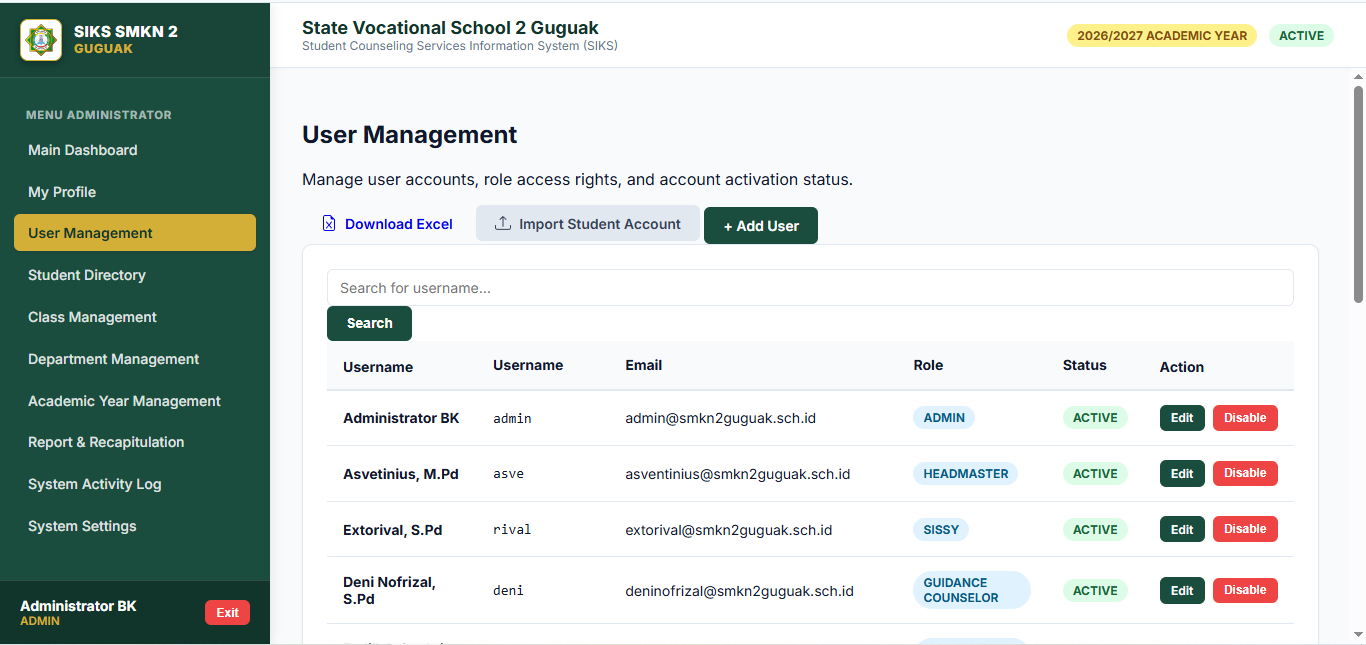
Fragmented school counseling records can obscure case histories, disrupt follow-up, and weaken communication with families. This study developed and formatively evaluated SiKS, an integrated web-based student counseling information system that connects counseling activities through role-based access and automated WhatsApp notifications. Requirements were elicited through interviews with the Vice-Principal for Student Affairs and a School Counselor at an Indonesian vocational high school, supplemented by analysis of the existing workflow. Developed using the Waterfall model, Laravel, and MySQL, the prototype links appointment requests, scheduling, counseling records, follow-up actions, parental summons, reporting, and notification logs across six user roles. Evaluation included 50 black-box scenarios derived from the requirements and user acceptance testing with 20 role-representative respondents after a guided walkthrough. Three validators reviewed the 15-item instrument, assigning 211 out of 225 possible points (93.78%). All 50 executed functional scenarios produced the expected outputs. User acceptance scores totaled 1,336 out of 1,500 points (89.07%), with item scores ranging from 82% to 96%. Interface attractiveness, suitability for school use, menu accessibility, and perceived confidentiality under role-based access received the strongest ratings; report clarity, printing and downloading, and notification services received comparatively lower ratings. The study presents a context-specific design that links case continuity, differentiated access, and event-triggered communication within a single counseling workflow. The findings support functional conformance under the tested conditions and favorable initial user perceptions. Developer-led testing, the single-school setting, and guided exposure limit inferences about independent use, sustained adoption, privacy protection, and counseling outcomes.
RIS is compatible with Zotero, Mendeley, and EndNote. Immediate opening depends on the visitor's browser and reference-manager settings.
Declarations reported in the published article
Author Contributions
Welly Aryatama: Conceptualization; Methodology; Software; Investigation; Data Curation; Writing – original draft. Syukhri: Conceptualization; Supervision; Validation; Writing – review & editing. Khairi Budayawan: Validation; Writing – review & editing. Delvi Asmara: Validation; Writing – review & editing. Dean Collin Langeveldt: Writing – review & editing. All authors have read and approved the final version of the manuscript.
Acknowledgments
The authors thank the staff of SMKN 2 Guguak in Ampang Gadang, Guguak District, Lima Puluh Kota Regency, West Sumatra, for their cooperation during the system requirements analysis and for providing information about the school's operational context. The authors are also grateful to the Department of Informatics Engineering Education, Universitas Negeri Padang, for the academic support provided throughout this research.
View statement in PDF · PDF page 16Ethics Approval
This study was conducted as an undergraduate software development and formative usability project at SMKN 2 Guguak with formal authorization from the school and the Principal's approval. The study involved no clinical or therapeutic intervention, used trial data only, and did not access or process real student counseling records or identifiable sensitive case information.
View statement in PDF · PDF page 16Informed Consent
Participation was voluntary, and all participants were informed of the purpose and procedures of the evaluation before taking part. The school-based evaluation was conducted with written authorization from SMKN 2 Guguak and approval from the Principal. Verbal informed consent was obtained from each participant. For student participants who were minors, written parental or guardian consent was obtained, along with the students’ voluntary agreement to participate. The evaluation used trial data only and did not involve real counseling records or identifiable sensitive case information. All names, telephone numbers, addresses, and other personal details shown in the manuscript figures are fictitious.
View statement in PDF · PDF page 16Funding
This research received no specific grant from any funding agency in the public, commercial, or not-forprofit sectors. It was conducted as part of the first author's undergraduate thesis at Universitas Negeri Padang.
View statement in PDF · PDF page 17Data Availability
Aggregated functional-testing and UAT results are reported in the manuscript and appendices. Additional de-identified supporting records may be available from the corresponding author upon reasonable request, subject to institutional and confidentiality requirements.
View statement in PDF · PDF page 17Competing Interests
The authors declare that there are no competing interests related to this article.
View statement in PDF · PDF page 17Generative AI Disclosure
During manuscript preparation and revision, the authors used generative AI tools, including ChatGPT, Claude, and Gemini, solely to edit language and improve clarity. These tools were not used to generate, fabricate, or modify empirical data, analyses, or reported results. The authors reviewed and verified all AI-assisted content against the original research records and cited sources. They take full responsibility for the accuracy, integrity, and final content of the manuscript. Preprint and Prior Dissemination This article is derived from the first author's undergraduate thesis and is not under consideration for publication elsewhere.
View statement in PDF · PDF page 17References
33 References[1] T. Q. A. Ho et al., “Barriers to and facilitators of user engagement with web-based mental health interventions in young people: A systematic review,” Eur. Child Adolesc. Psychiatry, vol. 34, no. 1, pp. 83–100, 2025, doi: https://doi.org/10.1007/s00787-024-02386-x.
[2] S. Liverpool et al., “Updates on digital mental health interventions for children and young people: Systematic overview of reviews,” Eur. Child Adolesc. Psychiatry, vol. 34, no. 10, pp. 2961–2974, 2025, doi: https://doi.org/10.1007/s00787-025-02722-9.
[3] M. Wright, F. Reitegger, H. Cela, A. Papst, and B. Gasteiger-Klicpera, “Interventions with digital tools for mental health promotion among 11–18 year olds: A systematic review and meta-analysis,” J. Youth Adolesc., vol. 52, no. 4, pp. 754–779, 2023, doi: https://doi.org/10.1007/s10964-023-01735-4.
[4] Republic of Indonesia, “Undang-Undang Republik Indonesia Nomor 20 Tahun 2003 tentang Sistem Pendidikan Nasional,” Lembaran Negara Republik Indonesia Tahun 2003 Nomor 78, Tambahan Lembaran Negara Republik Indonesia Nomor 4301, Jul. 8, 2003.
[5] S. Siraj, S. Nasrah, and T. Trisfayani, “The system approach in the perspective of Law Number 20 of 2003 concerning the National Education System,” Int. J. Educ. Vocat. Stud., vol. 1, no. 1, pp. 47–52, 2019, doi: https://doi.org/10.29103/ijevs.v1i1.1465.
[6] R. Muhammad and Patriana, “Analisis implementasi Permendikbud Nomor 111 Tahun 2014 tentang bimbingan dan konseling,” J. Ilm. Edukatif, vol. 7, no. 1, pp. 53–65, 2021, doi: https://doi.org/10.37567/jie.v7i1.518.
[7] D. Parveen and S. Akhtar, “The role of guidance and counselling in schools: A literature review,” Int. J. Indian Psychol., vol. 11, no. 2, pp. 558–568, 2023, doi: https://doi.org/10.25215/1102.058.
[8] N. Daulay, S. T. Sumanti, F. Faisal, and M. F. S. Siregar, “The urgence of counseling guidance in developing student discipline in junior high school Muhammadiyah Tebing Tinggi,” KONSELI: J. Bimbingan dan Konseling (E-Journal), vol. 8, no. 2, pp. 251–256, 2021, doi: https://doi.org/10.24042/kons.v8i2.10424.
[9] E. Ahyani and E. M. Dhuhani, “Transformasi digital dalam manajemen perkantoran pendidikan: Sebuah kajian literatur,” J. Visionary: Penelit. dan Pengemb. dibidang Adm. Pendidik., vol. 12, no. 1, pp. 205–215, 2024, doi: https://doi.org/10.33394/vis.v12i1.10785.
[10] W. H. DeLone and E. R. McLean, “The DeLone and McLean model of information systems success: A ten-year update,” J. Manag. Inf. Syst., vol. 19, no. 4, pp. 9–30, 2003, doi: https://doi.org/10.1080/07421222.2003.11045748.
[11] M. A. de Carvalho Junior and P. Bandiera-Paiva, “Health information system role-based access control current security trends and challenges,” J. Healthc. Eng., vol. 2018, Art. no. 6510249, 2018, doi: https://doi.org/10.1155/2018/6510249.
[12] D. Robotham, S. Satkunanathan, J. Reynolds, D. Stahl, and T. Wykes, “Using digital notifications to improve attendance in clinic: Systematic review and meta-analysis,” BMJ Open, vol. 6, no. 10, Art. no. e012116, 2016, doi: https://doi.org/10.1136/bmjopen-2016-012116.
[13] W. Atika, Susanti, and A. B. Permadi, “Perancangan sistem informasi e-konseling berbasis web pada SMKs Siti Banun Sumatera Utara,” Indonesian J. Informatic Res. Softw. Eng. (IJIRSE), vol. 2, no. 2, pp. 147–158, 2022, doi: https://doi.org/10.57152/ijirse.v2i2.433.
[14] V. Marisa, S. A. Wijaya, and N. Tsabitah, “Penerapan model prototype rancang bangun sistem bimbingan konseling berbasis web pada SMK Muhammadiyah 3 Pekanbaru,” J. Ilmu Komput. dan Sist. Inf. (JIKOMSI), vol. 7, no. 1, pp. 254–263, 2024, doi: https://doi.org/10.55338/jikomsi.v7i1.2925.
[15] N. M. N. F. Yanti, A. A. I. I. Paramitha, and E. G. A. Dewi, “Rancang bangun sistem informasi bimbingan konseling pada SMA Negeri 1 Baturiti dengan metode Waterfall,” Kumpul. Artik. Mhs. Pendidik. Tek. Inform., vol. 13, no. 3, pp. 117–128, 2024, doi: https://doi.org/10.23887/karmapati.v13i3.87662.
[16] H. Wulandari and G. Farell, “Rancang bangun sistem informasi poin pelanggaran siswa berbasis web di SMK Negeri 1 Painan,” ELEKTIF J. Elektron. Inform., vol. 2, no. 2, pp. 126–140, 2024, doi: https://doi.org/10.24036/elektif.v2i2.62.
[17] E. Mariati, C. C. Scorpiono, and Kristanto, “Perancangan sistem informasi bimbingan konseling untuk SMK Santa Monika Sungai Raya,” TECHBUS (Technology, Business and Entrepreneurship), vol. 3, no. 1, pp. 19–30, 2025, doi: https://doi.org/10.61245/techbus.v3i1.48.
[18] H. J. S. Putranto and J. J. C. Tambotoh, “Perancangan sistem informasi layanan pengaduan dan konseling siswa Teman Konseling berbasis web,” Jutisi J. Ilm. Tek. Inform. dan Sist. Inf., vol. 14, no. 2, pp. 1290–1303, 2025, doi: https://doi.org/10.35889/jutisi.v14i2.2980.
[19] Ruspisah and C. E. Suharyanto, “Implementasi sistem informasi pendataan siswa berbasis web dengan fitur dynamic reporting dan auto-grouping kelas di Sekolah Globe National Plus 2 Batam,” J. Teknol. Digit. dan Sist. Inf., vol. 3, no. 1, pp. 84–92, 2026, doi: https://doi.org/10.47024/jutekdisi.v3i1.1329.
[20] E. Proctor et al., “Outcomes for implementation research: Conceptual distinctions, measurement challenges, and research agenda,” Adm. Policy Ment. Health, vol. 38, pp. 65–76, 2011, doi: https://doi.org/10.1007/s10488-010-0319-7.
[21] L. J. Damschroder, C. M. Reardon, M. A. O. Widerquist, and J. Lowery, “The updated Consolidated Framework for Implementation Research based on user feedback,” Implement. Sci., vol. 17, Art. no. 75, 2022, doi: https://doi.org/10.1186/s13012-022-01245-0.
[22] F. T. Zany, A. Sujud, and J. Nurgaza, “Pengembangan sistem manajemen WhatsApp API (Application Programming Interface) dengan menggunakan WhatsApp-Web.js,” J. Informatics Comput. Sci., vol. 10, no. 2, pp. 140–153, 2024, doi: https://doi.org/10.33143/jics.v10i2.4761.
[23] S. Aprilia, “Sistem informasi absensi berbasis website menggunakan API WhatsApp dengan metodologi incremental (Studi kasus: SMP Negeri 29 Pekanbaru),” J. Appl. Informatics Comput., vol. 4, no. 1, pp. 38–44, 2020, doi: https://doi.org/10.30871/jaic.v4i1.1966.
[24] S. V. Yulianto, L. D. Setia, and A. P. Atmaja, “The use of WhatsApp Gateway for automatic notification system,” J. Phys.: Conf. Ser., vol. 1845, no. 1, Art. no. 012014, 2021, doi: https://doi.org/10.1088/1742-6596/1845/1/012014.
[25] A. B. Nasution, A. Y. N. Hrp, Y. Yudi, and M. Fauzi, “Implementation of OTP code as application login verification via Whatsapp,” Indonesian J. Appl. Ind. Sci. (ESA), vol. 3, no. 4, pp. 395–402, 2024, doi: https://doi.org/10.55927/esa.v3i4.10225.
[26] Uminingsih, M. N. Ichsanudin, M. Yusuf, and Suraya, “Pengujian fungsional perangkat lunak sistem informasi perpustakaan dengan metode Black Box Testing bagi pemula,” STORAGE J. Ilm. Tek. dan Ilmu Komput., vol. 1, no. 2, pp. 1–8, 2022, doi: https://doi.org/10.55123/storage.v1i2.270.
[27] A. Wibowo and I. Darwati, “Perancangan sistem informasi pengelolaan sarana dan prasarana dengan pengujian User Acceptance Testing,” Reputasi: J. Rekayasa Perangkat Lunak, vol. 3, no. 1, pp. 1–6, 2022, doi: https://doi.org/10.31294/reputasi.v3i1.1200.
[28] W. Harjono and K. J. Tute, “Perancangan sistem informasi perpustakaan berbasis web menggunakan metode Waterfall,” SATESI J. Sains Teknol. dan Sist. Inf., vol. 2, no. 1, pp. 47–51, 2022, doi: https://doi.org/10.54259/satesi.v2i1.773.
[29] M. Demba, “Algorithm for relational database normalization up to 3NF,” Int. J. Database Manag. Syst., vol. 5, no. 3, pp. 39–51, 2013, doi: https://doi.org/10.5121/ijdms.2013.5303.
[30] M. Hardini, V. Agarwal, D. Apriani, I. A. Widjaya, E. Setiawaty, and Nurasiah, “Application of database normalization in increasing data storage efficiency,” Int. Trans. Artif. Intell. (ITALIC), vol. 3, no. 2, pp. 201–211, 2025, doi: https://doi.org/10.33050/italic.v3i2.799.
[31] K. ’Afiifah, Z. F. Azzahra, and A. D. Anggoro, “Analisis teknik Entity-Relationship Diagram dalam perancangan database: Sebuah literature review,” INTECH, vol. 3, no. 2, pp. 70–74, 2022, doi: https://doi.org/10.54895/intech.v3i2.1682.
[32] M. Sumiati, R. Abdillah, and A. Cahyo, “Pemodelan UML untuk sistem informasi persewaan alat pesta,” J. FASILKOM, vol. 11, no. 2, pp. 79–86, 2021, doi: https://doi.org/10.37859/jf.v11i2.2673.
[33] M. R. Wayahdi and F. Ruziq, “Pemodelan sistem penerimaan anggota baru dengan Unified Modeling Language (UML) (Studi kasus: Programmer Association of Battuta),” J. Minfo Polgan, vol. 12, no. 1, pp. 1514–1521, 2023, doi: https://doi.org/10.33395/jmp.v12i1.12870.
Copyright and License

This work is licensed under a Creative Commons Attribution 4.0 International License.
Copyright (c) 2026 Welly Aryatama, Syukhri, Khairi Budayawan, Delvi Asmara, Dean Collin Langeveldt