

1. Introduction
Guidance and counseling in secondary schools is an educational service that depends on continuity of information. Counselors must provide a safe channel through which students can seek help, protect confidentiality, maintain traceable records of assessments and follow-up, and coordinate with teachers and families when additional support is required. Digital tools may improve access and continuity, but research on digital mental health among young people indicates that engagement depends on perceived usefulness, privacy, trust, guidance, and implementation context rather than on the availability of technology alone [1], [2], [3]. Digitizing counseling therefore involves more than replacing paper forms: the system must support appropriate access, continuity, and communication without exposing sensitive case information.
In Indonesia, Law No. 20 of 2003 on the National Education System provides the national legal framework for education [4], and its implications for the education system are discussed in [5]. Ministry of Education and Culture Regulation No. 111 of 2014 (Permendikbud No. 111/2014) further frames guidance and counseling as support for students' personal, social, learning, and career development [6]. Indonesian scholarship also links school counseling services with student development and discipline support [7], [8]. These responsibilities make record continuity and controlled information access important operational requirements for school counseling services.
Information systems can support these requirements by organizing, controlling access to, and reporting information more consistently [9], although information-system success also depends on system quality, information quality, service quality, use, user satisfaction, and net benefits [10]. For sensitive records, access must be differentiated according to legitimate responsibilities. Role-based access control is widely used to restrict access to sensitive records, but its effectiveness depends on careful role definition and implementation [11]. Claims about communication functions also require careful qualification: digital notifications can improve appointment-related communication in other service settings [12], but those findings cannot be assumed to transfer directly to school counseling. Accordingly, this study evaluates notifications as an operational mechanism for reducing manual handoffs, while counseling outcomes remain outside the study scope.
The practical context for this study is SMKN 2 Guguak, a public vocational high school in Guguak District, Lima Puluh Kota Regency, West Sumatra, Indonesia. The school offered five vocational study programs and enrolled 622 students in the 2025/2026 academic year. At this scale, the counseling unit needs reliable mechanisms for recording case histories, coordinating appointments, monitoring follow-up, and generating summary reports for authorized school personnel.
Interviews conducted in April 2026 with the Vice-Principal for Student Affairs and the School Counselor identified four interrelated weaknesses in the existing workflow. First, daily individual and group counseling had no comprehensive longitudinal record apart from limited paper documentation, making case chronology and periodic recapitulation difficult to reconstruct. Second, appointments were requested verbally or face to face, which offered limited privacy to students seeking counseling. Third, follow-up relied on manual coordination, so missed or postponed sessions were difficult to monitor systematically. Fourth, parental summons letters were delivered on paper through students,leaving delivery unverified and allowing communication to be delayed or withheld.
These limitations were interrelated. When requests, sessions, follow-up, and parental communication are stored or handled separately, the school cannot easily determine the progression of a case from initial contact to completion. The same fragmentation also also complicates appropriate restrictions on information access: school leaders may need aggregate monitoring, whereas detailed session content should remain restricted. The design problem is therefore a case-lifecycle problem involving traceability, role-specific visibility, and event-driven communication, rather than simply a need to digitize individual forms.
Previous counseling information systems address elements of this problem but remain fragmented in several respects. Atika et al. [13] developed web-based counseling data management, monitoring, and reporting; Marisa et al. [14] digitized scheduling and record tracking; Yanti et al. [15] and Wulandari and Farell [16] focused on student violation or case-handling records; Mariati et al. [17] incorporated counseling-related communication records; and Putranto and Tambotoh [18] integrated complaint and counseling services. Other school information systems demonstrate broader digital reporting and administrative integration [19]. Collectively, these studies establish the feasibility of web-based counseling or student-service systems, but provide limited explicit evidence of an end-to-end structure that keeps a counseling request, its validation, the session record, follow-up status, parental summons, and notification history traceably connected while restricting visibility according to user roles.
This study addresses that application-level gap by asking the following question: How can SiKS, an integrated web-based student counseling information system, connect the counseling case lifecycle through role-based access and automated notifications, and to what extent does the resulting prototype meet its specified functional requirements and receive favorable initial evaluations from representative users? Accordingly, the study aims to design, implement, and formatively evaluate SiKS at SMKN 2 Guguak. The study makes three contributions: (1) a traceable data structure linking request, session, follow-up, summons, and notification events; (2) a role-based interaction design that distinguishes case-level access from leadership monitoring, while revealing a permission exception requiring correction; and (3) an evaluation that distinguishes developer-verified functional conformance from initial user acceptance. Favorable user acceptance testing (UAT) results provide initial evidence of perceived acceptability and feasibility; sustained adoption, counseling effectiveness, privacy robustness, and long-term implementation require separate evidence [20], [21].
The following sections review the relevant literature, describe the Waterfall development process and evaluation procedures, and discuss the findings, contributions, and limitations.
2. Literature Review
2.1. Counseling Service Principles, Privacy, and Digital Engagement
School counseling systems must reflect counseling principles in their technical requirements. Permendikbud No. 111/2014 positions guidance and counseling as a means of supporting students' personal, social, learning, and career development [6], while counseling literature emphasizes confidentiality, voluntary engagement, and supportive access [7]. In digital systems, confidentiality requires access rules that prevent unnecessary exposure of session content; voluntariness requires a discreet means for students to initiate requests without publicly approaching the counseling room. Evidence from web-based mental-health interventions for young people reinforces this design logic: privacy, perceived usefulness, trust, guidance, and contextual fit can shape engagement, whereas unclear safety or ethical arrangements can impede uptake [1], [2], [3]. These findings do not make a school counseling information system equivalent to a mental-health intervention, but they help explain why privacy, clarity, and low-friction access are important system requirements for a service used by young people.
2.2. Case Continuity, Traceability, and Role-Based Access
Existing web-based counseling systems demonstrate the value of digitized records, but they vary in the extent to which they represent a counseling case over time. Some systems emphasize counseling data management, monitoring, and reporting [13]; others add scheduling and status tracking [14], violation handling [15], [16], communication records [17], or integrated complaint and counseling services [18]. The central design issue is therefore not the presence of a database, but whether it preserves links among requests, validation decisions, sessions, follow-up actions, and communication events. A disconnected set of digital records can reproduce the fragmentation of the paper process. The present study consequently treats chronological case linkage as a primary design requirement. Because counseling records are sensitive, traceability must also be paired with role-specific visibility: students need access to information related to their own cases, counselors require case-level data, homeroom teachers need information relevant to assigned students, and leadership access should be limited to what oversight requires. This logic is consistent with role-based access control in sensitive information systems [11], while recognizing that least-privilege access must be verified through implemented permissions rather than inferred from role labels.
2.3. Automated Notifications and School-Family Coordination
Automated notifications connect system status changes to communication events. WhatsApp API management systems demonstrate the feasibility of programmatic notification delivery [22]. School-based applications have used WhatsApp for attendance communication [23], while other implementations demonstrate automated notification [24] and OTP-based authentication [25]. A systematic review and meta-analysis in healthcare also indicates that text-based electronic notifications can improve appointment attendance [12]. This evidence is relevant only by analogy: a school counseling summons differs in purpose, sensitivity, and recipient relationship, and the present study did not measure attendance outcomes. Accordingly, the notification module is evaluated here as part of the workflow infrastructure. A request can alert a counselor, a validation decision can notify a student, and a follow-up summons can be sent directly to a parent or guardian. Because the prototype uses a third-party WhatsApp gateway rather than a fully controlled institutional messaging service, message content should be minimized to what the recipient needs, delivery statuses should be recorded, and failed automated delivery should trigger a documented manual follow-up process.
2.4. Evaluation Logic: Functional Conformance, Acceptance, and Implementation
Software evaluation produces different types of evidence that should be interpreted separately. Black-box testing establishes whether executed scenarios produce specified outputs [26], whereas UAT captures users' assessments of a system's acceptability and feasibility in its intended setting [27]. Implementation research further distinguishes acceptability and feasibility from adoption, fidelity, penetration, and sustainability [20], and the updated Consolidated Framework for Implementation Research emphasizes that real-world implementation depends on contextual determinants across the innovation, setting, and people involved [21]. These distinctions guide the evaluation. A 100% functional pass rate supports conformance for the tested scenarios, and a favorable UAT score supports initial acceptance after guided exposure. Long-term use, privacy robustness, counseling effectiveness, and transferability require additional evaluation.
3. Methods
3.1. Research Design
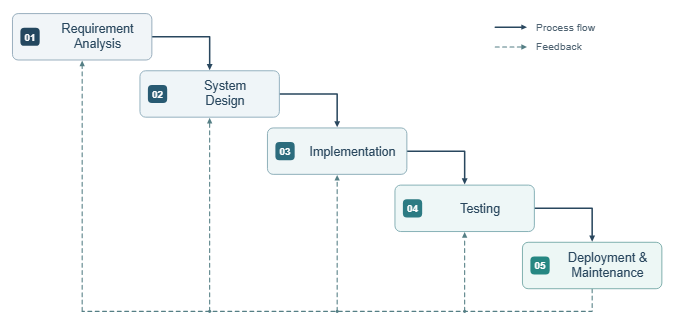
This study used the Waterfall system development model, comprising requirements definition, system and software design, implementation, integration and testing, and operation and maintenance (Figure 1) [28]. Waterfall was selected because the counseling workflow, organizational roles, and core regulatory constraints had been identified before implementation and were treated as relatively stable requirements. The research was therefore designed as a single-site study of software design and formative evaluation rather than as an effectiveness trial. The technical unit of analysis was the requirement-derived test scenario, whereas the UAT analysis drew on respondents' questionnaire ratings.
3.2. Study Site and Participants
The study was conducted at SMKN 2 Guguak, a public vocational high school in West Sumatra, Indonesia. Requirements data were obtained through semi-structured interviews with the Vice-Principal for Student Affairs and the School Counselor, supplemented by documentation of existing referral, scheduling, parental-summons, and visit-logging processes. UAT involved 20 purposively selected respondents representing roles responsible for using or overseeing the system: one Principal, one Administrator, one Vice-Principal for Student Affairs, two Guidance Counselors, two Homeroom Teachers, and 13 Students. The six role-specific interactions are shown in Figure 2.This purposive sample supported formative evaluation at the study site, not an estimate of population-level acceptance.
3.3. System Architecture and Development Tools
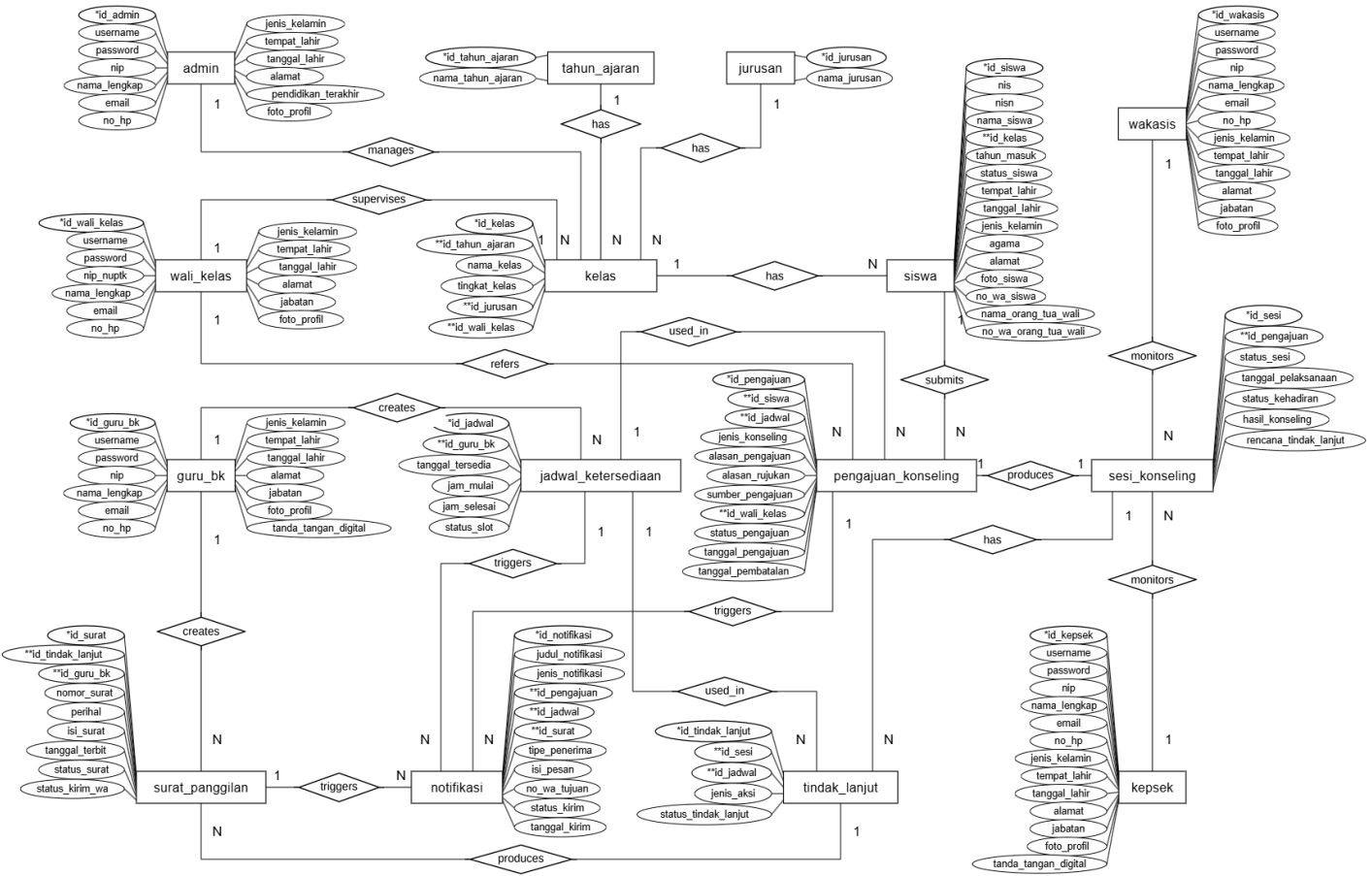
SiKS was implemented as a Laravel (PHP) web application with MySQL as the relational database management system. Laravel supported authentication, routing, and role-based application logic across the six user groups. The database schema was developed through normalization from an unnormalized form through the first, second, and third normal forms to reduce repeating groups and partial or transitive dependencies [29], [30]. The resulting entity-relationship structure centers on the counseling request and links it to scheduling, counseling sessions, follow-up actions, parental summons, and a notification log (Figure 3) [31]. System behavior and access were modeled with Unified Modeling Language (UML) use-case and activity diagrams [32], [33]. Automated messages were sent via the Fonnte WhatsApp gateway and its application programming interface. The browser interface used HTML, CSS, and JavaScript, while Laragon and Visual Studio Code supported local development.
3.4. System Development Procedure
3.4.1. Requirements Analysis
Interviews and an analysis of the manual workflow identified four linked operational problems: incomplete counseling histories, requests made without adequate privacy or formal scheduling, paper summons letters with uncertain delivery, and the lack of a shared, role-appropriate view of case status. These problems informed four core requirements: chronological case histories with summary reporting, student self-service scheduling, event-triggered notifications and summons delivery, and role-based status monitoring. The requirements were used as the basis for the subsequent UML models and functional test scenarios.
3.4.2. System Design
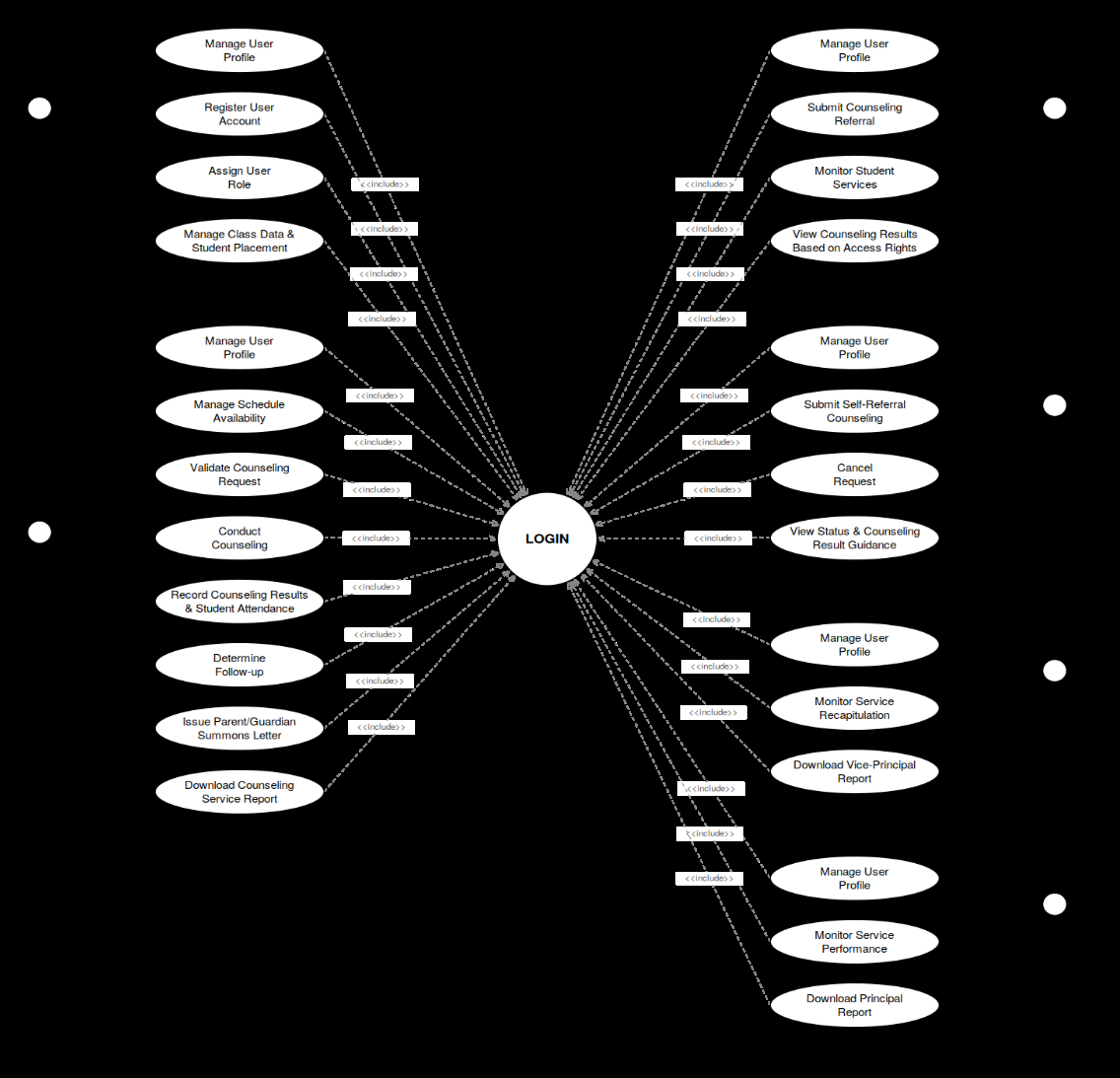
The requirements described in Section 3.4.1 were modeled using UML [32], [33]. The use-case model identifies six authorized actors: Administrator, Counselor, Homeroom Teacher, Student, Vice-Principal for Student Affairs, and Principal (Figure 2). Actor-specific workflows cover account and access management, referral and monitoring, schedule validation, counseling-session recording, student self-service requests, and leadership-level review of recapitulation data. The design aimed to separate case-level work from leadership monitoring so that access permissions would reflect operational responsibilities; the implemented privilege set was subsequently examined through functional testing against that design intent.
The database design progressed from an unnormalized form through first normal form (1NF), second normal form (2NF), and third normal form (3NF). The final entity-relationship model contains 15 interconnected entities and 18 relationships (Figure 3). Counseling Request functions as the principal case entry point and is linked to Counseling Session, Follow-Up Action, Summons Letter, and Notification records, while supporting entities represent users, classes, departments, academic years, and schedule availability. This structure was designed to preserve the sequence of events in a case and to avoid storing summons or follow-up information as isolated records.
Access-control rules were incorporated into the design before implementation. Under the intended access-control design, students can access only their own case-related information; Homeroom Teachers can view information about students assigned to their classes; and Counselors manage counseling content and follow-up. Leadership interfaces were designed primarily for read-only monitoring and recapitulation. Functional testing then assessed the implemented permissions against the design.
3.4.3. Implementation
Implementation proceeded from local verification to limited hosted use. The first stage ran the application locally with Laragon and MySQL to verify role-based authentication, account and class management, counseling requests and schedule validation, session and history recording, parental summons management, and notification delivery. In the second stage, the application was made available on a hosted web server to a limited set of users to test the main workflow and address interface issues before final evaluation.
In the final stage, the revised prototype was demonstrated and evaluated across all six system roles using trial data. This stage supported the black-box scenarios and the guided UAT described below. This was not a longitudinal production deployment; therefore, outcomes such as sustained daily use, long-term data quality, message-response behavior, or counseling effectiveness were not measured.
3.4.4. Testing and Data Analysis
Functional verification used black-box testing, which examines whether specified inputs and actions produce the expected system behavior without requiring inspection of internal code [26]. Fifty scenarios derived from the requirements covered general authentication and the six role-specific modules, including account management, schedule availability, request submission and validation, session recording, summons generation, report functions, and WhatsApp notification dispatch. Scenarios were executed by the development team and cross-checked with Selenium IDE browser automation. A scenario was classified as valid when the observed behavior matched the expected result. The complete scenario matrix is reported in Appendix A.
UAT used a 15-item questionnaire adapted for this study, drawing on the UAT approach described by Wibowo and Darwati [27], with four design items, six service items, and five efficiency items. Before administration, three validators assessed the 15 items using a five-point rating scale; the item-level ratings and validator summary are reported in Appendix B. This expert-review score represents a study-specific pre-administration assessment and was not treated as a psychometric validity coefficient. The questionnaire was then administered via Google Forms to the 20 respondents described in Section 3.2 after a guided walkthrough of features relevant to each role. Responses were recorded on a five-point Likert scale (5 = strongly agree, 4 = agree, 3 = somewhat agree, 2 = disagree, 1 = strongly disagree). The feasibility percentage was calculated as the obtained score divided by the maximum possible score, multiplied by 100. Scores of 81–100% were classified as Very Feasible; 61–80%, Feasible; 41–60%, Reasonably Feasible; 21–40%, Less Feasible; and below 21%, Unfeasible. Item-level response distributions and feasibility scores are reported in Appendix C. Because UAT followed a guided walkthrough and involved a small purposive sample at one school, the analysis is descriptive and formative.
3.4.5. Operation and Maintenance Plan
Following evaluation, a proposed maintenance plan was prepared to cover corrective maintenance (resolving post-release errors), adaptive maintenance (updating academic-year, class, or category data), perfective maintenance (improving report, search, and interface performance), preventive maintenance (periodic backups), and service-availability monitoring. These activities describe a planned maintenance process; longitudinal maintenance performance was not evaluated in the present study.
4. Results
4.1. System Implementation
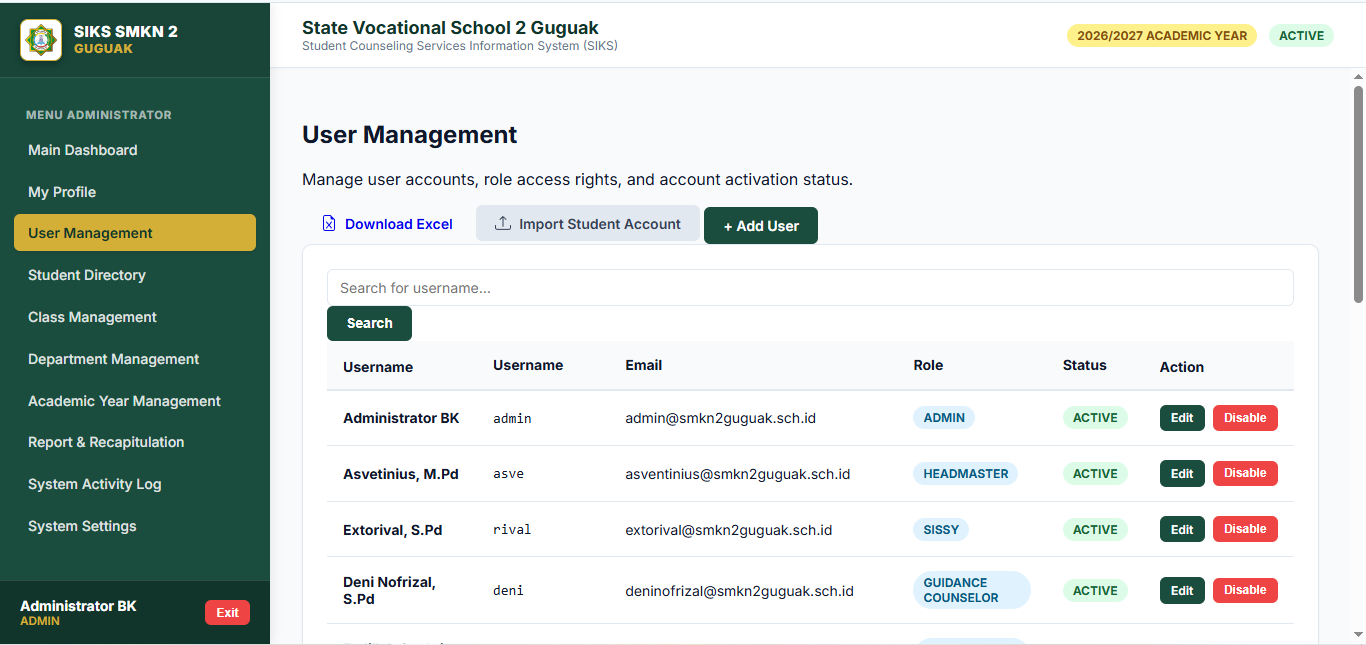
The final SiKS prototype implemented the workflow specified in the design stage as a Laravel web application with a MySQL database. Six role-based dashboards provide functions aligned with the respective roles. The Administrator interface manages user accounts, data import and export, activation status, and supporting master data (Figure 4), while the remaining modules connect schedule requests, counseling sessions, follow-up, recapitulation, and notifications to the same underlying case structure. Functional testing revealed that the Principal role can access detailed counseling-session information (Appendix Table A1, BB-45), revealing a least-privilege concern that must be resolved before use with real counseling records.
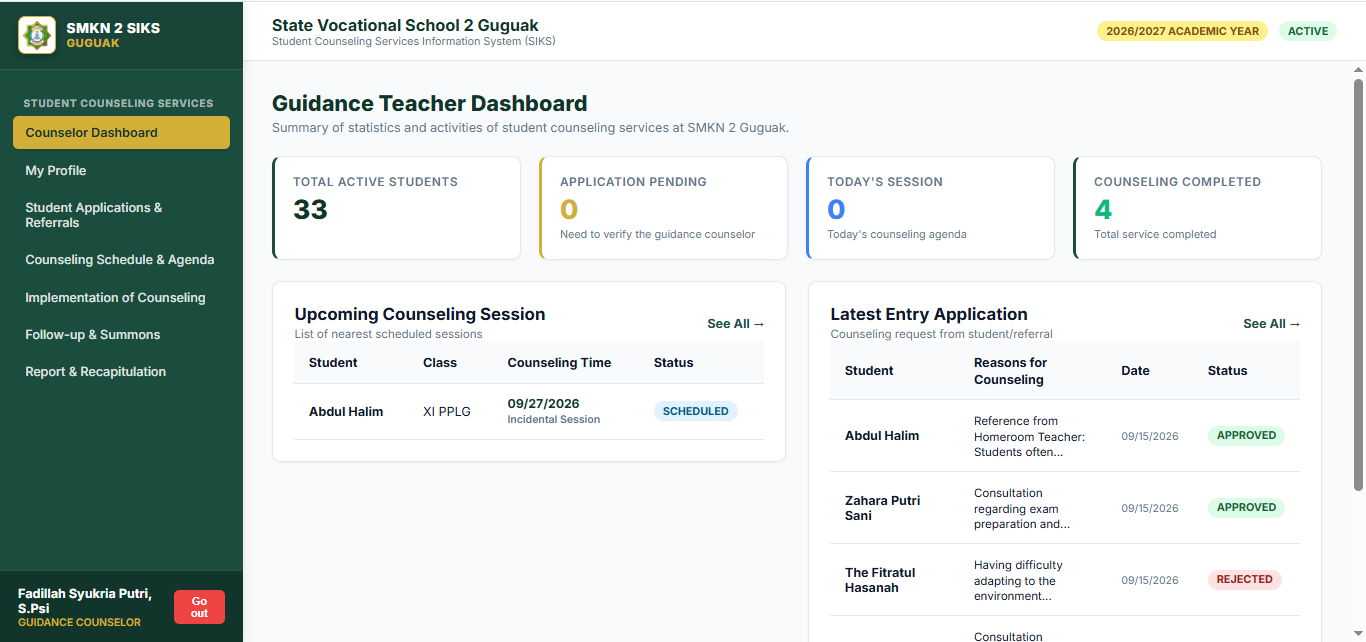
The Counselor dashboard serves as the operational center for case management (Figure 5). It summarizes active students, pending requests, sessions scheduled for the day, and completed sessions, while also providing direct access to upcoming sessions and recent requests. These dashboard counts describe recorded system activity rather than counseling outcomes; their purpose is to support case triage and continuity.
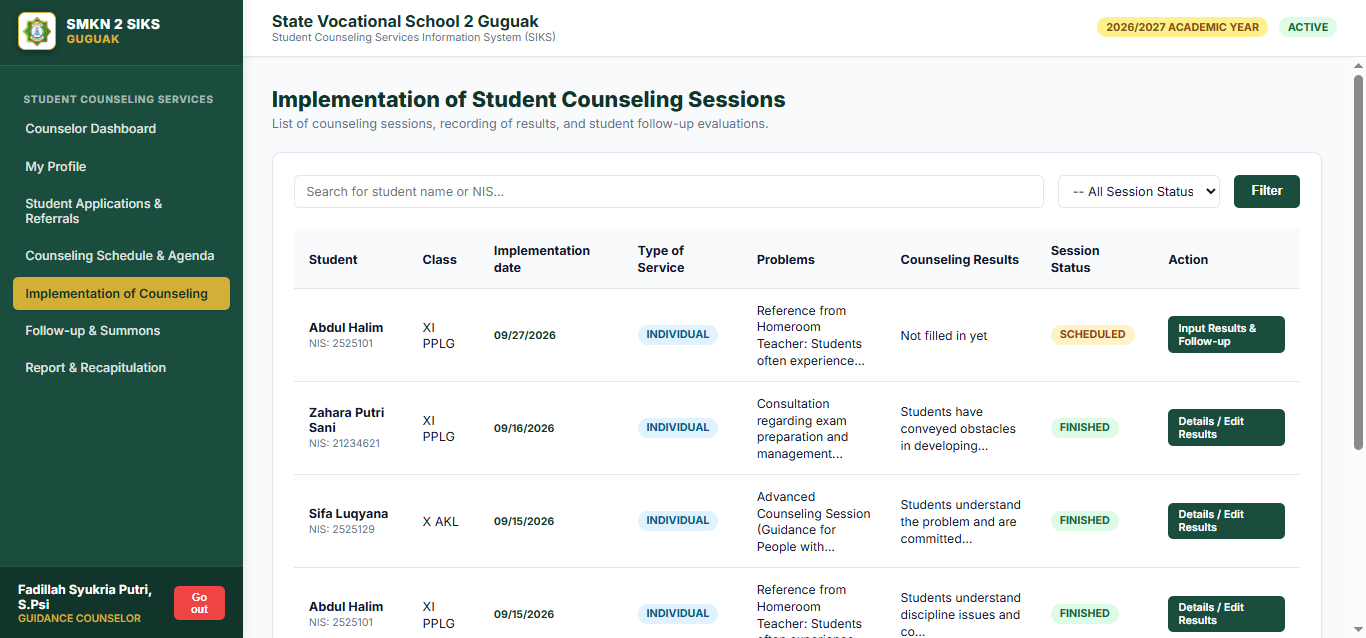
Counselors record and review counseling session histories on the counseling implementation page (Figure 6). The page links a session to the corresponding student, service type, presenting problem, counseling result, and follow-up status so that subsequent actions remain linked to the originating case instead of being stored separately.
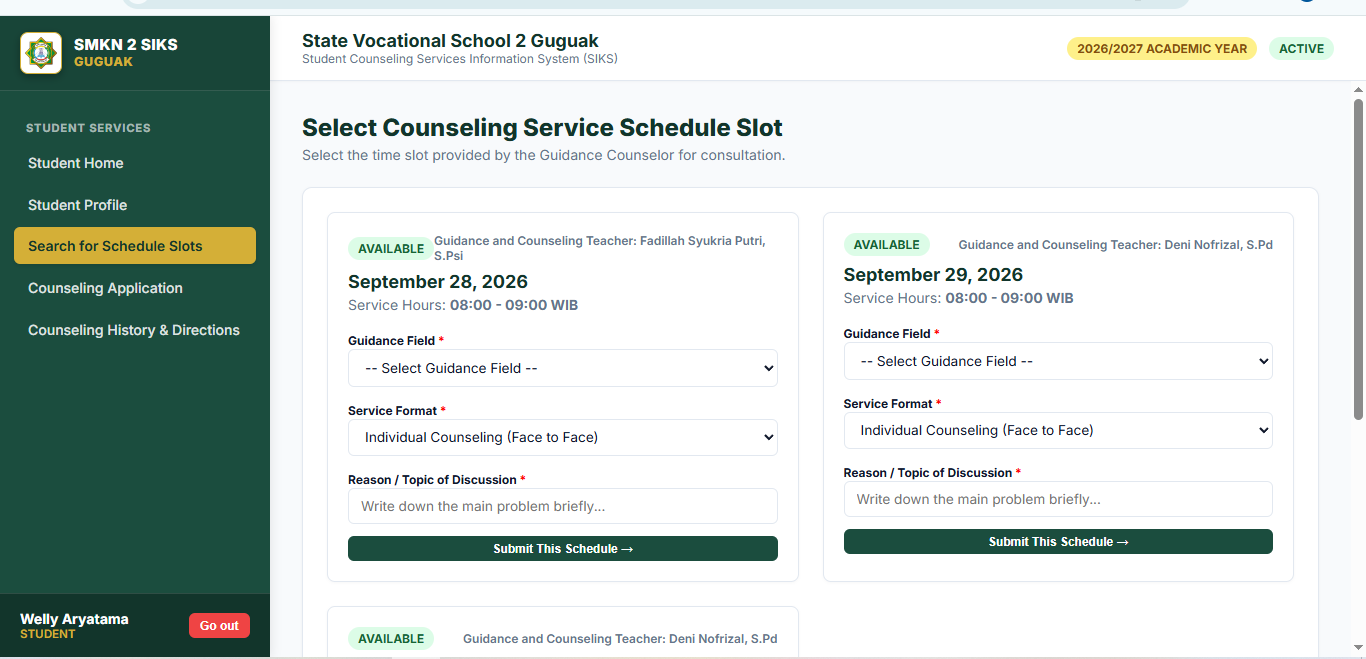
Students submit counseling requests and monitor their status through the scheduling page (Figure 7). For each request, the system displays the selected date and time, assigned counselor, service type, reason for the request, validation status, counselor feedback, and an option to cancel. This workflow offers a discreet digital request channel and separates request submission from counselor validation.
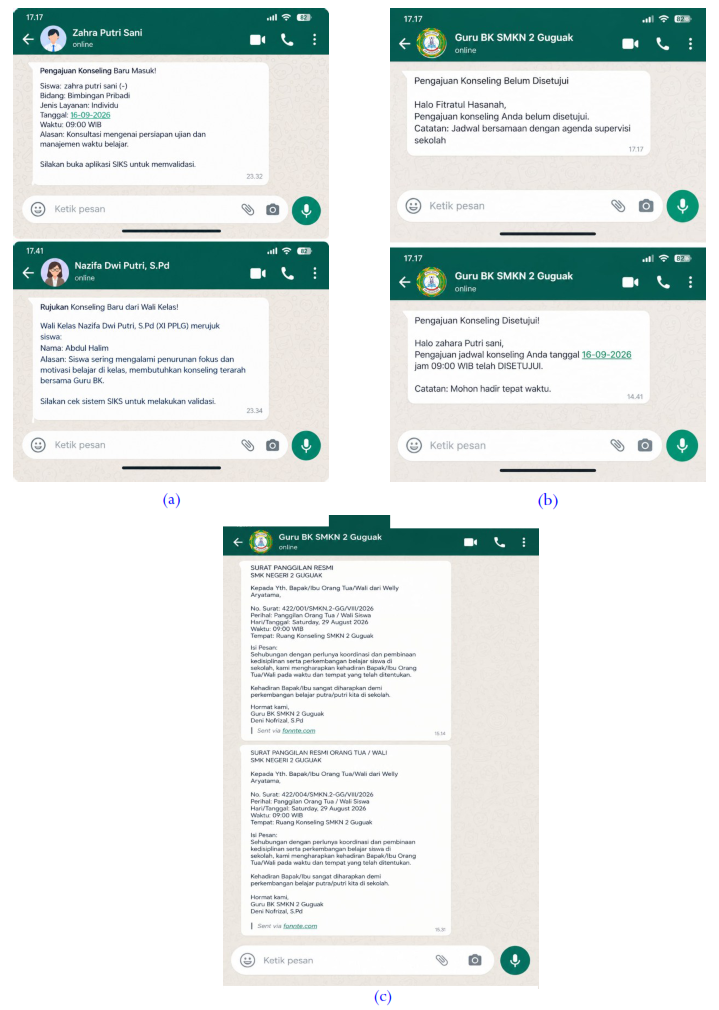
SiKS implements three event-triggered WhatsApp notifications (Figure 8): a new request or a referral from a homeroom teacher alerts the counselor; an approval or rejection is communicated to the student; and a follow-up summons can be sent directly to the student's parent or guardian. The prototype records notification events, linking communications to the corresponding case. Names, telephone numbers, and other identifying details shown in the interface figures are fictitious test data.
4.2. Functional Testing Results
Fifty black-box scenarios evaluated general authentication and the six role-specific modules [26]. The scenarios covered standard workflows and error cases for account access, master-data management, schedule availability, counseling request submission and validation, session recording, follow-up, generation of summons letters, report functions, and notification dispatch. Figure 9 summarizes the scenario count by module, and Appendix Table A1 provides the complete scenario matrix.
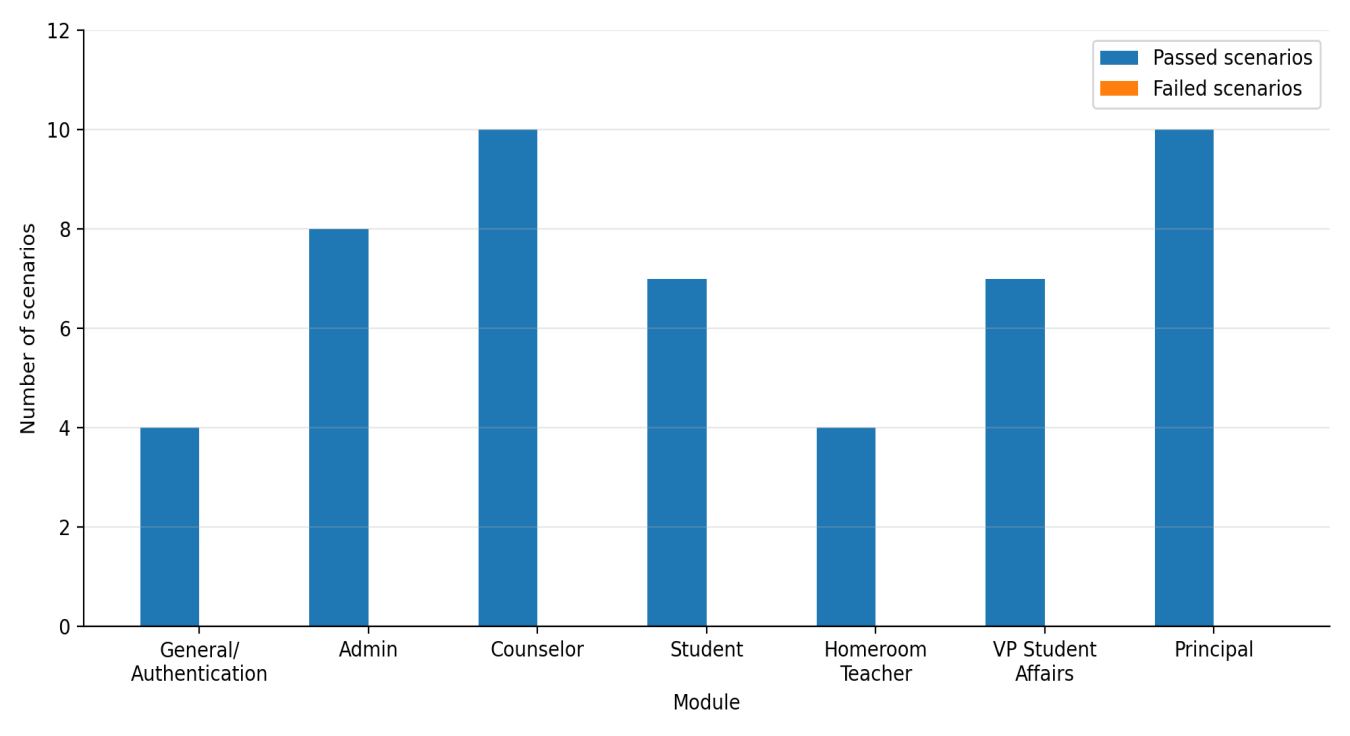
All 50 executed scenarios matched their specified expected outputs and were recorded as valid. This result supports functional conformance for the executed requirements, including the notification pathway used in the test environment. These findings apply only to the scenarios executed; independent security and penetration testing, stress testing, and long-term reliability testing were outside the present evaluation.
4.3. User Acceptance Testing Results
4.3.1. Instrument Validation
Three validators reviewed the 15-item UAT instrument. Their respective scores were 70, 71, and 70 out of 75 points each, for a combined score of 211 out of 225 (93.78%). The study's scoring rubric classified this result as Very Valid. Appendix Tables B1 and B2 provide the item-level ratings and validator summary, and requested revisions were incorporated before administration. As an expert-rating exercise, the 93.78% value reflects a favorable assessment before administration and is not a psychometric coefficient of construct validity, reliability, or measurement invariance.
4.3.2. User Acceptance Results
After the guided walkthrough, 20 respondents completed the reviewed questionnaire. Among the 300 item responses, 149 were Strongly Agree, 138 Agree, and 13 Somewhat Agree; none were rated Disagree or Strongly Disagree. The total score was 1,336 out of 1,500 (89.07%), classified as Very Feasible. Item-level feasibility ranged from 82% to 96% (Appendix Tables C1 and C2). The highest scores were for interface attractiveness (96%), suitability for school use (94%), ease of menu and feature access (93%), and the item concerning access-based security and confidentiality (92%). Relatively lower scores concerned printing and downloading functions (82%), clarity of summaries and reports (84%), automated notification services (86%), and perceived advantages over other methods or applications (86%). These responses indicate favorable initial acceptance while identifying functions that warrant refinement.
5. Discussion
5.1. Integrated Case Continuity and Role-Based Confidentiality
SiKS chiefly contributes an explicit connection among counseling activities that were previously fragmented. A request initiates a connected sequence of validation, scheduling, session recording, follow-up, summons, and notification history. This architecture addresses the gap identified in the local workflow and clarifies the difference between storing records and preserving the progression of a case. Earlier counseling systems demonstrate useful components such as counseling data management, scheduling, reporting, violation handling, or complaint management [13], [14], [15], [16], [17], [18], but the present design makes the interdependence among those stages visible in one case structure. Operationally, recapitulation and follow-up can be derived from connected records instead of reconstructed from recollection or disconnected documents.
The role-based access model combines a private student request channel with differentiated permissions, in line with counseling principles and evidence indicating that privacy, trust, and low-friction access can shape young people's engagement with digital support [1], [2], [3]. Role-based authorization is likewise an established mechanism for limiting access to sensitive information systems [11]. Appendix Table A1 (BB-45) shows one important exception: the implemented Principal role can open detailed counseling-session information. The current configuration therefore does not satisfy least-privilege access for counseling-session details and must be corrected before production deployment. The 92% UAT rating for access-based security and confidentiality reflects favorable user perception after guided exposure, although independent security validation is still needed. Stigma reduction, help-seeking behavior, and willingness to disclose concerns were not measured.
5.2. Notifications as Workflow Infrastructure
The WhatsApp workflow addresses a specific weakness in the previous process: a paper summons given to a student for delivery could be delayed or never reach the parent. In the prototype, a status change can trigger a direct message and create a notification record linked to the case. Evidence from healthcare indicates that electronic text notifications can improve appointment attendance [12]. School-based systems have used WhatsApp for attendance communication [23], while other implementations demonstrate automated notification [24] and OTP-based authentication [25]. Because these settings differ from school counseling, this study evaluated the notification pathway as part of the workflow infrastructure. Message generation and gateway dispatch were verified in the test workflow; confirmed receipt, parental responses, appointment attendance, time to follow-up, and counseling completion remain to be evaluated. The evidence therefore supports an implemented mechanism for traceable communication and fewer manual handoffs, not confirmed message receipt.
This distinction also has governance implications. Counseling messages may contain sensitive contextual information, and the prototype relies on a third-party gateway. Safe operation would require minimizing message content, use a dedicated institutional sender, retain only necessary delivery metadata, maintain role-restricted access to case details, and provide a manual fallback when automated delivery fails. Future evaluation should test delivery reliability and privacy controls directly instead of inferring security from successful functional execution.
5.3. What the Functional and UAT Results Establish
The 50/50 functional-test result and the 89.07% UAT score describe different aspects of the prototype. Black-box testing establishes conformance of the executed requirements, whereas UAT captures users' assessments after a guided walkthrough. Together, these findings provide formative evidence of functional conformance and favorable initial acceptance. Unaided learnability, routine adoption, and effectiveness require separate evaluation. Proctor et al. distinguish acceptability and feasibility from adoption, fidelity, penetration, and sustainability [20], while CFIR emphasizes contextual determinants across the innovation, setting, and people involved [21].
Item-level results add detail to the overall percentage. Respondents rated interface attractiveness, school appropriateness, menu access, and perceived access-based confidentiality most favorably, suggesting that the basic interaction model was understandable and contextually plausible. Lower ratings for printing and downloading, report clarity, and notifications identify specific usability concerns that can be addressed without characterizing them as failures. In particular, an 82% score for printing and downloading remains within the study's Very Feasible category, but it signals that document-generation workflows deserve priority in the next design cycle. Similarly, the 86% notification score suggests that successful dispatch in functional testing did not translate into uniformly high user ratings, reinforcing the value of combining technical and user-centered evidence.
5.4. Practical Implications, Limitations, and Future Evaluation
For schools with similar counseling workflows, this design suggests a practical sequence: define the case lifecycle first; map each role to the minimum information required; connect every follow-up and communication event to the originating case; and then automate notifications and reporting. This sequence keeps the system centered on counseling continuity. Leadership dashboards should present aggregate information to support decisions, whereas session content should remain accessible only to those with a legitimate need. The item-level UAT findings further indicate that report readability and export functions should be refined before broader use because administrative value depends on both data collection and clear presentation.
Several limitations qualify these findings. The study was conducted at one vocational school, requirements were elicited from a small number of staff, functional testing was led by the development team, and UAT used a 20-person purposive sample after a guided walkthrough. The evaluation did not include unguided task-based usability testing, longitudinal adoption measures, comparison with the prior workflow, message-delivery and parent-response measures, independent security or penetration testing, stress testing, or direct counseling outcomes. Future multisite studies should pair independent functional and security testing with longitudinal usage logs, task-based usability measures, delivery and response metrics, and implementation outcomes such as adoption and sustainability [20], [21]. When systems are used by minors, future studies should document in advance the ethics and consent procedures required by the relevant institution and journal.
6. Conclusion
This study designed and formatively evaluated SiKS, an integrated web-based student counseling information system that links student requests, scheduling, session records, follow-up actions, parental summons, and automated WhatsApp notifications within a single case-centered workflow. All 50 requirement-derived black-box scenarios produced the expected outputs, and the 15-item UAT yielded 89.07% across 20 respondents, with item-level scores ranging from 82% to 96%. These findings support functional conformance for the executed scenarios and favorable initial acceptance at SMKN 2 Guguak. The main design contribution is a traceable case workflow connecting role-based access with event-triggered communication. The evidence is formative, reflecting developer-led testing at one school and a single UAT administration after a guided walkthrough. The Principal session-detail permission documented in BB-45 remains an access-control issue requiring resolution before production use. Future work should examine independent usability, least-privilege access, delivery reliability, privacy and security, longitudinal implementation, and counseling-service outcomes across broader school contexts.
Declarations
Informed Consent
Participation was voluntary, and all participants were informed of the purpose and procedures of the evaluation before taking part. The school-based evaluation was conducted with written authorization from SMKN 2 Guguak and approval from the Principal. Verbal informed consent was obtained from each participant. For student participants who were minors, written parental or guardian consent was obtained, along with the students’ voluntary agreement to participate. The evaluation used trial data only and did not involve real counseling records or identifiable sensitive case information. All names, telephone numbers, addresses, and other personal details shown in the manuscript figures are fictitious.
Generative AI and AI-Assisted Technologies Statement
During manuscript preparation and revision, the authors used generative AI tools, including ChatGPT, Claude, and Gemini, solely to edit language and improve clarity. These tools were not used to generate, fabricate, or modify empirical data, analyses, or reported results. The authors reviewed and verified all AI-assisted content against the original research records and cited sources. The authors retain full responsibility for the accuracy, integrity, and final content of the manuscript.
Preprint and Prior Dissemination
This article is derived from the first author's undergraduate thesis and is not under consideration for publication elsewhere.
Appendix A. Complete Black-Box Functional Test Matrix
Appendix A reports the 50 retained requirement-derived functional test scenarios used in the developer-led black-box evaluation. The matrix covers general authentication and all six role-specific modules. Expected results were defined from the implemented requirements, and each observed result was compared with its corresponding expectation. All scenarios were recorded as valid; the matrix documents conformance only for the executed scenarios and does not constitute independent security testing, stress testing, or an exhaustive search for defects.
Appendix Table A1. Complete black-box functional test matrix.
|
ID |
User role |
Test scenario |
Expected result |
Observed result |
Status |
|---|---|---|---|---|---|
|
BB-01 |
General |
Access the website's main page (landing page) |
The system displays the SiKS SMKN 2 Guguak homepage |
The landing page loaded successfully |
Valid |
|
BB-02 |
General |
Leave the login form blank and click the login button |
The system validates required fields on the login form |
Required-field validation prevented form submission |
Valid |
|
BB-03 |
General |
Log in with a valid username and incorrect password |
The system rejects the login and displays a credential error message |
An "invalid credentials" error message appears |
Valid |
|
BB-04 |
General |
Log in using an inactive account |
The system denies access and displays a rejection message |
An "inactive account access denied" message is displayed |
Valid |
|
BB-05 |
Admin |
Log in with valid Administrator credentials |
The system redirects the user to the Administrator Dashboard |
The Administrator Dashboard was successfully accessed |
Valid |
|
BB-06 |
Admin |
Access the User Management menu page |
The system displays a table listing all system user accounts |
The user management table was displayed correctly |
Valid |
|
BB-07 |
Admin |
Add a new user account with valid data |
The system saves the new account and displays a success notification |
The account was saved successfully with a success notification |
Valid |
|
BB-08 |
Admin |
Add a new user with a duplicate username |
The system rejects the duplication and displays a validation error message |
A "duplicate username" error message appears |
Valid |
|
BB-09 |
Admin |
Edit and reset a user account's password |
The system updates the password and displays a success notification |
The new password was saved successfully |
Valid |
|
BB-10 |
Admin |
Change a user account's active/inactive status |
The system updates the account status with a confirmation dialog |
The account status was updated successfully |
Valid |
|
BB-11 |
Admin |
Access the student data import page via Excel |
The system displays a template download link and a file upload form |
The import form and Excel template are ready to use |
Valid |
|
BB-12 |
Admin |
Test the WhatsApp Gateway connection |
The system sends a test message and displays a successful response status |
The WhatsApp delivery-response status was verified |
Valid |
|
BB-13 |
Counselor |
Log in using valid Counselor credentials |
The system redirects the user to the Counselor Dashboard |
The Counselor dashboard was accessed successfully |
Valid |
|
BB-14 |
Counselor |
Add a new counseling schedule availability slot |
The system saves the schedule slot and displays a success notification |
The counseling time slot was added successfully |
Valid |
|
BB-15 |
Counselor |
Access the counseling request and referral list page |
The system displays a queue table of student service requests |
The counseling request queue was displayed correctly |
Valid |
|
BB-16 |
Counselor |
Approve a student's counseling request in the queue |
The system approves the request and displays a success notification |
The request was approved successfully |
Valid |
|
BB-17 |
Counselor |
Reject a counseling request by entering a reason for rejection |
The system records the rejection reason and displays a success notification |
The request was rejected with the reason recorded |
Valid |
|
BB-18 |
Counselor |
Input the results of a student's counseling session |
The system saves the counseling results, attendance, and follow-up |
The counseling results were saved successfully |
Valid |
|
BB-19 |
Counselor |
Display a preview of the official summons letter |
The system displays a letter preview and a PDF download button |
The official summons letter preview was displayed correctly |
Valid |
|
BB-20 |
Counselor |
Download the summons letter file in PDF format |
The system processes and downloads the summons letter PDF file |
The PDF file was downloaded successfully |
Valid |
|
BB-21 |
Counselor |
Send a summons notification via WhatsApp |
The system sends a WhatsApp message to the parent and shows success |
The WhatsApp notification was sent successfully |
Valid |
|
BB-22 |
Counselor |
Print and export the counseling service report to Excel |
The system downloads the service report summary in Excel format |
The report was exported to Excel successfully |
Valid |
|
BB-23 |
Student |
Log in using valid Student credentials |
The system redirects the student to the student homepage/dashboard |
The student dashboard was accessed successfully |
Valid |
|
BB-24 |
Student |
Update profile information and a parent's contact number |
The system saves the profile changes and displays a success notification |
The profile and parent's contact number were updated successfully |
Valid |
|
BB-25 |
Student |
Search for available counseling schedule slots |
The system displays available counseling schedule slots provided by the Counselor |
The list of available counseling schedule slots is displayed |
Valid |
|
BB-26 |
Student |
Submit a counseling request while leaving the reason field blank |
The system rejects the submission and triggers required-field validation |
Required-field validation prevented submission of the incomplete form |
Valid |
|
BB-27 |
Student |
Submit a complete and valid counseling schedule request |
The system saves the request and displays a success message |
The counseling request was submitted successfully |
Valid |
|
BB-28 |
Student |
Cancel a counseling request in the "My Requests" menu |
The system changes the status to canceled and shows success |
The request was canceled successfully |
Valid |
|
BB-29 |
Student |
View counseling history and outcomes/guidance |
The system displays counseling history with a "completed" status |
The counseling history and results were displayed successfully |
Valid |
|
BB-30 |
Homeroom Teacher |
Log in using valid Homeroom Teacher credentials |
The system redirects the user to the Homeroom Teacher Dashboard |
The Homeroom Teacher Dashboard was successfully accessed |
Valid |
|
BB-31 |
Homeroom Teacher |
Access the class roster/student directory menu |
The system displays a table of homeroom student data and a search form |
The homeroom student directory was displayed correctly |
Valid |
|
BB-32 |
Homeroom Teacher |
Submit a counseling referral for a student in the homeroom class to the Counselor |
The system sends the referral and displays a success notification |
The student referral was sent to the Counselor successfully |
Valid |
|
BB-33 |
Homeroom Teacher |
Monitor the counseling status of a student in the homeroom class |
The system displays a monitoring table for handling status |
The handling status monitoring table displays properly |
Valid |
|
BB-34 |
Vice-Principal for Student Affairs |
Log in using valid Vice-Principal for Student Affairs credentials |
The system redirects to the Student Affairs Dashboard |
The Student Affairs Dashboard was successfully accessed |
Valid |
|
BB-35 |
Vice-Principal for Student Affairs |
Monitor student affairs statistical metrics and analytics charts |
The system displays total active students and monthly charts |
The student affairs analytics dashboard displays accurately |
Valid |
|
BB-36 |
Vice-Principal for Student Affairs |
Access the school's student directory with read-only access rights |
The system displays a student data table with a read-only label |
Read-only access was enforced, and the student data loaded successfully |
Valid |
|
BB-37 |
Vice-Principal for Student Affairs |
Search and filter student data in the directory |
The system filters the data table according to the search keyword |
The student data search and filter function worked as expected |
Valid |
|
BB-38 |
Vice-Principal for Student Affairs |
Access the student affairs service recap and report menu |
The system displays the recap page and filter options |
The report recap page was successfully accessed |
Valid |
|
BB-39 |
Vice-Principal for Student Affairs |
Download the report recap in PDF format |
The system processes and downloads the PDF report file |
The PDF recap was downloaded successfully |
Valid |
|
BB-40 |
Vice-Principal for Student Affairs |
Download the report recap in Excel format |
The system processes and downloads the Excel spreadsheet file |
The Excel recap was downloaded successfully |
Valid |
|
BB-41 |
Principal |
Log in using valid Principal credentials |
The system redirects to the Principal Dashboard |
The Principal Dashboard was successfully accessed |
Valid |
|
BB-42 |
Principal |
Monitor key performance indicators on the dashboard |
The system displays student reach metrics and completion ratios |
The KPI metrics were loaded correctly |
Valid |
|
BB-43 |
Principal |
Monitor the workload and performance evaluation of the counseling team |
The system displays a recap of the counselor team's performance effectiveness |
The counseling team’s performance evaluation was displayed successfully |
Valid |
|
BB-44 |
Principal |
Access the school counseling session monitoring menu |
The system displays a counseling session monitoring overview |
The counseling session monitoring menu opened successfully |
Valid |
|
BB-45 |
Principal |
View detailed information on a counseling session |
The system opens a detailed counseling information page |
The detailed counseling session information was displayed successfully |
Valid |
|
BB-46 |
Principal |
Access the school's student directory with read-only status |
The system displays the read-only executive student directory |
The school’s student directory was displayed correctly |
Valid |
|
BB-47 |
Principal |
Access the report and evaluation center |
The system displays the report center with filter options |
The report and evaluation center was successfully accessed |
Valid |
|
BB-48 |
Principal |
Print and download the report in PDF format |
The system downloads the official report in PDF format |
The PDF report download completed successfully |
Valid |
|
BB-49 |
Principal |
Export the report in Excel format |
The system downloads the report in Excel format |
The Excel report was downloaded successfully |
Valid |
|
BB-50 |
Principal |
Log out of the system |
The system ends the session and returns to the login page |
Logout was successful and the login form reappeared |
Valid |
Appendix B. UAT Instrument Validation
Before user acceptance testing, three validators reviewed the 15-item UAT questionnaire. The instrument comprises four design items, six service items, and five efficiency items. Validators used a five-point scale. The combined validator score was 211 out of 225 (93.78%) and was classified as Very Valid. Tables B1 and B2 preserve the item-level ratings and validator summary used in the study.
Appendix Table B1. Item-level UAT instrument validation ratings.
|
No. |
Aspect |
Statement |
Validator 1 |
Validator 2 |
Validator 3 |
|---|---|---|---|---|---|
|
1 |
Design |
Interface (visual appearance) is attractive |
5 |
5 |
5 |
|
2 |
Design |
Menus/features are easy to understand and access |
5 |
5 |
5 |
|
3 |
Design |
Color combination and background are comfortable to view |
5 |
5 |
5 |
|
4 |
Design |
Font style and size are easy to read |
5 |
5 |
5 |
|
5 |
Service |
Simplifies submitting and managing counseling schedules |
4 |
5 |
5 |
|
6 |
Service |
Counseling record, follow-up, and referral features function well |
5 |
5 |
5 |
|
7 |
Service |
WhatsApp notification integration is automatic and prompt |
4 |
5 |
5 |
|
8 |
Service |
Can accurately print/download reports and letters |
5 |
5 |
5 |
|
9 |
Service |
Maintains data security and confidentiality per access rights |
4 |
4 |
4 |
|
10 |
Service |
Overall service is satisfactory |
5 |
5 |
5 |
|
11 |
Efficiency |
System use is appropriate and effective |
5 |
4 |
4 |
|
12 |
Efficiency |
More time-efficient than the manual method |
4 |
4 |
4 |
|
13 |
Efficiency |
Reduces processing workload and operational costs |
5 |
5 |
4 |
|
14 |
Efficiency |
Makes it easier for users to understand reports |
4 |
5 |
4 |
|
15 |
Efficiency |
Has advantages over other methods/applications |
5 |
4 |
5 |
|
Total |
70 |
71 |
70 |
Appendix Table B2. Validator score summary and overall instrument validity.
|
No. |
Validator |
Score |
Maximum |
Percentage (%) |
|---|---|---|---|---|
|
1 |
Validator 1 |
70 |
75 |
93.33 |
|
2 |
Validator 2 |
71 |
75 |
94.67 |
|
3 |
Validator 3 |
70 |
75 |
93.33 |
|
Combined |
211 |
225 |
93.78 |
Combined validity: 211/225 = 93.78% (Very Valid).
Appendix C. User Acceptance Test Results
UAT involved 20 respondents: one Principal, one Administrator, one Vice-Principal for Student Affairs, two Guidance Counselors, two Homeroom Teachers, and 13 Students. Each respondent rated 15 statements on a five-point scale (5 = Strongly Agree, 4 = Agree, 3 = Somewhat Agree, 2 = Disagree, 1 = Strongly Disagree). To improve readability in the portrait layout, response distributions and item-level feasibility scores are reported in separate tables while preserving the same dataset.
Appendix Table C1. Item-level UAT response distribution.
|
No. |
Aspect |
Statement |
SA |
A |
SWA |
D |
SD |
|---|---|---|---|---|---|---|---|
|
1 |
Design |
The system interface is attractive. |
16 |
4 |
0 |
0 |
0 |
|
2 |
Design |
Menus and features are easy to access. |
13 |
7 |
0 |
0 |
0 |
|
3 |
Design |
Text color and background are comfortable to view. |
8 |
11 |
1 |
0 |
0 |
|
4 |
Design |
Font style and size are easy to read on mobile and computer devices. |
9 |
11 |
0 |
0 |
0 |
|
5 |
Service |
The system simplifies counseling schedule and availability submission. |
12 |
6 |
2 |
0 |
0 |
|
6 |
Service |
Counseling records, follow-up, and referral functions support the service process. |
11 |
8 |
1 |
0 |
0 |
|
7 |
Service |
WhatsApp notifications are delivered automatically and promptly within the tested workflow. |
8 |
10 |
2 |
0 |
0 |
|
8 |
Service |
The system supports printing or downloading relevant summons and reports. |
5 |
12 |
3 |
0 |
0 |
|
9 |
Service |
Access rights support the security and confidentiality expected for counseling data. |
12 |
8 |
0 |
0 |
0 |
|
10 |
Service |
Overall system services are satisfactory. |
11 |
9 |
0 |
0 |
0 |
|
11 |
Efficiency |
The system is appropriate and effective for use at the school. |
14 |
6 |
0 |
0 |
0 |
|
12 |
Efficiency |
The system is more time-efficient than the prior manual process. |
9 |
10 |
1 |
0 |
0 |
|
13 |
Efficiency |
The system can reduce workload and related administrative effort. |
9 |
10 |
1 |
0 |
0 |
|
14 |
Efficiency |
Recapitulation and reports are easier to understand through the system. |
5 |
14 |
1 |
0 |
0 |
|
15 |
Efficiency |
The system offers advantages over the previous method or comparable applications. |
7 |
12 |
1 |
0 |
0 |
|
Total |
149 |
138 |
13 |
0 |
0 |
Abbreviations: SA = Strongly Agree; A = Agree; SWA = Somewhat Agree; D = Disagree; SD = Strongly Disagree.
Appendix Table C2. Item-level UAT feasibility scores.
|
No. |
Obtained score |
Maximum score |
Percentage (%) |
Category |
|---|---|---|---|---|
|
1 |
96 |
100 |
96.00 |
Very Feasible |
|
2 |
93 |
100 |
93.00 |
Very Feasible |
|
3 |
87 |
100 |
87.00 |
Very Feasible |
|
4 |
89 |
100 |
89.00 |
Very Feasible |
|
5 |
90 |
100 |
90.00 |
Very Feasible |
|
6 |
90 |
100 |
90.00 |
Very Feasible |
|
7 |
86 |
100 |
86.00 |
Very Feasible |
|
8 |
82 |
100 |
82.00 |
Very Feasible |
|
9 |
92 |
100 |
92.00 |
Very Feasible |
|
10 |
91 |
100 |
91.00 |
Very Feasible |
|
11 |
94 |
100 |
94.00 |
Very Feasible |
|
12 |
88 |
100 |
88.00 |
Very Feasible |
|
13 |
88 |
100 |
88.00 |
Very Feasible |
|
14 |
84 |
100 |
84.00 |
Very Feasible |
|
15 |
86 |
100 |
86.00 |
Very Feasible |
|
Total |
1336 |
1500 |
89.07 |
Very Feasible |
Overall feasibility: 1,336 / 1,500 × 100 = 89.07% (Very Feasible). Item-level feasibility ranged from 82% to 96%.
Author Contributions
Welly Aryatama: Conceptualization; Methodology; Software; Investigation; Data Curation; Writing – Original Draft. Syukhri: Conceptualization; Supervision; Validation; Writing – Review & Editing. Khairi Budayawan: Validation; Writing – review & editing. Delvi Asmara: Validation; Writing – review & editing. Dean Collin Langeveldt: Writing – review & editing. All authors have read and approved the final version of the manuscript.
Acknowledgments
The authors thank the staff of SMKN 2 Guguak, Ampang Gadang, Guguak District, Lima Puluh Kota Regency, West Sumatra, for their cooperation during the system requirements analysis and for providing information about the school's operational context. The authors are also grateful to the Department of Informatics Engineering Education, Universitas Negeri Padang, for the academic support provided throughout this research.
Ethical Approval
This study was conducted as an undergraduate software development and formative usability project at SMKN 2 Guguak with formal authorization from the school and the Principal's approval. The study involved no clinical or therapeutic intervention and used trial data only, and did not access or process real student counseling records or identifiable sensitive case information.
Funding
This research received no specific grant from any funding agency in the public, commercial, or not-for-profit sectors. It was conducted as part of the first author's undergraduate thesis at Universitas Negeri Padang.
Data Availability Statement
Aggregated functional-testing and UAT results are reported in the manuscript and appendices. Additional de-identified supporting records may be available from the corresponding author upon reasonable request, subject to institutional and confidentiality requirements.
Competing Interests
The authors declare that there are no competing interests related to this article.
References
- T. Q. A. Ho et al., “Barriers to and facilitators of user engagement with web-based mental health interventions in young people: A systematic review,” Eur. Child Adolesc. Psychiatry, vol. 34, no. 1, pp. 83–100, 2025, doi: 10.1007/s00787-024-02386-x.
- S. Liverpool et al., “Updates on digital mental health interventions for children and young people: Systematic overview of reviews,” Eur. Child Adolesc. Psychiatry, vol. 34, no. 10, pp. 2961–2974, 2025, doi: 10.1007/s00787-025-02722-9.
- M. Wright, F. Reitegger, H. Cela, A. Papst, and B. Gasteiger-Klicpera, “Interventions with digital tools for mental health promotion among 11–18 year olds: A systematic review and meta-analysis,” J. Youth Adolesc., vol. 52, no. 4, pp. 754–779, 2023, doi: 10.1007/s10964-023-01735-4.
- Republic of Indonesia, “Undang-Undang Republik Indonesia Nomor 20 Tahun 2003 tentang Sistem Pendidikan Nasional,” Lembaran Negara Republik Indonesia Tahun 2003 Nomor 78, Tambahan Lembaran Negara Republik Indonesia Nomor 4301, Jul. 8, 2003.
- S. Siraj, S. Nasrah, and T. Trisfayani, “The system approach in the perspective of Law Number 20 of 2003 concerning the National Education System,” Int. J. Educ. Vocat. Stud., vol. 1, no. 1, pp. 47–52, 2019, doi: 10.29103/ijevs.v1i1.1465.
- R. Muhammad and Patriana, “Analisis implementasi Permendikbud Nomor 111 Tahun 2014 tentang bimbingan dan konseling,” J. Ilm. Edukatif, vol. 7, no. 1, pp. 53–65, 2021, doi: 10.37567/jie.v7i1.518.
- D. Parveen and S. Akhtar, “The role of guidance and counselling in schools: A literature review,” Int. J. Indian Psychol., vol. 11, no. 2, pp. 558–568, 2023, doi: 10.25215/1102.058.
- N. Daulay, S. T. Sumanti, F. Faisal, and M. F. S. Siregar, “The urgence of counseling guidance in developing student discipline in junior high school Muhammadiyah Tebing Tinggi,” KONSELI: J. Bimbingan dan Konseling (E-Journal), vol. 8, no. 2, pp. 251–256, 2021, doi: 10.24042/kons.v8i2.10424.
- E. Ahyani and E. M. Dhuhani, “Transformasi digital dalam manajemen perkantoran pendidikan: Sebuah kajian literatur,” J. Visionary: Penelit. dan Pengemb. dibidang Adm. Pendidik., vol. 12, no. 1, pp. 205–215, 2024, doi: 10.33394/vis.v12i1.10785.
- W. H. DeLone and E. R. McLean, “The DeLone and McLean model of information systems success: A ten-year update,” J. Manag. Inf. Syst., vol. 19, no. 4, pp. 9–30, 2003, doi: 10.1080/07421222.2003.11045748.
- M. A. de Carvalho Junior and P. Bandiera-Paiva, “Health information system role-based access control current security trends and challenges,” J. Healthc. Eng., vol. 2018, Art. no. 6510249, 2018, doi: 10.1155/2018/6510249.
- D. Robotham, S. Satkunanathan, J. Reynolds, D. Stahl, and T. Wykes, “Using digital notifications to improve attendance in clinic: Systematic review and meta-analysis,” BMJ Open, vol. 6, no. 10, Art. no. e012116, 2016, doi: 10.1136/bmjopen-2016-012116.
- W. Atika, Susanti, and A. B. Permadi, “Perancangan sistem informasi e-konseling berbasis web pada SMKs Siti Banun Sumatera Utara,” Indonesian J. Informatic Res. Softw. Eng. (IJIRSE), vol. 2, no. 2, pp. 147–158, 2022, doi: 10.57152/ijirse.v2i2.433.
- V. Marisa, S. A. Wijaya, and N. Tsabitah, “Penerapan model prototype rancang bangun sistem bimbingan konseling berbasis web pada SMK Muhammadiyah 3 Pekanbaru,” J. Ilmu Komput. dan Sist. Inf. (JIKOMSI), vol. 7, no. 1, pp. 254–263, 2024, doi: 10.55338/jikomsi.v7i1.2925.
- N. M. N. F. Yanti, A. A. I. I. Paramitha, and E. G. A. Dewi, “Rancang bangun sistem informasi bimbingan konseling pada SMA Negeri 1 Baturiti dengan metode Waterfall,” Kumpul. Artik. Mhs. Pendidik. Tek. Inform., vol. 13, no. 3, pp. 117–128, 2024, doi: 10.23887/karmapati.v13i3.87662.
- H. Wulandari and G. Farell, “Rancang bangun sistem informasi poin pelanggaran siswa berbasis web di SMK Negeri 1 Painan,” ELEKTIF J. Elektron. Inform., vol. 2, no. 2, pp. 126–140, 2024, doi: 10.24036/elektif.v2i2.62.
- E. Mariati, C. C. Scorpiono, and Kristanto, “Perancangan sistem informasi bimbingan konseling untuk SMK Santa Monika Sungai Raya,” TECHBUS (Technology, Business and Entrepreneurship), vol. 3, no. 1, pp. 19–30, 2025, doi: 10.61245/techbus.v3i1.48.
- H. J. S. Putranto and J. J. C. Tambotoh, “Perancangan sistem informasi layanan pengaduan dan konseling siswa Teman Konseling berbasis web,” Jutisi J. Ilm. Tek. Inform. dan Sist. Inf., vol. 14, no. 2, pp. 1290–1303, 2025, doi: 10.35889/jutisi.v14i2.2980.
- Ruspisah and C. E. Suharyanto, “Implementasi sistem informasi pendataan siswa berbasis web dengan fitur dynamic reporting dan auto-grouping kelas di Sekolah Globe National Plus 2 Batam,” J. Teknol. Digit. dan Sist. Inf., vol. 3, no. 1, pp. 84–92, 2026, doi: 10.47024/jutekdisi.v3i1.1329.
- E. Proctor et al., “Outcomes for implementation research: Conceptual distinctions, measurement challenges, and research agenda,” Adm. Policy Ment. Health, vol. 38, pp. 65–76, 2011, doi: 10.1007/s10488-010-0319-7.
- L. J. Damschroder, C. M. Reardon, M. A. O. Widerquist, and J. Lowery, “The updated Consolidated Framework for Implementation Research based on user feedback,” Implement. Sci., vol. 17, Art. no. 75, 2022, doi: 10.1186/s13012-022-01245-0.
- F. T. Zany, A. Sujud, and J. Nurgaza, “Pengembangan sistem manajemen WhatsApp API (Application Programming Interface) dengan menggunakan WhatsApp-Web.js,” J. Informatics Comput. Sci., vol. 10, no. 2, pp. 140–153, 2024, doi: 10.33143/jics.v10i2.4761.
- S. Aprilia, “Sistem informasi absensi berbasis website menggunakan API WhatsApp dengan metodologi incremental (Studi kasus: SMP Negeri 29 Pekanbaru),” J. Appl. Informatics Comput., vol. 4, no. 1, pp. 38–44, 2020, doi: 10.30871/jaic.v4i1.1966.
- S. V. Yulianto, L. D. Setia, and A. P. Atmaja, “The use of WhatsApp Gateway for automatic notification system,” J. Phys.: Conf. Ser., vol. 1845, no. 1, Art. no. 012014, 2021, doi: 10.1088/1742-6596/1845/1/012014.
- A. B. Nasution, A. Y. N. Hrp, Y. Yudi, and M. Fauzi, “Implementation of OTP code as application login verification via Whatsapp,” Indonesian J. Appl. Ind. Sci. (ESA), vol. 3, no. 4, pp. 395–402, 2024, doi: 10.55927/esa.v3i4.10225.
- Uminingsih, M. N. Ichsanudin, M. Yusuf, and Suraya, “Pengujian fungsional perangkat lunak sistem informasi perpustakaan dengan metode Black Box Testing bagi pemula,” STORAGE J. Ilm. Tek. dan Ilmu Komput., vol. 1, no. 2, pp. 1–8, 2022, doi: 10.55123/storage.v1i2.270.
- A. Wibowo and I. Darwati, “Perancangan sistem informasi pengelolaan sarana dan prasarana dengan pengujian User Acceptance Testing,” Reputasi: J. Rekayasa Perangkat Lunak, vol. 3, no. 1, pp. 1–6, 2022, doi: 10.31294/reputasi.v3i1.1200.
- W. Harjono and K. J. Tute, “Perancangan sistem informasi perpustakaan berbasis web menggunakan metode Waterfall,” SATESI J. Sains Teknol. dan Sist. Inf., vol. 2, no. 1, pp. 47–51, 2022, doi: 10.54259/satesi.v2i1.773.
- M. Demba, “Algorithm for relational database normalization up to 3NF,” Int. J. Database Manag. Syst., vol. 5, no. 3, pp. 39–51, 2013, doi: 10.5121/ijdms.2013.5303.
- M. Hardini, V. Agarwal, D. Apriani, I. A. Widjaya, E. Setiawaty, and Nurasiah, “Application of database normalization in increasing data storage efficiency,” Int. Trans. Artif. Intell. (ITALIC), vol. 3, no. 2, pp. 201–211, 2025, doi: 10.33050/italic.v3i2.799.
- K. ’Afiifah, Z. F. Azzahra, and A. D. Anggoro, “Analisis teknik Entity-Relationship Diagram dalam perancangan database: Sebuah literature review,” INTECH, vol. 3, no. 2, pp. 70–74, 2022, doi: 10.54895/intech.v3i2.1682.
- M. Sumiati, R. Abdillah, and A. Cahyo, “Pemodelan UML untuk sistem informasi persewaan alat pesta,” J. FASILKOM, vol. 11, no. 2, pp. 79–86, 2021, doi: 10.37859/jf.v11i2.2673.
- M. R. Wayahdi and F. Ruziq, “Pemodelan sistem penerimaan anggota baru dengan Unified Modeling Language (UML) (Studi kasus: Programmer Association of Battuta),” J. Minfo Polgan, vol. 12, no. 1, pp. 1514–1521, 2023, doi: 10.33395/jmp.v12i1.12870.
Author Biographies

Welly Aryatama is an undergraduate student in the Informatics Engineering Education program, Department of Electronics Engineering, Faculty of Engineering, Universitas Negeri Padang (UNP), Indonesia. His research interests include information systems, web-based application development, educational technology, and digital notification systems.
mailto:welliaryatama@gmail.com https://orcid.org/0009-0006-7531-5295


Syukhri is a lecturer and researcher in the Department of Electronics Engineering, Faculty of Engineering, Universitas Negeri Padang (UNP), Indonesia. His research interests include information technology management, cybersecurity, computer networks, web-based systems, educational technology, and information systems development in vocational and engineering education.
mailto:syukhri@unp.ac.id https://www.scopus.com/authid/detail.uri?authorId=57216220766 https://orcid.org/0000-0002-3393-7364



Khairi Budayawan is a lecturer and researcher in the Department of Electronics Engineering, Faculty of Engineering, Universitas Negeri Padang (UNP), Indonesia. He serves as head of the Informatics Engineering Education study program. His research interests include artificial intelligence, machine learning, educational data analytics, electronic systems, and technology-enhanced learning.
mailto:khairi@ft.unp.ac.id https://www.scopus.com/authid/detail.uri?authorId=55193623100 https://orcid.org/0000-0002-2028-2266



Delvi Asmara is a lecturer and researcher in the Department of Electronics Engineering, Faculty of Engineering, Universitas Negeri Padang (UNP), Indonesia. His research interests include information systems, cybersecurity, interactive learning media, vocational education, and database systems.
mailto:delviasmara@ft.unp.ac.id https://www.scopus.com/authid/detail.uri?authorId=57340260900 https://orcid.org/0009-0009-5602-7855



Dean Collin Langeveldt is a Senior Lecturer in the Faculty of Education at Sol Plaatje University, Kimberley, South Africa. His research focuses on educational leadership and management, artificial intelligence in education, educational law, and decolonial approaches to knowledge in African educational contexts. He coordinates the Advanced Diploma in School Leadership and Management, serves as an external examiner at several South African universities, and supervises master's and doctoral candidates. His current work includes a monograph on technology integration in rural South African schools and a co-edited volume on artificial intelligence and education in sub-Saharan Africa.
mailto:delviasmara@ft.unp.ac.id https://www.scopus.com/authid/detail.uri?authorId=57340260900 https://orcid.org/0009-0009-5602-7855


Publisher’s and Journal’s Note
Sagamedia Teknologi Nusantara, as the publisher of the Journal of Hypermedia & Technology-Enhanced Learning (J-HyTEL), upholds the highest ethical standards in academic publishing. The journal remains neutral with regard to jurisdictional claims in published maps or institutional affiliations. Authors are fully responsible for the originality, accuracy, and integrity of their work. Post-publication ethical concerns will be addressed through corrections, clarifications, or retractions as necessary. The content of this publication has not been approved by the United Nations and does not reflect the views of the United Nations or its officials or Member States. https://www.un.org/sustainabledevelopment
Copyright & License

© 2026 Welly Aryatama, Syukhri, Khairi Budayawan, Delvi Asmara, Dean Collin Langeveldt. Authors retain copyright.
This article is licensed under a Creative Commons Attribution 4.0 International License, which permits use, sharing, adaptation, distribution, and reproduction in any medium or format, provided that appropriate credit is given to the original author(s) and the source, a link to the Creative Commons license is provided, and any modifications are indicated. Unless otherwise specified in a credit line, this article’s images or other third-party material are included under the Creative Commons license. If certain material is not covered by the article’s Creative Commons license and its intended use is not permitted by statutory regulation or exceeds the allowed usage, permission must be obtained directly from the copyright holder. http://creativecommons.org/licenses/by/4.0/.
Read the licence terms