

Sustainable Development Goals
This article contributes to the following United Nations Sustainable Development Goals.
关键词
引用方式




出版物概览

下一期
J-HyTEL welcomes original and rigorous scholarship advancing education, media technology, and computer science applications.
Rolling submissions are accepted throughout the year.
摘要
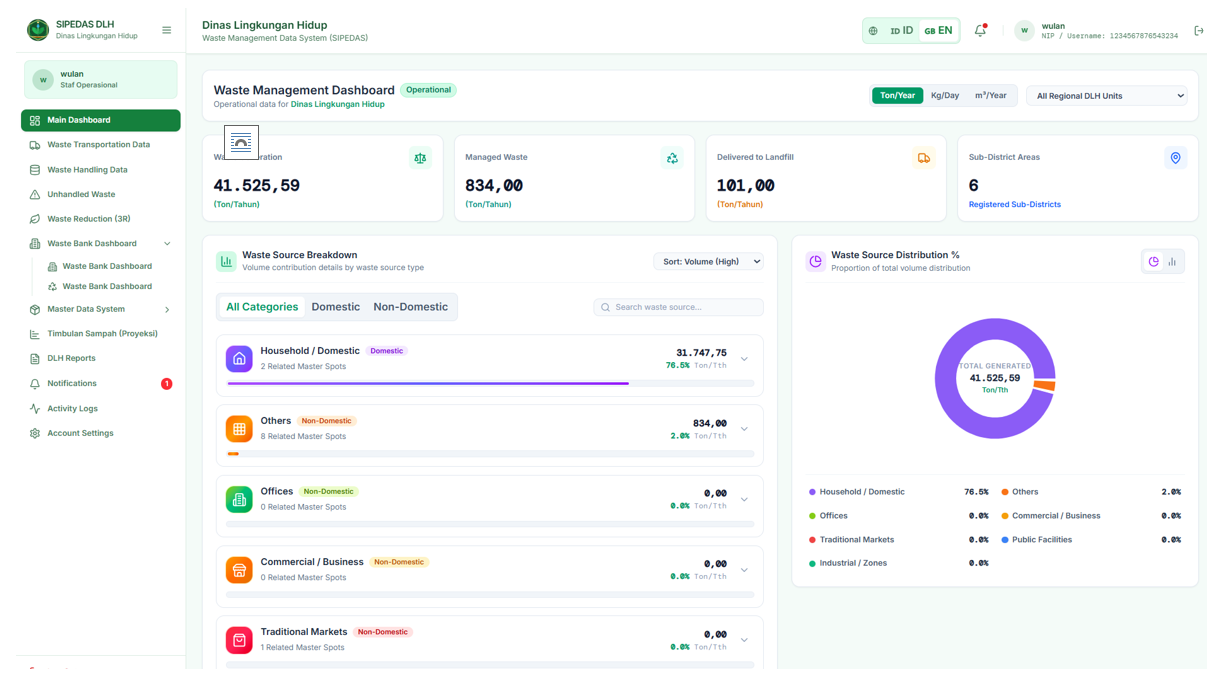
许多地方政府在城市垃圾管理方面,往往受到记录分散、报告流程脱节以及跨组织单位可追溯性有限的制约。本研究探讨了如何将分散的行政流程整合到一个集中化、基于角色管理且可审计的数字工作流中,并评估了其功能性和感知可用性。 本研究在印度尼西亚帕当帕里亚曼县环境办公室开展了一项单一地点的设计与评估案例研究,涉及17个分区的垃圾管理活动。 SIPEDAS 通过 Laravel RESTful API、React/TypeScript 界面以及集中式 MySQL 数据库,整合了运营记录、主数据、报告、基于角色的访问控制和活动日志。 评估将25个基于需求设计的“黑盒”测试场景与系统可用性量表(SUS)相结合。所有25个已执行的功能测试场景均满足预先定义的验收标准。 10份完整的参与者级SUS记录得出的平均分为68.25(标准差=11.37;中位数=71.25;范围=50–80),接近广为引用的基准值,但参与者之间存在显著差异。 需求收集、测试人员独立性及 SUS 实施方面的记录不完整,限制了研究结果的可重复性,也限制了对受试者之间差异的解读。 研究结果支持将SIPEDAS作为可追溯废弃数据管理的功能基础,但并未证明其不存在缺陷、能提升组织效率,或具备经过验证的安全性、可靠性和性能。其主要贡献在于提出了一种将需求与评估证据相联系的方法,该方法能够区分已实施的控制措施、已执行的功能符合性、感知可用性、实际使用情况以及组织成果。
RIS is compatible with Zotero, Mendeley, and EndNote. Immediate opening depends on the visitor's browser and reference-manager settings.
已发表文章中报告的声明
Author Contributions
Wulan Ainiyyah Puteri: Conceptualization; Methodology; Software; Investigation; Writing – Original Draft. Syafrijon: Data Curation; Writing – Review & Editing; Supervision. All authors have read and approved the final version of the manuscript.
Acknowledgments
The authors would like to thank the management and operational staff of the Environmental Office (Dinas Lingkungan Hidup) of Padang Pariaman Regency, West Sumatra, for their cooperation and provision of operational context, as well as the Department of Electronics Engineering, Universitas Negeri Padang, for their academic support.
View statement in PDF · PDF page 16资助
This research received no specific grant from any funding agency.
View statement in PDF · PDF page 16利益冲突
The authors declare no competing interests.
View statement in PDF · PDF page 16Ethics Approval
The study involved non-invasive software evaluation and an adult professional-user usability questionnaire. Institutional operational permission from the Environmental Office of Padang Pariaman Regency and informed consent from participants were documented. However, the retained study record contains no formal ethics-committee approval, exemption, or waiver determination. Institutional operational permission is therefore not presented as equivalent to research-ethics review.
View statement in PDF · PDF page 16Informed Consent
Informed consent was obtained from all participants before completion of the usability questionnaire.
View statement in PDF · PDF page 16数据可用性
The data supporting the reported functional testing and usability results, together with system documentation and database schemas, are available from the corresponding author upon reasonable request, subject to institutional data-governance requirements.
View statement in PDF · PDF page 16Generative AI Disclosure
During manuscript preparation in July 2026, the authors used ChatGPT (OpenAI; GPT-5-series models) for language editing. All final wording was critically checked and revised by the human authors, who retain full responsibility for the accuracy, originality, and integrity of the manuscript.
View statement in PDF · PDF page 16参考
26 References[1] Z. Zhang, Z. Chen, J. Zhang, Y. Liu, L. Chen, M. Yang, A. I. Osman, M. Farghali, E. Liu, D. Hassan, I. Ihara, K. Lu, D. W. Rooney, and P.-S. Yap, “Municipal solid waste management challenges in developing regions: A comprehensive review and future perspectives for Asia and Africa,” Sci. Total Environ., vol. 930, Art. no. 172794, 2024, doi: https://doi.org/10.1016/j.scitotenv.2024.172794
[2] D. C. Wilson, L. Rodic, M. J. Cowing, C. A. Velis, A. D. Whiteman, A. Scheinberg, R. Vilches, D. Masterson, J. Stretz, and B. Oelz, “‘Wasteaware’ benchmark indicators for integrated sustainable waste management in cities,” Waste Manag., vol. 35, pp. 329–342, 2015, doi: https://doi.org/10.1016/j.wasman.2014.10.006
[3] Y. A. Fatimah, K. Govindan, R. Murniningsih, and A. Setiawan, “Industry 4.0 based sustainable circular economy approach for smart waste management system to achieve sustainable development goals: A case study of Indonesia,” J. Clean. Prod., vol. 269, Art. no. 122263, 2020, doi: https://doi.org/10.1016/j.jclepro.2020.122263
[4] D. Kannan, S. Khademolqorani, N. Janatyan, and S. Alavi, “Smart waste management 4.0: The transition from a systematic review to an integrated framework,” Waste Manag., vol. 174, pp. 1–14, 2024, doi: https://doi.org/10.1016/j.wasman.2023.08.041
[5] I. Mergel, N. Edelmann, and N. Haug, “Defining digital transformation: Results from expert interviews,” Gov. Inf. Q., vol. 36, no. 4, Art. no. 101385, 2019, doi: https://doi.org/10.1016/j.giq.2019.06.002
[6] J. J. Pittaway and A. R. Montazemi, “Know-how to lead digital transformation: The case of local governments,” Gov. Inf. Q., vol. 37, no. 4, Art. no. 101474, 2020, doi: https://doi.org/10.1016/j.giq.2020.101474
[7] L. Tangi, M. Janssen, M. Benedetti, and G. Noci, “Digital government transformation: A structural equation modelling analysis of driving and impeding factors,” Int. J. Inf. Manag., vol. 60, Art. no. 102356, 2021, doi: https://doi.org/10.1016/j.ijinfomgt.2021.102356
[8] Dinas Lingkungan Hidup, Perumahan, Kawasan Permukiman dan Pertanahan Kabupaten Padang Pariaman, “Data and administrative records on waste management and 2024 regional waste performance,” unpublished internal institutional records, Padang Pariaman, Indonesia, 2025.
[9] Pemerintah Kabupaten Padang Pariaman, Dokumen Perencanaan Teknis dan Manajemen Persampahan (PTMP) Kabupaten Padang Pariaman. Padang Pariaman, Indonesia, 2016.
[10] T.-D. Bui, J.-W. Tseng, M.-L. Tseng, K.-J. Wu, and M. K. Lim, “Municipal solid waste management technological barriers: A hierarchical structure approach in Taiwan,” Resour. Conserv. Recycl., vol. 190, Art. no. 106842, 2023, doi: https://doi.org/10.1016/j.resconrec.2022.106842
[11] I. Giraldo-Almario, G. Rueda-Saa, and J. R. Uribe-Ceballos, “Wasteaware adaptation to the context of a Latin American country: Evaluation of the municipal solid waste management in Cali, Colombia,” J. Mater. Cycles Waste Manag., vol. 26, pp. 908–922, 2024, doi: https://doi.org/10.1007/s10163-023-01868-5
[12] L. Mersico, S. Aureli, and E. Foschi, “Exploring the role of digital platforms in promoting value co-creation: Evidence from the Italian municipal solid waste management system,” Sustain. Account. Manag. Policy J., vol. 17, no. 1, pp. 233–266, 2026, doi: https://doi.org/10.1108/SAMPJ-03-2024-0317
[13] C. Wang, J. Qin, C. Qu, X. Ran, C. Liu, and B. Chen, “A smart municipal waste management system based on deep-learning and Internet of Things,” Waste Manag., vol. 135, pp. 20–29, 2021, doi: https://doi.org/10.1016/j.wasman.2021.08.028
[14] D. Yulianto and A. Febrianto, “Sistem Informasi Pengelolaan Sampah Kabupaten Bantul Berbasis Website Menggunakan Model Modified Waterfall,” Technomedia J., vol. 9, no. 3, pp. 309–320, 2025, doi: https://doi.org/10.33050/tmj.v9i3.2168
[15] I. Sommerville, Software Engineering, 9th ed. Boston, MA, USA: Addison-Wesley, 2011.
[16] R. S. Sandhu, E. J. Coyne, H. L. Feinstein, and C. E. Youman, “Role-based access control models,” Computer, vol. 29, no. 2, pp. 38–47, 1996, doi: https://doi.org/10.1109/2.485845
[17] A. Lawi, B. L. E. Panggabean, and T. Yoshida, “Evaluating GraphQL and REST API services performance in a massive and intensive accessible information system,” Computers, vol. 10, no. 11, Art. no. 138, 2021, doi: https://doi.org/10.3390/computers10110138
[18] J. R. Lewis, “The System Usability Scale: Past, present, and future,” Int. J. Hum.-Comput. Interact., vol. 34, no. 7, pp. 577–590, 2018, doi: https://doi.org/10.1080/10447318.2018.1455307
[19] J. Brooke, “SUS: A ‘quick and dirty’ usability scale,” in Usability Evaluation in Industry, P. W. Jordan, B. Thomas, B. A. Weerdmeester, and I. L. McClelland, Eds. London, U.K.: Taylor & Francis, 1996, pp. 189–194, doi: https://doi.org/10.1201/9781498710411-35
[20] A. Bangor, P. T. Kortum, and J. T. Miller, “Determining what individual SUS scores mean: Adding an adjective rating scale,” J. Usability Stud., vol. 4, no. 3, pp. 114–123, 2009.
[21] G. Baxter and I. Sommerville, “Socio-technical systems: From design methods to systems engineering,” Interact. Comput., vol. 23, no. 1, pp. 4–17, Jan. 2011, doi: https://doi.org/10.1016/j.intcom.2010.07.003
[22] W. H. DeLone and E. R. McLean, “The DeLone and McLean model of information systems success: A ten-year update,” J. Manage. Inf. Syst., vol. 19, no. 4, pp. 9–30, 2003, doi: https://doi.org/10.1080/07421222.2003.11045748
[23] O. M. Hassan, “Integrated digital, biological, and human capital innovations for circular and sustainable waste management: A critical review,” Discov. Appl. Sci., vol. 7, Art. no. 1289, 2025, doi: https://doi.org/10.1007/s42452-025-07904-3
[24] V. Mogha and N. Tebourbi, “Digital platform to scale initiatives for community engagement and social impact: A case study in the Indian plastic recycling industry,” J. Asia Bus. Stud., vol. 19, no. 3, pp. 586–605, 2025, doi: https://doi.org/10.1108/JABS-07-2024-0389
[25] J. A. Nielsen, K. T. Elmholdt, and M. S. Noesgaard, “Leading digital transformation: A narrative perspective,” Public Adm. Rev., vol. 84, no. 4, pp. 589–603, 2024, doi: https://doi.org/10.1111/puar.13721
[26] V. Siwawa, “Effect of the ICT-enabled reclaimer system on the informal waste recycling system in Cape Town, South Africa: The Regenize model,” Electron. J. Inf. Syst. Dev. Ctries., vol. 91, no. 1, Art. no. e12345, 2025, doi: https://doi.org/10.1002/isd2.12345
Copyright and License

This work is licensed under a Creative Commons Attribution 4.0 International License.
Copyright (c) 2026 Wulan Ainiyyah Puteri, Syafrijon