

Sustainable Development Goals
This article contributes to the following United Nations Sustainable Development Goals.
Keywords
How to Cite




Publication Snapshot

Upcoming Issue
J-HyTEL welcomes original and rigorous scholarship advancing education, media technology, and computer science applications.
Rolling submissions are accepted throughout the year.
Abstract
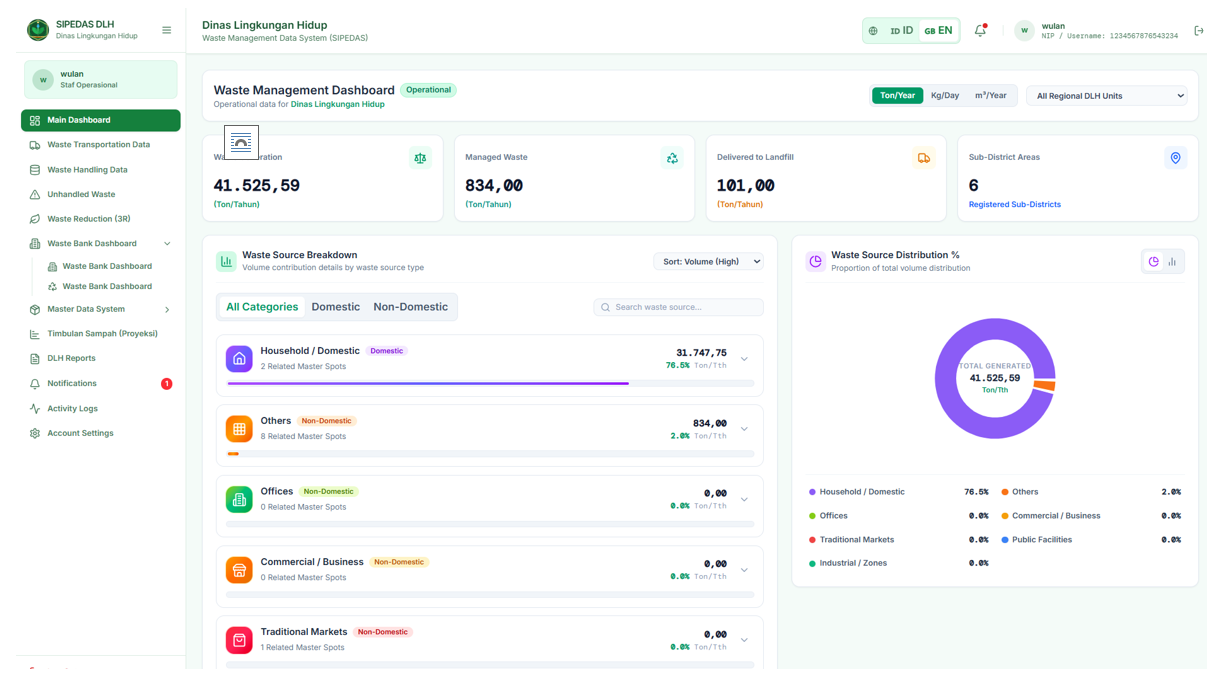
Municipal waste administration in many local governments is often constrained by fragmented records, disconnected reporting practices, and limited traceability across organizational units. This study examines how fragmented administrative processes can be integrated into a centralized, role-governed, and auditable digital workflow and evaluates its functionality and perceived usability. A single-site design-and-evaluation case was conducted at the Environmental Office of Padang Pariaman Regency, Indonesia, involving waste-administration activities across 17 sub-districts. SIPEDAS integrates operational records, master data, reporting, role-based access control, and activity logging through a Laravel RESTful API, React/TypeScript interface, and centralized MySQL database. Evaluation combined 25 requirement-derived Black Box scenarios with the System Usability Scale (SUS). All 25 executed functional test scenarios met their predefined acceptance criteria. Ten complete participant-level SUS records yielded a mean score of 68.25 (SD = 11.37; median = 71.25; range = 50–80), close to the widely cited benchmark but with substantial variation among participants. Incomplete records of requirements elicitation, tester independence, and SUS administration limit reproducibility and the interpretation of differences among respondents. The findings support SIPEDAS as a functional foundation for traceable waste-data administration, but do not establish the absence of defects, organizational efficiency gains, or verified security, reliability, and performance. Its main contribution is an approach to linking requirements with evaluation evidence that distinguishes implemented controls, executed functional conformance, perceived usability, actual use, and organizational outcomes.
RIS is compatible with Zotero, Mendeley, and EndNote. Immediate opening depends on the visitor's browser and reference-manager settings.
Declarations reported in the published article
Author Contributions
Wulan Ainiyyah Puteri: Conceptualization; Methodology; Software; Investigation; Writing – Original Draft. Syafrijon: Data Curation; Writing – Review & Editing; Supervision. All authors have read and approved the final version of the manuscript.
Acknowledgments
The authors would like to thank the management and operational staff of the Environmental Office (Dinas Lingkungan Hidup) of Padang Pariaman Regency, West Sumatra, for their cooperation and provision of operational context, as well as the Department of Electronics Engineering, Universitas Negeri Padang, for their academic support.
View statement in PDF · PDF page 16Funding
This research received no specific grant from any funding agency.
View statement in PDF · PDF page 16Competing Interests
The authors declare no competing interests.
View statement in PDF · PDF page 16Ethics Approval
The study involved non-invasive software evaluation and an adult professional-user usability questionnaire. Institutional operational permission from the Environmental Office of Padang Pariaman Regency and informed consent from participants were documented. However, the retained study record contains no formal ethics-committee approval, exemption, or waiver determination. Institutional operational permission is therefore not presented as equivalent to research-ethics review.
View statement in PDF · PDF page 16Informed Consent
Informed consent was obtained from all participants before completion of the usability questionnaire.
View statement in PDF · PDF page 16Data Availability
The data supporting the reported functional testing and usability results, together with system documentation and database schemas, are available from the corresponding author upon reasonable request, subject to institutional data-governance requirements.
View statement in PDF · PDF page 16Generative AI Disclosure
During manuscript preparation in July 2026, the authors used ChatGPT (OpenAI; GPT-5-series models) for language editing. All final wording was critically checked and revised by the human authors, who retain full responsibility for the accuracy, originality, and integrity of the manuscript.
View statement in PDF · PDF page 16References
26 References[1] Z. Zhang, Z. Chen, J. Zhang, Y. Liu, L. Chen, M. Yang, A. I. Osman, M. Farghali, E. Liu, D. Hassan, I. Ihara, K. Lu, D. W. Rooney, and P.-S. Yap, “Municipal solid waste management challenges in developing regions: A comprehensive review and future perspectives for Asia and Africa,” Sci. Total Environ., vol. 930, Art. no. 172794, 2024, doi: https://doi.org/10.1016/j.scitotenv.2024.172794
[2] D. C. Wilson, L. Rodic, M. J. Cowing, C. A. Velis, A. D. Whiteman, A. Scheinberg, R. Vilches, D. Masterson, J. Stretz, and B. Oelz, “‘Wasteaware’ benchmark indicators for integrated sustainable waste management in cities,” Waste Manag., vol. 35, pp. 329–342, 2015, doi: https://doi.org/10.1016/j.wasman.2014.10.006
[3] Y. A. Fatimah, K. Govindan, R. Murniningsih, and A. Setiawan, “Industry 4.0 based sustainable circular economy approach for smart waste management system to achieve sustainable development goals: A case study of Indonesia,” J. Clean. Prod., vol. 269, Art. no. 122263, 2020, doi: https://doi.org/10.1016/j.jclepro.2020.122263
[4] D. Kannan, S. Khademolqorani, N. Janatyan, and S. Alavi, “Smart waste management 4.0: The transition from a systematic review to an integrated framework,” Waste Manag., vol. 174, pp. 1–14, 2024, doi: https://doi.org/10.1016/j.wasman.2023.08.041
[5] I. Mergel, N. Edelmann, and N. Haug, “Defining digital transformation: Results from expert interviews,” Gov. Inf. Q., vol. 36, no. 4, Art. no. 101385, 2019, doi: https://doi.org/10.1016/j.giq.2019.06.002
[6] J. J. Pittaway and A. R. Montazemi, “Know-how to lead digital transformation: The case of local governments,” Gov. Inf. Q., vol. 37, no. 4, Art. no. 101474, 2020, doi: https://doi.org/10.1016/j.giq.2020.101474
[7] L. Tangi, M. Janssen, M. Benedetti, and G. Noci, “Digital government transformation: A structural equation modelling analysis of driving and impeding factors,” Int. J. Inf. Manag., vol. 60, Art. no. 102356, 2021, doi: https://doi.org/10.1016/j.ijinfomgt.2021.102356
[8] Dinas Lingkungan Hidup, Perumahan, Kawasan Permukiman dan Pertanahan Kabupaten Padang Pariaman, “Data and administrative records on waste management and 2024 regional waste performance,” unpublished internal institutional records, Padang Pariaman, Indonesia, 2025.
[9] Pemerintah Kabupaten Padang Pariaman, Dokumen Perencanaan Teknis dan Manajemen Persampahan (PTMP) Kabupaten Padang Pariaman. Padang Pariaman, Indonesia, 2016.
[10] T.-D. Bui, J.-W. Tseng, M.-L. Tseng, K.-J. Wu, and M. K. Lim, “Municipal solid waste management technological barriers: A hierarchical structure approach in Taiwan,” Resour. Conserv. Recycl., vol. 190, Art. no. 106842, 2023, doi: https://doi.org/10.1016/j.resconrec.2022.106842
[11] I. Giraldo-Almario, G. Rueda-Saa, and J. R. Uribe-Ceballos, “Wasteaware adaptation to the context of a Latin American country: Evaluation of the municipal solid waste management in Cali, Colombia,” J. Mater. Cycles Waste Manag., vol. 26, pp. 908–922, 2024, doi: https://doi.org/10.1007/s10163-023-01868-5
[12] L. Mersico, S. Aureli, and E. Foschi, “Exploring the role of digital platforms in promoting value co-creation: Evidence from the Italian municipal solid waste management system,” Sustain. Account. Manag. Policy J., vol. 17, no. 1, pp. 233–266, 2026, doi: https://doi.org/10.1108/SAMPJ-03-2024-0317
[13] C. Wang, J. Qin, C. Qu, X. Ran, C. Liu, and B. Chen, “A smart municipal waste management system based on deep-learning and Internet of Things,” Waste Manag., vol. 135, pp. 20–29, 2021, doi: https://doi.org/10.1016/j.wasman.2021.08.028
[14] D. Yulianto and A. Febrianto, “Sistem Informasi Pengelolaan Sampah Kabupaten Bantul Berbasis Website Menggunakan Model Modified Waterfall,” Technomedia J., vol. 9, no. 3, pp. 309–320, 2025, doi: https://doi.org/10.33050/tmj.v9i3.2168
[15] I. Sommerville, Software Engineering, 9th ed. Boston, MA, USA: Addison-Wesley, 2011.
[16] R. S. Sandhu, E. J. Coyne, H. L. Feinstein, and C. E. Youman, “Role-based access control models,” Computer, vol. 29, no. 2, pp. 38–47, 1996, doi: https://doi.org/10.1109/2.485845
[17] A. Lawi, B. L. E. Panggabean, and T. Yoshida, “Evaluating GraphQL and REST API services performance in a massive and intensive accessible information system,” Computers, vol. 10, no. 11, Art. no. 138, 2021, doi: https://doi.org/10.3390/computers10110138
[18] J. R. Lewis, “The System Usability Scale: Past, present, and future,” Int. J. Hum.-Comput. Interact., vol. 34, no. 7, pp. 577–590, 2018, doi: https://doi.org/10.1080/10447318.2018.1455307
[19] J. Brooke, “SUS: A ‘quick and dirty’ usability scale,” in Usability Evaluation in Industry, P. W. Jordan, B. Thomas, B. A. Weerdmeester, and I. L. McClelland, Eds. London, U.K.: Taylor & Francis, 1996, pp. 189–194, doi: https://doi.org/10.1201/9781498710411-35
[20] A. Bangor, P. T. Kortum, and J. T. Miller, “Determining what individual SUS scores mean: Adding an adjective rating scale,” J. Usability Stud., vol. 4, no. 3, pp. 114–123, 2009.
[21] G. Baxter and I. Sommerville, “Socio-technical systems: From design methods to systems engineering,” Interact. Comput., vol. 23, no. 1, pp. 4–17, Jan. 2011, doi: https://doi.org/10.1016/j.intcom.2010.07.003
[22] W. H. DeLone and E. R. McLean, “The DeLone and McLean model of information systems success: A ten-year update,” J. Manage. Inf. Syst., vol. 19, no. 4, pp. 9–30, 2003, doi: https://doi.org/10.1080/07421222.2003.11045748
[23] O. M. Hassan, “Integrated digital, biological, and human capital innovations for circular and sustainable waste management: A critical review,” Discov. Appl. Sci., vol. 7, Art. no. 1289, 2025, doi: https://doi.org/10.1007/s42452-025-07904-3
[24] V. Mogha and N. Tebourbi, “Digital platform to scale initiatives for community engagement and social impact: A case study in the Indian plastic recycling industry,” J. Asia Bus. Stud., vol. 19, no. 3, pp. 586–605, 2025, doi: https://doi.org/10.1108/JABS-07-2024-0389
[25] J. A. Nielsen, K. T. Elmholdt, and M. S. Noesgaard, “Leading digital transformation: A narrative perspective,” Public Adm. Rev., vol. 84, no. 4, pp. 589–603, 2024, doi: https://doi.org/10.1111/puar.13721
[26] V. Siwawa, “Effect of the ICT-enabled reclaimer system on the informal waste recycling system in Cape Town, South Africa: The Regenize model,” Electron. J. Inf. Syst. Dev. Ctries., vol. 91, no. 1, Art. no. e12345, 2025, doi: https://doi.org/10.1002/isd2.12345
Copyright and License

This work is licensed under a Creative Commons Attribution 4.0 International License.
Copyright (c) 2026 Wulan Ainiyyah Puteri, Syafrijon