

Sustainable Development Goals
This article contributes to the following United Nations Sustainable Development Goals.
Palabras clave
Cómo citar




Resumen de la publicación

Próximo número
J-HyTEL welcomes original and rigorous scholarship advancing education, media technology, and computer science applications.
Rolling submissions are accepted throughout the year.
Resumen
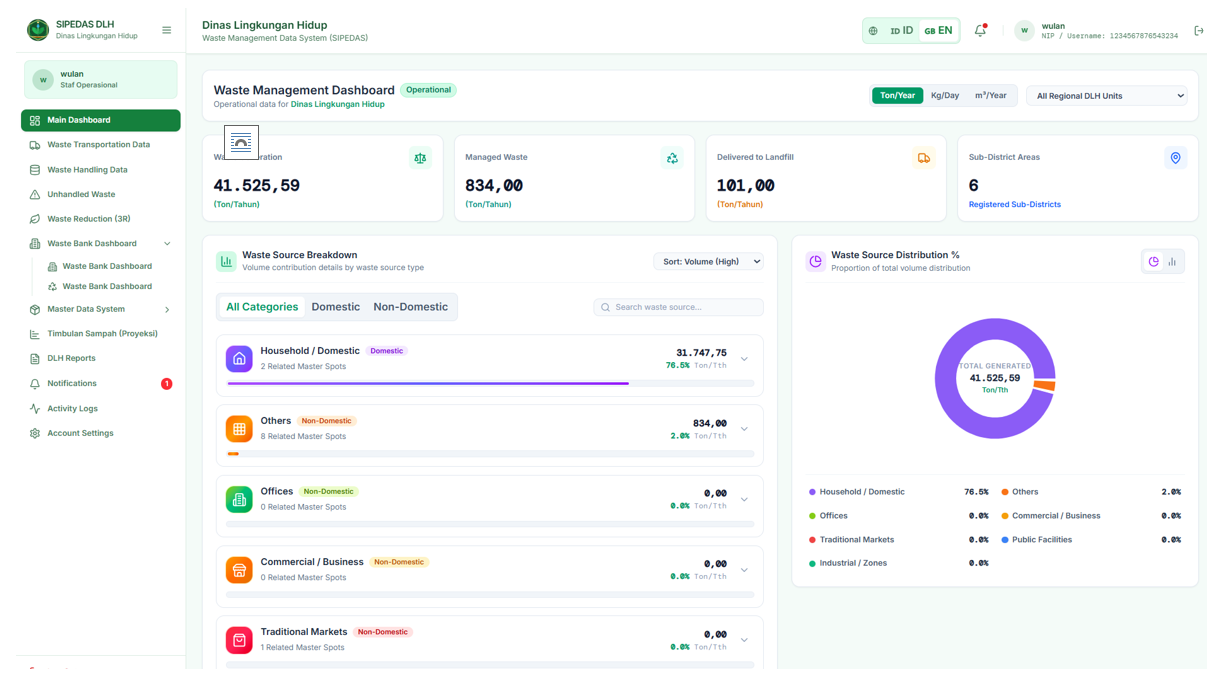
La gestión de los residuos municipales en muchos ayuntamientos se ve a menudo limitada por registros fragmentados, prácticas de presentación de informes inconexas y una trazabilidad limitada entre las distintas unidades organizativas. Este estudio examina cómo los procesos administrativos fragmentados pueden integrarse en un flujo de trabajo digital centralizado, regido por roles y auditable, y evalúa su funcionalidad y la usabilidad percibida. Se llevó a cabo un caso de diseño y evaluación en un único emplazamiento en la Oficina de Medio Ambiente de la regencia de Padang Pariaman (Indonesia), que abarcó las actividades de gestión de residuos en 17 subdistritos. SIPEDAS integra registros operativos, datos maestros, elaboración de informes, control de acceso basado en roles y registro de actividades a través de una API RESTful de Laravel, una interfaz React/TypeScript y una base de datos MySQL centralizada. La evaluación combinó 25 escenarios de «caja negra» derivados de los requisitos con la Escala de Usabilidad del Sistema (SUS). Los 25 escenarios de pruebas funcionales ejecutados cumplieron sus criterios de aceptación predefinidos. Diez registros completos de la SUS a nivel de participante arrojaron una puntuación media de 68,25 (DE = 11,37; mediana = 71,25; rango = 50-80), cercana al valor de referencia ampliamente citado, pero con una variación sustancial entre los participantes. Los registros incompletos sobre la obtención de requisitos, la independencia de los evaluadores y la administración de la SUS limitan la reproducibilidad y la interpretación de las diferencias entre los encuestados. Los resultados respaldan a SIPEDAS como base funcional para una gestión trazable de los datos de residuos, pero no garantizan la ausencia de defectos, el aumento de la eficiencia organizativa ni la seguridad, fiabilidad y rendimiento verificados. Su principal contribución es un enfoque para vincular los requisitos con las pruebas de evaluación que distingue entre los controles implementados, la conformidad funcional alcanzada, la usabilidad percibida, el uso real y los resultados organizativos.
RIS is compatible with Zotero, Mendeley, and EndNote. Immediate opening depends on the visitor's browser and reference-manager settings.
Declaraciones recogidas en el artículo publicado
Author Contributions
Wulan Ainiyyah Puteri: Conceptualization; Methodology; Software; Investigation; Writing – Original Draft. Syafrijon: Data Curation; Writing – Review & Editing; Supervision. All authors have read and approved the final version of the manuscript.
Acknowledgments
The authors would like to thank the management and operational staff of the Environmental Office (Dinas Lingkungan Hidup) of Padang Pariaman Regency, West Sumatra, for their cooperation and provision of operational context, as well as the Department of Electronics Engineering, Universitas Negeri Padang, for their academic support.
View statement in PDF · PDF page 16Financiación
This research received no specific grant from any funding agency.
View statement in PDF · PDF page 16Conflictos de Intereses
The authors declare no competing interests.
View statement in PDF · PDF page 16Ethics Approval
The study involved non-invasive software evaluation and an adult professional-user usability questionnaire. Institutional operational permission from the Environmental Office of Padang Pariaman Regency and informed consent from participants were documented. However, the retained study record contains no formal ethics-committee approval, exemption, or waiver determination. Institutional operational permission is therefore not presented as equivalent to research-ethics review.
View statement in PDF · PDF page 16Informed Consent
Informed consent was obtained from all participants before completion of the usability questionnaire.
View statement in PDF · PDF page 16Disponibilidad de Datos
The data supporting the reported functional testing and usability results, together with system documentation and database schemas, are available from the corresponding author upon reasonable request, subject to institutional data-governance requirements.
View statement in PDF · PDF page 16Generative AI Disclosure
During manuscript preparation in July 2026, the authors used ChatGPT (OpenAI; GPT-5-series models) for language editing. All final wording was critically checked and revised by the human authors, who retain full responsibility for the accuracy, originality, and integrity of the manuscript.
View statement in PDF · PDF page 16Citas
26 References[1] Z. Zhang, Z. Chen, J. Zhang, Y. Liu, L. Chen, M. Yang, A. I. Osman, M. Farghali, E. Liu, D. Hassan, I. Ihara, K. Lu, D. W. Rooney, and P.-S. Yap, “Municipal solid waste management challenges in developing regions: A comprehensive review and future perspectives for Asia and Africa,” Sci. Total Environ., vol. 930, Art. no. 172794, 2024, doi: https://doi.org/10.1016/j.scitotenv.2024.172794
[2] D. C. Wilson, L. Rodic, M. J. Cowing, C. A. Velis, A. D. Whiteman, A. Scheinberg, R. Vilches, D. Masterson, J. Stretz, and B. Oelz, “‘Wasteaware’ benchmark indicators for integrated sustainable waste management in cities,” Waste Manag., vol. 35, pp. 329–342, 2015, doi: https://doi.org/10.1016/j.wasman.2014.10.006
[3] Y. A. Fatimah, K. Govindan, R. Murniningsih, and A. Setiawan, “Industry 4.0 based sustainable circular economy approach for smart waste management system to achieve sustainable development goals: A case study of Indonesia,” J. Clean. Prod., vol. 269, Art. no. 122263, 2020, doi: https://doi.org/10.1016/j.jclepro.2020.122263
[4] D. Kannan, S. Khademolqorani, N. Janatyan, and S. Alavi, “Smart waste management 4.0: The transition from a systematic review to an integrated framework,” Waste Manag., vol. 174, pp. 1–14, 2024, doi: https://doi.org/10.1016/j.wasman.2023.08.041
[5] I. Mergel, N. Edelmann, and N. Haug, “Defining digital transformation: Results from expert interviews,” Gov. Inf. Q., vol. 36, no. 4, Art. no. 101385, 2019, doi: https://doi.org/10.1016/j.giq.2019.06.002
[6] J. J. Pittaway and A. R. Montazemi, “Know-how to lead digital transformation: The case of local governments,” Gov. Inf. Q., vol. 37, no. 4, Art. no. 101474, 2020, doi: https://doi.org/10.1016/j.giq.2020.101474
[7] L. Tangi, M. Janssen, M. Benedetti, and G. Noci, “Digital government transformation: A structural equation modelling analysis of driving and impeding factors,” Int. J. Inf. Manag., vol. 60, Art. no. 102356, 2021, doi: https://doi.org/10.1016/j.ijinfomgt.2021.102356
[8] Dinas Lingkungan Hidup, Perumahan, Kawasan Permukiman dan Pertanahan Kabupaten Padang Pariaman, “Data and administrative records on waste management and 2024 regional waste performance,” unpublished internal institutional records, Padang Pariaman, Indonesia, 2025.
[9] Pemerintah Kabupaten Padang Pariaman, Dokumen Perencanaan Teknis dan Manajemen Persampahan (PTMP) Kabupaten Padang Pariaman. Padang Pariaman, Indonesia, 2016.
[10] T.-D. Bui, J.-W. Tseng, M.-L. Tseng, K.-J. Wu, and M. K. Lim, “Municipal solid waste management technological barriers: A hierarchical structure approach in Taiwan,” Resour. Conserv. Recycl., vol. 190, Art. no. 106842, 2023, doi: https://doi.org/10.1016/j.resconrec.2022.106842
[11] I. Giraldo-Almario, G. Rueda-Saa, and J. R. Uribe-Ceballos, “Wasteaware adaptation to the context of a Latin American country: Evaluation of the municipal solid waste management in Cali, Colombia,” J. Mater. Cycles Waste Manag., vol. 26, pp. 908–922, 2024, doi: https://doi.org/10.1007/s10163-023-01868-5
[12] L. Mersico, S. Aureli, and E. Foschi, “Exploring the role of digital platforms in promoting value co-creation: Evidence from the Italian municipal solid waste management system,” Sustain. Account. Manag. Policy J., vol. 17, no. 1, pp. 233–266, 2026, doi: https://doi.org/10.1108/SAMPJ-03-2024-0317
[13] C. Wang, J. Qin, C. Qu, X. Ran, C. Liu, and B. Chen, “A smart municipal waste management system based on deep-learning and Internet of Things,” Waste Manag., vol. 135, pp. 20–29, 2021, doi: https://doi.org/10.1016/j.wasman.2021.08.028
[14] D. Yulianto and A. Febrianto, “Sistem Informasi Pengelolaan Sampah Kabupaten Bantul Berbasis Website Menggunakan Model Modified Waterfall,” Technomedia J., vol. 9, no. 3, pp. 309–320, 2025, doi: https://doi.org/10.33050/tmj.v9i3.2168
[15] I. Sommerville, Software Engineering, 9th ed. Boston, MA, USA: Addison-Wesley, 2011.
[16] R. S. Sandhu, E. J. Coyne, H. L. Feinstein, and C. E. Youman, “Role-based access control models,” Computer, vol. 29, no. 2, pp. 38–47, 1996, doi: https://doi.org/10.1109/2.485845
[17] A. Lawi, B. L. E. Panggabean, and T. Yoshida, “Evaluating GraphQL and REST API services performance in a massive and intensive accessible information system,” Computers, vol. 10, no. 11, Art. no. 138, 2021, doi: https://doi.org/10.3390/computers10110138
[18] J. R. Lewis, “The System Usability Scale: Past, present, and future,” Int. J. Hum.-Comput. Interact., vol. 34, no. 7, pp. 577–590, 2018, doi: https://doi.org/10.1080/10447318.2018.1455307
[19] J. Brooke, “SUS: A ‘quick and dirty’ usability scale,” in Usability Evaluation in Industry, P. W. Jordan, B. Thomas, B. A. Weerdmeester, and I. L. McClelland, Eds. London, U.K.: Taylor & Francis, 1996, pp. 189–194, doi: https://doi.org/10.1201/9781498710411-35
[20] A. Bangor, P. T. Kortum, and J. T. Miller, “Determining what individual SUS scores mean: Adding an adjective rating scale,” J. Usability Stud., vol. 4, no. 3, pp. 114–123, 2009.
[21] G. Baxter and I. Sommerville, “Socio-technical systems: From design methods to systems engineering,” Interact. Comput., vol. 23, no. 1, pp. 4–17, Jan. 2011, doi: https://doi.org/10.1016/j.intcom.2010.07.003
[22] W. H. DeLone and E. R. McLean, “The DeLone and McLean model of information systems success: A ten-year update,” J. Manage. Inf. Syst., vol. 19, no. 4, pp. 9–30, 2003, doi: https://doi.org/10.1080/07421222.2003.11045748
[23] O. M. Hassan, “Integrated digital, biological, and human capital innovations for circular and sustainable waste management: A critical review,” Discov. Appl. Sci., vol. 7, Art. no. 1289, 2025, doi: https://doi.org/10.1007/s42452-025-07904-3
[24] V. Mogha and N. Tebourbi, “Digital platform to scale initiatives for community engagement and social impact: A case study in the Indian plastic recycling industry,” J. Asia Bus. Stud., vol. 19, no. 3, pp. 586–605, 2025, doi: https://doi.org/10.1108/JABS-07-2024-0389
[25] J. A. Nielsen, K. T. Elmholdt, and M. S. Noesgaard, “Leading digital transformation: A narrative perspective,” Public Adm. Rev., vol. 84, no. 4, pp. 589–603, 2024, doi: https://doi.org/10.1111/puar.13721
[26] V. Siwawa, “Effect of the ICT-enabled reclaimer system on the informal waste recycling system in Cape Town, South Africa: The Regenize model,” Electron. J. Inf. Syst. Dev. Ctries., vol. 91, no. 1, Art. no. e12345, 2025, doi: https://doi.org/10.1002/isd2.12345
Copyright and License

Esta obra está bajo una licencia internacional Creative Commons Atribución 4.0.
Derechos de autor 2026 Wulan Ainiyyah Puteri, Syafrijon