

Sustainable Development Goals
This article contributes to the following United Nations Sustainable Development Goals.

关键词
引用方式




出版物概览
下一期
J-HyTEL welcomes original and rigorous scholarship advancing education, media technology, and computer science applications.
Rolling submissions are accepted throughout the year.
摘要
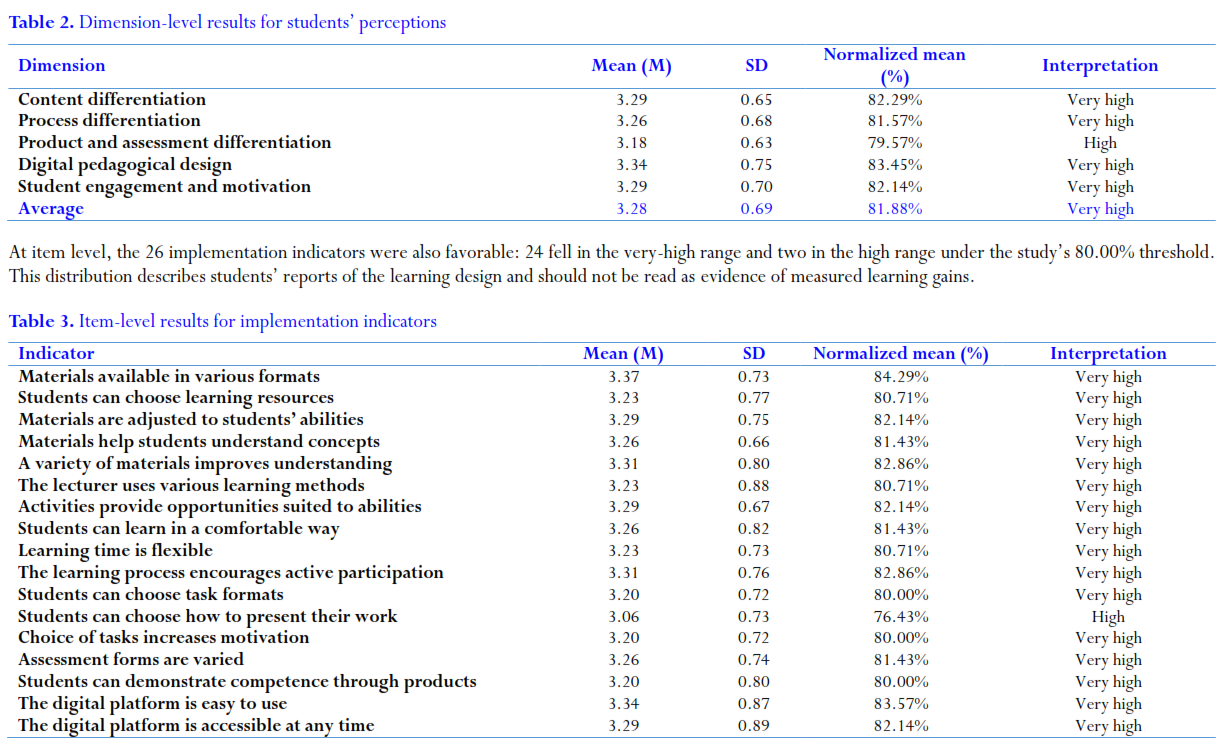
学生多样性给高等教育带来了持续的挑战,特别是在必须保持共同学习目标的同时,又需在学习资源、活动、互动、支持和评估方面提供灵活性的情况下。本研究探讨了学生对信息技术教育中数字化支持的差异化学习的看法和接受程度。 研究采用定量横断面描述性调查方法,在印尼楠榜大学(Universitas Lampung)35名学生完成学习体验后进行了调查。 数据通过一份包含31个项目的问卷收集,采用四点李克特量表进行评分,该问卷显示出较高的内部一致性(克朗巴赫α系数=0.985),并采用均值、标准差和标准化均分进行分析。 学生对五个实施维度的评价均较为积极(M = 3.28,81.88%)。 数字化教学设计获得的评分最高(M = 3.34,83.45%),而产品和评估差异化获得的评分最低(M = 3.18,79.57%)。 技术支持的协作是评分最高的单项(均值 = 3.49,87.14%),而展示形式的选择和数字反馈的及时性则获得较低评分。 关于接受度的次要总结同样积极(M = 3.31,82.74%),其中“学习动机增强”获得最高评分。这些发现表明,数字支持与协作被视为学习设计的优势所在,而学生成果的灵活性及反馈的及时性则需要进一步关注。 鉴于本研究采用单组、仅限课后评估的设计,且缺乏客观的学习成果衡量指标,这些发现应被视为学生对实施情况的特定情境下的感知证据,而非对学习产生因果影响的证据。
RIS is compatible with Zotero, Mendeley, and EndNote. Immediate opening depends on the visitor's browser and reference-manager settings.
已发表文章中报告的声明
Author Contributions
Margaretha Karolina Sagala: Conceptualization; Methodology; Investigation; Writing – Original Draft. Afif Rahman Riyanda: Formal Analysis; Validation; Investigation; Writing – Original Draft; Writing – Review & Editing. Daniel Rinaldi: Investigation; Writing – Review & Editing. Ghea Chandra Surawan: Investigation; Methodology (instrument development); Writing – Review & Editing. All authors reviewed and approved the final manuscript and accepted responsibility for the work.
Acknowledgments
Not applicable.
View statement in PDF · PDF page 9资助
DIPA BLU FKIP Universitas Lampung supported this research for fiscal year 2026.
View statement in PDF · PDF page 9利益冲突
The authors declare no competing interests.
View statement in PDF · PDF page 10Ethics Approval
The study was conducted in accordance with the ethical principles and applicable institutional guidelines governing research involving human participants.
View statement in PDF · PDF page 10Informed Consent
Informed consent was obtained from all participants before participation. Participants were informed about the study purpose and procedures, the voluntary nature of participation, confidentiality, and their right to withdraw without consequence.
View statement in PDF · PDF page 10Consent for Publication
Not applicable. The study does not report identifiable participant data, images, or other information that could identify an individual. Study or Protocol Registration This descriptive survey was not prospectively registered in a study or protocol registry.
View statement in PDF · PDF page 10数据可用性
The data supporting the findings are not publicly available because of privacy and ethical considerations concerning the participants. They may be available from the corresponding author upon reasonable request, subject to applicable ethical and institutional requirements. Generative AI and AI-Assisted Technologies During manuscript preparation, the authors used ChatGPT solely for language editing, grammar correction, and readability. The authors reviewed and verified all AI-assisted suggestions, made the final substantive and scientific decisions, and take full responsibility for the content. Preprint and Prior Dissemination The authors declare that this manuscript has not been previously published or posted as a preprint, conference paper, conference abstract, working paper, thesis, dissertation, repository version, or other related publication.
View statement in PDF · PDF page 10参考
31 References[1] R. Boelens, M. Voet, and B. De Wever, “The design of blended learning in response to student diversity in higher education: Instructors’ views and use of differentiated instruction in blended learning,” Comput. Educ., vol. 120, pp. 197–212, May 2018, doi: https://doi.org/10.1016/j.compedu.2018.02.009.
[2] P. Subban, M. N. Suprayogi, M. Preston, A. N. Liyani, and A. P. P. Ratri, “Differentiation is sometimes a hit and miss: Educator perceptions of differentiated instruction in the higher education sector,” Asia-Pac. Educ. Res., vol. 34, no. 3, pp. 873–884, Jun. 2025, doi: https://doi.org/10.1007/s40299-024-00904-8.
[3] M. Preston, P. Subban, M. N. Suprayogi, A. N. Liyani, and A. P. P. Ratri, “Differentiated instruction in higher education: The experience and perceptions of five academics,” J. Educ. Learn. (EduLearn), vol. 19, no. 3, pp. 1295–1306, Aug. 2025, doi: https://doi.org/10.11591/edulearn.v19i3.21760.
[4] A. E. Smale-Jacobse, A. Meijer, M. Helms-Lorenz, and R. Maulana, “Differentiated instruction in secondary education: A systematic review of research evidence,” Front. Psychol., vol. 10, Nov. 2019, Art. no. 2366, doi: https://doi.org/10.3389/fpsyg.2019.02366.
[5] M. I. Deunk, A. E. Smale-Jacobse, H. de Boer, S. Doolaard, and R. J. Bosker, “Effective differentiation practices: A systematic review and meta-analysis of studies on the cognitive effects of differentiation practices in primary education,” Educ. Res. Rev., vol. 24, pp. 31–54, Jun. 2018, doi: https://doi.org/10.1016/j.edurev.2018.02.002.
[6] M. J. Koehler, P. Mishra, and W. Cain, “What is technological pedagogical content knowledge (TPACK)?,” J. Educ., vol. 193, no. 3, pp. 13–19, 2013, doi: https://doi.org/10.1177/002205741319300303.
[7] J. O. Väätäjä and H. Ruokamo, “Conceptualizing dimensions and a model for digital pedagogy,” J. Pac. Rim Psychol., vol. 15, 2021, Art. no. 1834490921995395, doi: https://doi.org/10.1177/1834490921995395.
[8] S. Santoveña-Casal and S. R. López, “Mapping of digital pedagogies in higher education,” Educ. Inf. Technol., vol. 29, no. 2, pp. 2437–2458, 2024, doi: https://doi.org/10.1007/s10639-023-11888-1.
[9] R. F. Schmid et al., “The effects of technology use in postsecondary education: A meta-analysis of classroom applications,” Comput. Educ., vol. 72, pp. 271–291, Mar. 2014, doi: https://doi.org/10.1016/j.compedu.2013.11.002.
[10] E. Meşe and E. Mede, “Using digital differentiation to improve EFL achievement and self-regulation of tertiary learners: The Turkish context,” Innov. Lang. Learn. Teach., vol. 17, no. 2, pp. 340–353, Mar. 2023, doi: https://doi.org/10.1080/17501229.2022.2043872.
[11] T. T. Heng, “Using technology-enhanced differentiated instruction to support learning in higher education,” J. Glob. High. Educ., vol. 1, no. 1, pp. 186–201, 2025, doi: https://doi.org/10.25774/JGHE.V1I1.10.
[12] M. Tavakol and R. Dennick, “Making sense of Cronbach’s alpha,” Int. J. Med. Educ., vol. 2, pp. 53–55, 2011, doi: https://doi.org/10.5116/ijme.4dfb.8dfd.
[13] M. A. C. Sedanza and J. A. Abatayo, “Beyond the average: A systematic review and meta-analysis of differentiated instruction for diverse English learners,” Front. Educ., vol. 11, Aug. 2026, Art. no. 1906974, doi: https://doi.org/10.3389/feduc.2026.1906974.
[14] T. T. Heng and N. Lu, “International students’ experiences of technology-enhanced differentiated instruction in higher education: Promises, pitfalls, propositions,” Teach. High. Educ., vol. 31, no. 2, pp. 191–210, 2026, doi: https://doi.org/10.1080/13562517.2025.2565790.
[15] J. Frohn, M. Pozas, J. Lau, and J. Hundt, “Differentiated instruction through learning management systems: Insights from teachers in Germany,” Educ. Inf. Technol., vol. 31, pp. 5807–5826, 2026, doi: https://doi.org/10.1007/s10639-026-13997-z.
[16] M. Godsk and K. L. Møller, “Engaging students in higher education with educational technology,” Educ. Inf. Technol., vol. 30, no. 3, pp. 2941–2976, Feb. 2025, doi: https://doi.org/10.1007/s10639-024-12901-x.
[17] M. M. Amin and M. K. K. Abdullah, “Designing effective and practical learning activities in higher education digital pedagogy: A systematic review of theories and practices,” Int. J. Learn. Teach. Educ. Res., vol. 24, no. 2, pp. 242–262, Feb. 2025, doi: https://doi.org/10.26803/ijlter.24.2.13.
[18] J. A. Pratama, A. R. Riyanda, M. K. Sagala, and B. Saputra, “Persepsi siswa terhadap penggunaan generative AI sebagai alat bantu belajar di SMK Negeri 4 Bandar Lampung,” Journal Purnama Education and Learning Studies, vol. 1, no. 1, pp. 10–16, 2026. [Online]. Available: https://journal-purnama.com/index.php/pels/article/view/7
[19] F. Herliana, T. Hafinda, and R. Firmayanto, “Differentiated instruction through adaptive learning platform in science education: A systematic literature review,” J. Pendidik. MIPA, vol. 25, no. 2, pp. 914–931, 2024, doi: https://doi.org/10.23960/jpmipa/v25i2.pp914-931
[20] K. Asafa, E. D. Sari, R. P. Adijaya, and R. P. Rahayu, “Analisis antarmuka VClass Universitas Lampung: Evaluasi prinsip heuristik dan eksplorasi kebutuhan sistem pengingat batas waktu tugas,” Journal Purnama Teknologi Kejuruan, vol. 1, no. 1, pp. 40–48, 2026. [Online]. Available: https://journal-purnama.com/index.php/purnatek/article/view/28
[21] CAST, “Universal design for learning guidelines version 3.0.” CAST. Accessed: Sep. 7, 2026. [Online]. Available: https://udlguidelines.cast.org/
[22] J. Hattie and H. Timperley, “The power of feedback,” Rev. Educ. Res., vol. 77, no. 1, pp. 81–112, Mar. 2007, doi: https://doi.org/10.3102/003465430298487.
[23] R. M. Ryan and E. L. Deci, “Intrinsic and extrinsic motivation from a self-determination theory perspective: Definitions, theory, practices, and future directions,” Contemp. Educ. Psychol., vol. 61, Apr. 2020, Art. no. 101860, doi: https://doi.org/10.1016/j.cedpsych.2020.101860.
[24] J. A. Fredricks, P. C. Blumenfeld, and A. H. Paris, “School engagement: Potential of the concept, state of the evidence,” Rev. Educ. Res., vol. 74, no. 1, pp. 59–109, Mar. 2004, doi: https://doi.org/10.3102/00346543074001059.
[25] M. Bond, K. Buntins, S. Bedenlier, O. Zawacki-Richter, and M. Kerres, “Mapping research in student engagement and educational technology in higher education: A systematic evidence map,” Int. J. Educ. Technol. High. Educ., vol. 17, 2020, Art. no. 2, doi: https://doi.org/10.1186/s41239-019-0176-8.
[26] F. Martin and D. U. Bolliger, “Developing an online learner satisfaction framework in higher education through a systematic review of research,” Int. J. Educ. Technol. High. Educ., vol. 19, Sep. 2022, Art. no. 50, doi: https://doi.org/10.1186/s41239-022-00355-5.
[27] R. S. Jansen, A. van Leeuwen, J. Janssen, S. Jak, and L. Kester, “Self-regulated learning partially mediates the effect of self-regulated learning interventions on achievement in higher education: A meta-analysis,” Educ. Res. Rev., vol. 28, Nov. 2019, Art. no. 100292, doi: https://doi.org/10.1016/j.edurev.2019.100292.
[28] M. Theobald, “Self-regulated learning training programs enhance university students’ academic performance, self-regulated learning strategies, and motivation: A meta-analysis,” Contemp. Educ. Psychol., vol. 66, Jul. 2021, Art. no. 101976, doi: https://doi.org/10.1016/j.cedpsych.2021.101976.
[29] J. L. Robles Mucho et al., “Open learner models and pedagogical strategies in higher education: A meta-synthesis of approaches to self-regulated learning,” Front. Educ., vol. 10, Jan. 2026, Art. no. 1760183, doi: https://doi.org/10.3389/feduc.2025.1760183.
[30] E. A. Patall, H. Cooper, and S. R. Wynn, “The effectiveness and relative importance of choice in the classroom,” J. Educ. Psychol., vol. 102, no. 4, pp. 896–915, Nov. 2010, doi: https://doi.org/10.1037/a0019545.
[31] D. Hauk and A. Gröschner, “How effective is learner-controlled instruction under classroom conditions? A systematic review,” Learn. Motiv., vol. 80, Nov. 2022, Art. no. 101850, doi: https://doi.org/10.1016/j.lmot.2022.101850.
Copyright and License

This work is licensed under a Creative Commons Attribution 4.0 International License.
Copyright (c) 2026 Margaretha Karolina Sagala, Afif Rahman Riyanda, Daniel Rinaldi, Ghea Chandra Surawan