

1. Introduction
Industry 4.0 is characterised by increasingly interconnected, automated, and data-intensive production systems, creating new demands for technical knowledge, problem solving, and adaptable vocational skills [1], [2]. Within industrial automation education, PLC programming is a foundational competence because it links control logic with sensors, actuators, and manufacturing processes. Studies of PLC training kits, learning modules, and electro-pneumatic simulators indicate that learners benefit from structured materials that connect conceptual programming tasks with safe practice on physical equipment [3], [4]. The instructional challenge is therefore not merely to provide hardware, but to pair it with validated guidance that supports progressive and reproducible practicum work.
In vocational practicum settings, instructional materials can function as procedural guides, conceptual scaffolds, safety references, and formative assessment tools [5]. A jobsheet translates these functions into explicit objectives, equipment lists, safety procedures, work sequences, observation records, and evaluation tasks [6]. Evidence from trainer-kit and module development studies further shows the importance of aligning equipment, instructional content, and learner-facing guidance before implementation [7], [8]. Accordingly, a Pick and Place trainer operated through FPWIN Pro 7 requires more than a technical manual: it requires a pedagogically organised module whose content and usability have been appraised for the intended learners and setting.
Problem-based learning (PBL) offers a coherent framework for embedding authentic technical problems within jobsheet activities. Initially formalised in professional education [9], PBL organises learning around a problem that requires learners to identify what they know, determine what they need to investigate, test possible solutions, and reflect on the evidence generated [10], [11]. In an automation practicum, scenarios involving actuator timing, counting logic, or electro-pneumatic sequencing can provide a meaningful context for diagnosis and programme revision. The instructional value of such scenarios, however, depends on adequate guidance, relevant equipment, and alignment between the problem, the procedure, and the intended competency [12].
Existing studies have examined PLC trainer development [12]–[14], PBL-oriented jobsheets and modules [15], [16], and the validity or practicality of vocational instructional materials [17], [18]. Within the literature reviewed for this study, however, no report was identified that combined a Pick and Place PLC trainer, FPWIN Pro 7 programming tasks, and an explicitly PBL-structured jobsheet module for Grade XI Industrial Automation students. The present study addresses this specific design problem by reporting both expert appraisal and a small-scale end-user practicality trial. It does not test learning effectiveness; rather, it establishes whether the module is sufficiently valid and usable to justify subsequent outcome-based evaluation.
The study therefore aimed to: (1) document the design and development of a five-jobsheet PBL module using the Four-D (4D) model; (2) determine its expert-assessed content and media validity; and (3) examine its post-use practicality as reported by one teacher and ten students in a small-scale practicum trial. By clearly separating product validity, perceived practicality, and untested effectiveness, the study provides a transparent basis for deciding whether broader field evaluation is warranted.
2. Literature Review
2.1. Instructional Materials in Vocational PLC Education
Purposefully designed learning materials can support learners as they coordinate conceptual knowledge, procedural steps, and equipment operation [5]. In PLC practicum contexts, jobsheets and modules provide an external scaffold that can help manage task complexity, although claims about reduced cognitive load require direct measurement rather than inference from user ratings [19]. Nieveen’s product-quality framework distinguishes validity, practicality, and effectiveness as related but separate criteria [20]. Validity concerns the soundness and internal consistency of the design, whereas practicality concerns whether intended users can work with the product under relevant conditions [20], [21]. In the present study, expert appraisal and end-user questionnaires were therefore used to examine validity and perceived practicality; effectiveness was outside the study scope [22].
The trainer configuration used in this study combines a Panasonic FP0-series controller and FP0-E32T digital I/O expansion hardware with Control FPWIN Pro 7. Panasonic documentation identifies the FP0-E32T family as 32-point, 24-V DC expansion I/O hardware [23]. Control FPWIN Pro 7 is an IEC 61131-3-compliant programming environment that supports standard PLC languages, including Ladder Diagram, Structured Text, Function Block Diagram, and Sequential Function Chart [24]. These characteristics make the platform suitable for sequencing and simulation activities; the present study evaluates the accompanying instructional module rather than the technical performance of the hardware or software.
2.2. Problem-Based Learning in Technical and Vocational Education
Barrows and Tamblyn [9] described PBL as an approach in which a problem initiates and organises learning. Its emphasis on active inquiry, knowledge construction, and reflection is compatible with constructivist accounts of learning [25], [26]. Reviews of PBL identify potential benefits for flexible knowledge, problem solving, self-directed learning, and collaboration, while also stressing the importance of facilitation and task design [10], [27]. Walker and Leary’s meta-analysis further showed that PBL effects vary by problem type, implementation, discipline, and assessment level rather than being uniformly positive [28].
The operational sequence adopted in the module—problem orientation, learner organisation, guided investigation, presentation of a proposed solution, and evaluation—is adapted from commonly used PBL teaching phases [29]. Importantly, all five phases are represented within each jobsheet; the five jobsheets are not intended to represent one phase each. The problem scenario introduces the technical fault, group roles organise inquiry, FPWIN Pro 7 supports investigation and simulation, learner documentation supports presentation, and trainer-kit execution enables evaluation. This guided structure differentiates the module from an unguided discovery task and is consistent with problem-solving designs that combine authentic problems with explicit scaffolding [30].
3. Methods
3.1. Research Design
This study used a design-and-development approach based on the Four-D (4D) model [31]. The work was deliberately limited to Define, Design, and Develop because its purpose was to produce and conduct an initial appraisal of a laboratory-ready jobsheet module, not to disseminate the product or determine its effectiveness. Likert-type validation and practicality responses were summarised descriptively, and open-ended comments were used to identify revisions. No experimental comparison or inferential test of learning outcomes was conducted.
The original Four-D framework comprises Define, Design, Develop, and Disseminate [31]. More broadly, design-and-development research requires an explicit problem analysis, a documented design rationale, iterative evaluation, and transparent reporting of the setting and users [32], [33]. In this study, the omission of Disseminate is treated as a scope limitation rather than evidence that dissemination was completed. The three implemented stages are also compatible with established educational design research accounts that emphasise iterative development and formative evaluation [34], [35].
3.2. Development Procedure
The procedure followed three linked stages. Define established the instructional problem, learner characteristics, task requirements, concepts, and objectives. Design translated these requirements into the module structure, jobsheet sequence, PBL scenarios, safety guidance, and visual format. Develop comprised expert appraisal, revision, and a small-scale practicality trial. This sequence is reported to make the design decisions and the boundary between product development and product evaluation explicit.
3.2.1 Define Stage
Front-end analysis indicated that the Pick and Place Trainer Kit in the school laboratory did not have an accompanying written practicum guide and that instruction relied mainly on oral explanation. Learner analysis involved the eleven Grade XI Industrial Automation Engineering students enrolled in the course; they had introductory knowledge of electro-pneumatic components but limited or no prior experience with FPWIN Pro 7. Task and concept analyses organised the Electro-Pneumatic and Hydraulic Control Systems content into five progressively sequenced competency clusters, one for each jobsheet. Learning objectives used observable verbs at the Apply and Analyse levels of the revised taxonomy [36].
3 .2. 2 Design Stage
An A4 print format was selected for laboratory use. Each jobsheet contained: (1) a title and learning objectives, (2) time allocation, (3) equipment and materials, (4) concise technical background, (5) occupational health and safety (K3) guidance, (6) a PBL-oriented problem scenario, (7) guided work procedures with FPWIN Pro 7 screenshots, (8) observation and data-recording fields, and (9) post-practicum evaluation tasks. The visual design drew on characteristics of self-instructional and user-oriented modules [37]. Table 1 summarises the five jobsheets, their problem scenarios, and their intended learning outcomes.
|
Jobsheet |
Topic |
PBL Phase/Problem Scenario |
Learning Outcome |
|---|---|---|---|
|
JS-01 |
Basic PLC Programming (Ladder Diagram) |
Phase 1: Orientation Students identify why manual control is inefficient for the Pick and Place sequence |
Understand PLC I/O and construct basic ladder rungs |
|
JS-02 |
Timer Instructions (TON) |
Phase 2: Organization Groups analyze a timed conveyor stoppage fault and assign investigation roles |
Program TON timers for delay-dependent actuator control |
|
JS-03 |
Counter Instructions (CTU) |
Phase 3: Investigation Students simulate a cycle-count limit switch fault in FPWIN Pro 7 |
Implement CTU counters to trigger end-of-batch outputs |
|
JS-04 |
Internal Memory and Self-Holding Circuits |
Phase 4: Result Presentation Groups demonstrate corrected self-holding logic to prevent actuator bounce |
Design latching circuits for pneumatic gripper lock control |
|
JS-05 |
Sequential Control of the Pick and Place System |
Phase 5: Evaluation Full-system commissioning test against an industry checklist on the physical trainer kit |
Integrate all instructions into a complete PLC programme for the Pick and Place trainer kit |
3 .2. 3 Develop Stage
The development stage comprised two sequential sub-phases: expert appraisal (validity testing) followed by developmental testing (practicality testing).
Expert appraisal: The draft module was reviewed by two validators: one subject-matter expert in electrical engineering and PLC instruction and one instructional-media expert in vocational instructional design. Each validator completed a five-point appraisal form (1 = Very Poor to 5 = Very Good) for the domain relevant to their expertise and provided written comments. Because only one validator assessed each domain, the percentages are descriptive expert-appraisal results rather than estimates of inter-rater agreement.
Developmental testing: After expert-informed revision, one vocational teacher and ten Grade XI Industrial Automation students used the module during a two-session small-scale practicum trial. Students first developed and checked their programmes in FPWIN Pro 7 and then executed the verified sequences on the physical Pick and Place Trainer Kit. The teacher and students completed post-use practicality questionnaires immediately after the trial. Students also completed a pre-use expectation questionnaire; those scores were analysed separately and were not included in the post-use practicality mean.
3.3. Research Setting and Participants
The study was conducted at SMK Pembangunan Teknologi Robotik UNP, Padang, West Sumatra, Indonesia, a vocational school established under the auspices of the Universitas Negeri Padang, specializing in robotics and industrial automation. The practicum laboratory houses six Pick and Place Trainer Kits, each equipped with a Panasonic FP0 5.0K PLC unit and a workstation computer running FPWIN Pro 7. All eleven Grade XI Teknik Otomasi Industri (TOI) students enrolled in the Electro-Pneumatic Control Systems course participated. One teacher holding a master’s degree in Electrical Engineering Education and responsible for the automation practicum also participated.
3.4. Instruments and Data Analysis
Validity Instrument: Two expert validation sheets were developed, each operationalizing Nieveen’s [20] quality criteria. The content validity sheet (28 items) assessed curriculum alignment, the conceptual accuracy of PLC and electro-pneumatic content, the appropriateness of K3 procedures, and the quality of PBL scenario integration. The media validity sheet (24 items) assessed layout aesthetics, typographic legibility, image proportion, visual hierarchy, and language clarity.
Practicality Instrument: The practicality questionnaire (20 items for students; 22 items for teachers) measured ease of module use, instructional clarity, time efficiency, learner engagement, and alignment with the trainer kit hardware. Both instruments were validated for content by two independent reviewers and pilot-tested for internal consistency; Cronbach’s alpha values exceeded 0.80 for all scales, confirming adequate reliability.
Data Analysis: Validity and practicality scores were computed as a percentage of the maximum possible score using the formula (1) recommended by Riduwan [38]:
|
|
(1) |
|---|
The five-tier interpretive scale used was: 81–100% = Very Valid/Very Practical; 61–80% = Valid/Practical; 41–60% = Moderately Valid/Practical; 21–40% = Less Valid/Practical; 0–20% = Not Valid/Not Practical. A minimum threshold of 61% (“Valid” and “Practical”) was set as the acceptance criterion, consistent with established practice in Indonesian R&D educational studies [32], [33].
4. Results
4.1. Product Description: PBL Jobsheet Module
The completed product was a 98-page printed module containing five sequential jobsheets, a foreword, a table of contents, and a reference list. Each jobsheet opened with a shaded industrial problem scenario and then presented objectives, technical background, K3 guidance, guided programming procedures, observation fields, and evaluation tasks. Annotated FPWIN Pro 7 screenshots illustrated key programming steps. The final jobsheet integrated the preceding I/O, timer, counter, memory, and sequencing tasks into a complete Pick and Place control programme. These are the product's design characteristics; their effects on learning were not measured in this study.
4.2 Expert Validation Results
|
Validation Aspect |
Validator |
Score (%) |
Category |
|---|---|---|---|
|
Content Validity (Curriculum alignment, PLC/pneumatic concepts, PBL syntax integration) |
Subject-Matter Expert |
89.58 |
Very Valid |
|
Media Validity (Layout, typography, image proportion, visual appeal) |
Instructional Media Expert |
93.75 |
Very Valid |
|
Overall Mean |
91.67 |
Very Valid |
As shown in Table 2, the content appraisal score was 89.58% and the media appraisal score was 93.75%; their arithmetic mean was 91.67%. Under the study’s predefined categories, all three values were classified as Very Valid. The content expert judged the PLC, electro-pneumatic, curriculum, K3, and PBL components positively, while the media expert rated layout, typography, image use, and visual organisation positively. Because each domain was assessed by one expert, these results should be read as domain-specific formative judgements rather than evidence of inter-rater reliability.
The subject-matter expert’s written comments focused on two areas requiring revision: (a) several FPWIN Pro 7 screenshots were too small to distinguish individual ladder rungs and required enlargement, and (b) the K3 section of each jobsheet needed more precise specification of the emergency stop button (X0) location and its role in the control circuit. The media expert recommended separating large screenshot figures from surrounding instructional text using explicit figure captions and adjusting the observation table columns to accommodate separate recording of pneumatic actuator stroke direction (extend/retract) and gripper state (open/closed). All recommended revisions were implemented prior to the practicality trial.
4.3 Practicality Testing Results
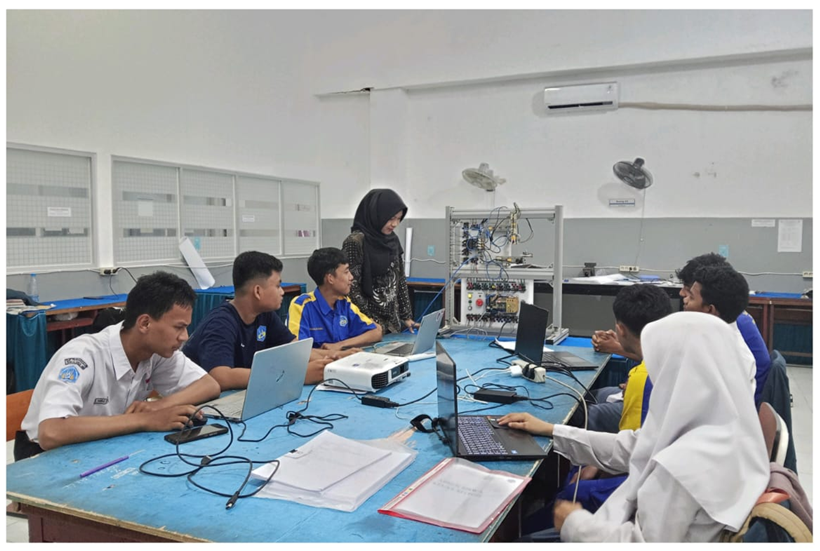
The teacher’s post-use practicality score was 93.8%, and the mean student post-use score was 95.0% (SD = 2.85). The participant-weighted post-use mean was therefore 94.9%, classified as Very Practical. The student pre-use expectation mean was 92.0% (SD = 3.12) and is shown only as contextual information; it was not included in the overall post-use practicality score. Although the post-use mean was numerically higher than the pre-use mean, the study was not designed or powered to test whether that difference was statistically or theoretically meaningful [39].
|
Respondent |
n |
Mean Score (%) |
Std. Dev. |
Category |
|---|---|---|---|---|
|
Vocational Teacher |
1 |
93.8 |
– |
Very Practical |
|
Students (pre-trial response) |
10 |
92.0 |
3.12 |
Very Practical |
|
Students (post-trial response) |
10 |
95.0 |
2.85 |
Very Practical |
|
Overall Mean |
93.6 |
Very Practical |
In the open-ended feedback, the teacher reported that the module reduced the amount of repeated verbal explanation required during the session. Students most frequently identified the step-by-step FPWIN Pro 7 screenshots and the opening problem scenarios as useful features. The most common requested revision was the addition of colour-coded wiring diagrams for pneumatic-solenoid connections. These comments informed the interpretation of usability but were not analysed as evidence of learning gains.
5. Discussion
5.1 Validity of the PBL Jobsheet Module
The composite expert-appraisal score of 91.67% indicates that the two validators judged the module favourably against the study criteria. Harjianto and Zamtinah [15], for example, reported content and media feasibility scores of 88.97% and 85.42% for PBL-based electrical-installation handouts and jobsheets. The present percentages are descriptively higher, but the studies used different products, instruments, validators, and settings; no causal explanation or formal superiority claim can therefore be made. The result supports continued formative development of the module, not a conclusion that contextualised PBL materials are inherently accurate or effective [40].
The expert comments led to concrete revisions, including enlarged screenshots, clearer emergency-stop information, explicit figure captions, and revised observation tables. This traceable link between appraisal and revision is a strength of the development process. It is consistent with product-quality and educational design research principles that emphasise iterative alignment among the intended use, the artefact, and the learning setting [20], [32], [33], [41].
5.2 Practicality and Learner Experience
The participant-weighted post-use practicality mean was 94.9%. Harjianto and Zamtinah [15] reported a 77.01% student response for a different PBL-based jobsheet, while Haryudo et al. [7] evaluated trainer-kit use within project-based learning. These studies provide relevant context, but direct score comparisons are limited by differences in instruments, samples, learning models, and implementation. The present result shows favourable perceived usability in one local trial; it does not establish improved motivation, competence, or learning relative to conventional instruction.
Software-first simulation: The module required learners to check ladder logic in FPWIN Pro 7 before executing it on the physical trainer. This sequencing was intended to separate programme debugging from hardware operation and to provide a lower-risk opportunity for revision. Comparable PLC training-kit and module work supports the pedagogical value of linking simulation, guidance, and equipment practice [3]. However, this study did not systematically record equipment incidents, cognitive load, comprehension, or retention; those outcomes should not be inferred from practicality ratings alone [19], [42].
PBL problem orientation: Participants’ comments indicated that the opening scenarios helped them understand the purpose of the programming task. This observation is compatible with PBL accounts in which an authentic problem organises inquiry [10], [29] and with engineering-education arguments for realistic problem-solving experiences [43]. Nevertheless, engagement was not measured with a validated scale, group-discussion frequency was not systematically coded, and the result should be interpreted as qualitative formative feedback.
Self-contained structure: Concise technical explanations, equipment lists, annotated diagrams, and K3 reminders were intended to reduce unnecessary searching during practicum work. The favourable usability comments are consistent with user-oriented module characteristics described by Sukiman [6] and Daryanto [37]. The study did not, however, directly measure learner independence or standardisation of delivery, so these remain design intentions for future observation-based testing.
The student mean increased descriptively from 92.0% before use to 95.0% after use. Because the questionnaires represented expectation and post-use practicality rather than a validated repeated measure of the same construct, the difference should not be interpreted as an effect of the module. The result is best used to refine future evaluation. Subsequent trials should examine how much guidance learners require, because PBL is most defensible when authentic inquiry is accompanied by appropriate scaffolding rather than minimal guidance [40], [44].
5.3 Contextualization within the Literature and Industry Relevance
|
Study |
Validity (%) |
Practicality (%) |
Context |
|---|---|---|---|
|
This study |
91.67 (Very Valid) |
93.6 (Very Practical) |
PBL Jobsheet Module Pick and Place PLC, FPWIN Pro 7, Grade XI TOI |
|
Wisnu Tri Harjianto & Zamtinah [15] |
88.97–85.42 (Very Valid) |
77.01 (Feasible) |
PBL Handout/Jobsheet Electrical Lighting Installation, Grade XI TITL |
|
Yasa et al. [13] |
Product judged feasible |
Student response reported; not directly comparable |
PLC Trainer Traffic light control, vocational context |
|
Rindaryati et al. [12] |
Validity coefficient 0.95 |
Teacher 92.44%; students 91.69% |
PLC Trainer Pneumatic relay control, SMK Batam |
Across the selected studies, development products were generally judged valid and practical within their respective settings, but the numerical results are not interchangeable. Differences may reflect instrument design, validator composition, participant characteristics, infrastructure, and implementation conditions. The present teacher and student ratings were both high, yet the single-site sample is too small to separate module quality from contextual support or response tendencies. Broader trials using common outcome definitions are needed before generalisability can be assessed.
The five-jobsheet sequence progresses from basic I/O logic to timers, counters, memory functions, and integrated Pick and Place control. This progression is relevant to the increasingly complex skills expected in technology-intensive vocational work [2] and uses an IEC 61131-3-compliant programming environment [24]. The scenarios also expose learners to representative faults such as missed counts and sequencing errors. Whether this design improves workplace troubleshooting competence remains an empirical question for performance-based and longitudinal research.
5.4 Limitations and Future Research Directions
Several limitations qualify the findings. First, the study stopped at Develop and did not implement the Disseminate stage. Second, the practicality trial involved one teacher and ten students from one school, while each validity domain was assessed by one expert; the results cannot be generalised statistically and do not provide inter-rater evidence. Third, the questionnaire evidence was self-reported, internal-consistency estimates were not established for the small trial, and the pre-use and post-use forms were not demonstrated to measure an identical construct. Fourth, no control group, pre-/post-test of competence, observation protocol, or performance-based assessment was used. The study therefore supports preliminary validity and perceived practicality only, not effectiveness, causal impact, or industry readiness.
Future research should: (1) conduct multi-site trials with larger and more diverse cohorts; (2) use multiple validators per domain and report agreement or reliability evidence; (3) compare the module with an appropriate alternative using knowledge, programming, troubleshooting, and psychomotor performance measures; (4) document implementation fidelity and the amount of teacher scaffolding required; and (5) examine digital extensions, HMI integration, and SCADA-related tasks only after the core module has demonstrated effectiveness and safe usability.
6. Conclusion
This study developed a five-jobsheet PBL module for a Pick and Place PLC Trainer Kit operated with FPWIN Pro 7. The Define, Design, and Develop stages produced a module that combines technical explanations, industrial problem scenarios, guided programming and simulation steps, observation tasks, and K3 safety guidance for Grade XI Industrial Automation students.
The content and media expert-appraisal scores were 89.58% and 93.75%, yielding a composite score of 91.67% (Very Valid). Post-use practicality scores were 93.8% for the teacher and 95.0% for students, with a participant-weighted mean of 94.9% (Very Practical). These values indicate favourable expert judgement and perceived usability in the local trial. They do not demonstrate improved learning, independent practice, or troubleshooting competence.
The module may be used provisionally for further supervised development and evaluation at the participating school. Its structured scenarios and software-before-hardware sequence are promising design features, but adoption beyond the local setting should follow multi-site validation, reliability testing, and direct assessment of learning and safety outcomes. The principal contribution of this study is therefore a transparently described instructional product and an initial evidence base for the next evaluation stage.
Declarations
Author Contributions
Elfitra Rahma Fionandes: Conceptualization; Methodology; Investigation; Data Curation; Writing – Original Draft. Zulwisli: Supervision; Validation; Formal Analysis; Writing – Review & Editing. Ilmiyati Rahmy Jasril: Methodology; Validation; Writing – Review & Editing. Winda Agustiarmi: Resources; Visualization; Writing – Review & Editing. All authors have read and approved the final version of the manuscript.
Acknowledgments
The authors express their sincere appreciation to the management, teachers, and students of SMK Pembangunan Teknologi Robotik UNP, Padang, Indonesia, for their cooperation during the implementation and evaluation phases of this study. Their support and participation substantially contributed to the development and validation of the PBL-based jobsheet module for the Pick and Place Trainer Kit using FPWIN Pro 7.
Ethical Approval
Institutional permission to conduct the study was granted by SMK Pembangunan Teknologi Robotik UNP under Letter No. 1045/SMK/PTR/04, dated 16 December 2025. The relevant institution determined that formal ethics committee review was not required for this low-risk educational evaluation. Participation was voluntary, and the reported data were anonymised and presented in aggregate form.
Informed Consent
Written informed consent was obtained from the participants’ parents or legal guardians, and assent was obtained from the participating students before data collection. Participation was voluntary, and participants could withdraw without academic penalty.
Funding
This study was conducted without external funding.
Data Availability Statement
The developed Jobsheet Module and anonymized validation/practicality data are available upon reasonable request from the corresponding author.
Competing Interests
The authors declare no conflicts of interest.
Generative AI and AI-Assisted Technologies Statement
During the preparation of this manuscript, generative AI tools were used solely to assist with language editing and proofreading. All outputs were critically reviewed, revised, and validated by the authors to ensure academic integrity, originality, and accuracy.
References
- H. Lasi, P. Fettke, H.-G. Kemper, T. Feld, and M. Hoffmann, “Industry 4.0,” Business & Information Systems Engineering, vol. 6, no. 4, pp. 239–242, 2014, doi: 10.1007/s12599-014-0334-4.
- G. Spöttl and L. Windelband, “The 4th industrial revolution—its impact on vocational skills,” Journal of Education and Work, vol. 34, no. 1, pp. 29–52, 2021, doi: 10.1080/13639080.2020.1858230.
- P. W. Rusimamto, Munoto, M. Samani, I. G. P. A. Buditjahjanto, Endryansyah, and S. I. Haryudo, “Training kit and module on PLC programming competence for students of electrical engineering education,” Jurnal Pendidikan: Teori, Penelitian, dan Pengembangan, vol. 6, no. 12, pp. 1963–1974, 2021, doi: 10.17977/jptpp.v6i12.15181.
- S. D. Ramdani, A. Pangestu, and H. Abizar, “The dual-design-based pneumatic simulator as supporting media for electro-pneumatic practicum in vocational higher education,” Jurnal Pendidikan Vokasi, vol. 9, no. 3, pp. 307–317, 2019, doi: 10.21831/jpv.v9i3.27345.
- N. Nieveen and T. Plomp, “Formative evaluation in educational design research,” in An Introduction to Educational Design Research, T. Plomp and N. Nieveen, Eds. Enschede: SLO, 2010, pp. 89–102.
- Sukiman, Pengembangan Media Pembelajaran. Yogyakarta: Pedagogia, 2012.
- S. I. Haryudo, Ekohariadi, Munoto, T. Rijanto, and F. Baskoro, “Implementation of trainer kits in project-based learning to improve critical thinking, motivation, and competency of electrical engineering students,” Jurnal Pendidikan: Teori, Penelitian, dan Pengembangan, vol. 6, no. 12, pp. 1947–1952, 2021, doi: 10.17977/jptpp.v6i12.15179.
- M. M. Wibowo and R. Nandika, “Pengembangan trainer kit pada praktikum mikrokontroler berbasis Internet of Things menggunakan Blynk,” Sigma Teknika, vol. 5, no. 2, pp. 295–304, 2022, doi: 10.33373/sigmateknika.v5i2.4601.
- H. S. Barrows and R. M. Tamblyn, Problem-Based Learning: An Approach to Medical Education. New York: Springer, 1980.
- C. E. Hmelo-Silver, “Problem-based learning: What and how do students learn?” Educ. Psychol. Rev., vol. 16, no. 3, pp. 235–266, 2004, doi: 10.1023/B:EDPR.0000034022.16470.f3.
- J. Gonzalez-Argote and W. Castillo-González, “Problem-Based Learning (PBL): Review of the topic in the context of health education,” Semin. Med. Writ. Educ., vol. 3, 2024, doi: 10.56294/mw202457.
- N. Rindaryati, D. Irfan, H. Maksum, and H. Effendi, “Pengaruh media trainer Programmable Logic Control (PLC) terintegrasi sistem pneumatik di SMK Negeri 5 Batam,” Aksara: Jurnal Ilmu Pendidikan Nonformal, vol. 8, no. 3, pp. 1795–1804, 2022, doi: 10.37905/aksara.8.3.1795-1804.2022.
- I. P. O. K. Yasa, I. P. S. Arsa, and I. N. Santiyadnya, “Pengembangan trainer pengaplikasian Programmable Logic Controller (PLC) sebagai sistem kontrol traffic light 4 jalur portable untuk siswa SMK,” Jurnal Pendidikan Teknik Elektro Undiksha, vol. 10, no. 3, pp. 118–130, 2021, doi: 10.23887/jjpte.v10i3.37085.
- R. A. Silaban and F. Rizal, “The development of Program Logic Control (PLC) trainer media in vocational high schools,” Journal of Education Research and Evaluation, vol. 4, no. 2, pp. 121–132, 2020, doi: 10.23887/jere.v4i2.24606.
- W. T. Harjianto and Zamtinah, “Pengembangan bahan ajar handout dan job sheet instalasi penerangan listrik pada bangunan gedung berbasis problem based learning,” Jurnal Pendidikan Teknik Elektro, vol. 8, no. 5, pp. 346–353, 2018, doi: 10.21831/elektro.v8i5.13447.
- R. Sitohang, "Peningkatan hasil belajar siswa SMK menggunakan PBL berbantuan modul dan jobsheet," Eductum: Jurnal Literasi Pendidikan, vol. 1, no. 2, pp. 188–198, 2022, doi: 10.56480/eductum.v1i2.731.
- M. A. P. Sukanto, R. E. Murtinugraha, and R. Arthur, “Pengembangan job sheet praktik plambing di Pendidikan Teknik Bangunan Fakultas Teknik Universitas Negeri Jakarta sesuai dengan Standar Kompetensi Kerja Nasional Indonesia (SKKNI),” Risenologi, vol. 6, no. 1b, pp. 63–69, 2021, doi: 10.47028/j.risenologi.2021.61b.248.
- N. Annisa and R. Darussyamsu, "Validitas dan praktikalitas pengembangan multimedia interaktif pada materi sistem koordinasi," BioEdu, vol. 10, pp. 49–57, 2023, doi: 10.29407/jbp.v10i1.19722.
- J. Sweller, J. J. G. van Merrienboer, and F. G. W. C. Paas, “Cognitive architecture and instructional design,” Educ. Psychol. Rev., vol. 10, no. 3, pp. 251–296, 1998, doi: 10.1023/A:1022193728205.
- N. Nieveen, “Prototyping to reach product quality,” in Design Approaches and Tools in Education and Training, J. van den Akker et al., Eds. Dordrecht: Springer, 1999, pp. 125–135, doi: 10.1007/978-94-011-4255-7_10.
- J. van den Akker, “Principles and methods of development research,” in Design Approaches and Tools in Education and Training, J. van den Akker et al., Eds. Dordrecht: Springer, 1999, pp. 1–14, doi: 10.1007/978-94-011-4255-7_1.
- Sugiyono, Metode Penelitian Kuantitatif, Kualitatif, dan R&D, 2nd ed. Bandung: Alfabeta, 2019.
- Panasonic Industry, “FP0R expansion unit AFP0RE32T: Specifications,” Panasonic Industry, 2026. [Online]. Available: https://industry.panasonic.com/global/en/products/fasys/plc/option/number/afp0re32t. [Accessed: Jul. 24, 2026].
- Panasonic Industry, Control FPWIN Pro 7 Programming Software, IEC 61131-3 Compliant. Panasonic Industry, 2026. [Online]. Available: https://industry.panasonic.com/global/en/products/fasys/plc/software/fpwinpro7. [Accessed: Jul. 24, 2026].
- L. S. Vygotsky, Mind in Society: The Development of Higher Psychological Processes. Cambridge, MA: Harvard University Press, 1978.
- J. Piaget, Science of Education and the Psychology of the Child. New York: Orion, 1970.
- W. Hung, D. H. Jonassen, and R. Liu, “Problem-based learning,” in Handbook of Research on Educational Communications and Technology, 3rd ed., J. M. Spector et al., Eds. New York: Lawrence Erlbaum, 2008, pp. 485–506.
- A. Walker and H. Leary, “A problem-based learning meta-analysis: Differences across problem types, implementation types, disciplines, and assessment levels,” Interdiscip. J. Probl. Based Learn., vol. 3, no. 1, pp. 6–28, 2009, doi: 10.7771/1541-5015.1061.
- R. I. Arends, Learning to Teach, 9th ed. New York: McGraw-Hill, 2012.
- D. H. Jonassen, “Instructional design models for well-structured and ill-structured problem-solving learning outcomes,” Educ. Technol. Res. Dev., vol. 45, no. 1, pp. 65–94, 1997, doi: 10.1007/BF02299613.
- S. Thiagarajan, D. S. Semmel, and M. I. Semmel, Instructional Development for Training Teachers of Exceptional Children. Bloomington, IN: Indiana University, 1974.
- R. C. Richey and J. D. Klein, Design and Development Research: Methods, Strategies, and Issues. New York, NY, USA: Routledge, 2007, doi: 10.4324/9780203826034.
- S. McKenney and T. C. Reeves, Conducting Educational Design Research, 2nd ed. London, UK: Routledge, 2019, doi: 10.4324/9781315105642.
- Sugiyono, Metode Penelitian dan Pengembangan, 4th ed. Bandung: Alfabeta, 2019.
- J. van den Akker, K. Gravemeijer, S. McKenney, and N. Nieveen, Eds., Educational Design Research. London: Routledge, 2006.
- L. W. Anderson and D. R. Krathwohl, Eds., A Taxonomy for Learning, Teaching, and Assessing. New York: Addison Wesley Longman, 2001.
- Daryanto, Menyusun Modul Bahan Ajar untuk Persiapan Guru dalam Mengajar. Yogyakarta: Gava Media, 2013.
- Riduwan, Skala Pengukuran Variabel-Variabel Penelitian, 12th ed. Bandung: Alfabeta, 2015.
- R. L. Oliver, “A cognitive model of the antecedents and consequences of satisfaction decisions,” J. Marketing Res., vol. 17, no. 4, pp. 460–469, 1980, doi: 10.1177/002224378001700405.
- P. A. Kirschner, J. Sweller, and R. E. Clark, “Why minimal guidance during instruction does not work,” Educ. Psychol., vol. 41, no. 2, pp. 75–86, 2006, doi: 10.1207/s15326985ep4102_1.
- F. Wang and M. J. Hannafin, “Design-based research and technology-enhanced learning environments,” Educational Technology Research and Development, vol. 53, no. 4, pp. 5–23, 2005, doi: 10.1007/BF02504682.
- R. E. Mayer, “Applying the science of learning to medical education,” Medical Education, vol. 44, no. 6, pp. 543–549, 2010, doi: 10.1111/j.1365-2923.2010.03624.x.
- D. H. Jonassen, J. Strobel, and C. B. Lee, “Everyday problem solving in engineering: Lessons for engineering educators,” Journal of Engineering Education, vol. 95, no. 2, pp. 139–151, 2006, doi: 10.1002/j.2168-9830.2006.tb00885.x.
- C. E. Hmelo-Silver, R. G. Duncan, and C. A. Chinn, “Scaffolding and achievement in problem-based and inquiry learning: A response to Kirschner, Sweller, and Clark (2006),” Educational Psychologist, vol. 42, no. 2, pp. 99–107, 2007, doi: 10.1080/00461520701263368.
Author Biographies

Elfitra Rahma Fionandes is an undergraduate student in the Electronics Engineering Education Study Program at Universitas Negeri Padang, Indonesia. His academic interests are centred on vocational electronics education, industrial automation, and the development of instructional media that connect theoretical concepts with practical laboratory activities. His current research focuses on Problem-Based Learning (PBL)-based instructional materials, particularly PLC-integrated jobsheets and Pick-and-Place Trainer Kits designed to support students’ practical competencies, analytical thinking, and troubleshooting skills. He is also interested in the use of structured practicum modules, industrial simulation software, and learner-centred teaching strategies to improve the quality of automation learning in vocational schools.



Zulwisli is a lecturer and Head of the Applied Bachelor Program in Robot and Smart Systems Engineering at Universitas Negeri Padang, Indonesia. His academic and professional interests include smart control systems, electronics engineering education, industrial automation, robotics, and the educational challenges associated with Industry 4.0 and Industry 5.0. His work emphasizes the development of Problem-Based Learning and project-oriented instructional media, including PLC-integrated jobsheets, Pick-and-Place Trainer Kits, and other laboratory-based learning tools that strengthen students’ technical competence and problem-solving ability. He is also involved in research on energy optimization systems, including analog maximum power point tracking applications for solar-energy systems, as well as blended learning and technology-supported instruction. His broader scholarly contribution focuses on linking engineering education with emerging industrial practices and preparing graduates for increasingly intelligent and interconnected production environments.




Ilmiyati Rahmy Jasril is a lecturer in the Electronics Engineering Education Study Program at Universitas Negeri Padang, Indonesia. Her research interests include vocational and electronics education, instructional-method development, educational media design, and the integration of technology into practical engineering learning. She is particularly interested in the development of learner-centred approaches that improve students’ conceptual understanding, technical skills, and engagement in electronics and automation courses. Her work also explores microcontroller-based projects, laboratory learning activities, and innovative teaching materials that connect classroom instruction with authentic technical applications. Through her research and teaching, she contributes to the improvement of instructional quality in vocational and higher education, with an emphasis on practical relevance, pedagogical effectiveness, and the preparation of students for contemporary technological environments.




Winda Agustiarmi is a lecturer in the Electronics Engineering Program at Universitas Negeri Padang, Indonesia. Her research focuses on embedded systems, the Internet of Things, smart control technologies, and their applications in sustainable and energy-efficient systems. Her interests include IoT-based monitoring, microcontroller-based automation, renewable-energy applications, and the design of intelligent systems that support more efficient use of resources. She is also involved in promoting project-based learning, practical laboratory development, and the integration of embedded technologies into electronics and industrial automation education. Her work aims to strengthen the connection between engineering theory, hands-on experimentation, and real-world technological applications, while encouraging students to develop technical creativity, system-design competence, and interdisciplinary problem-solving skills.



Publisher’s and Journal’s Note
Sagamedia Teknologi Nusantara, as the publisher and editor of the Journal of Hypermedia & Technology-Enhanced Learning (J-HyTEL), upholds the highest ethical standards in academic publishing. The journal remains neutral with regard to jurisdictional claims in published maps and institutional affiliations. Authors are fully responsible for the originality, accuracy, and integrity of their work. Post-publication ethical concerns will be addressed through corrections, clarifications, or retractions as necessary. The content of this publication has not been approved by the United Nations and does not reflect the views of the United Nations or its officials or Member States. https://www.un.org/sustainabledevelopment
Copyright & License

© 2026 Elfitra Rahma Fionandes, Zulwisli, Ilmiyati Rahmy Jasril, Winda Agustiarmi. Authors retain copyright.
This article is licensed under a Creative Commons Attribution 4.0 International License, which permits use, sharing, adaptation, distribution, and reproduction in any medium or format, provided that appropriate credit is given to the original author(s) and the source, a link to the Creative Commons license is provided, and any modifications are indicated. Unless otherwise specified in a credit line, this article’s images or other third-party material are included under the Creative Commons license. If certain material is not covered by the article’s Creative Commons license and its intended use is not permitted by statutory regulation or exceeds the allowed usage, permission must be obtained directly from the copyright holder. http://creativecommons.org/licenses/by/4.0/.
Read the licence terms