

Sustainable Development Goals
This article contributes to the following United Nations Sustainable Development Goals.

关键词
引用方式




出版物概览

下一期
J-HyTEL welcomes original and rigorous scholarship advancing education, media technology, and computer science applications.
Rolling submissions are accepted throughout the year.
摘要
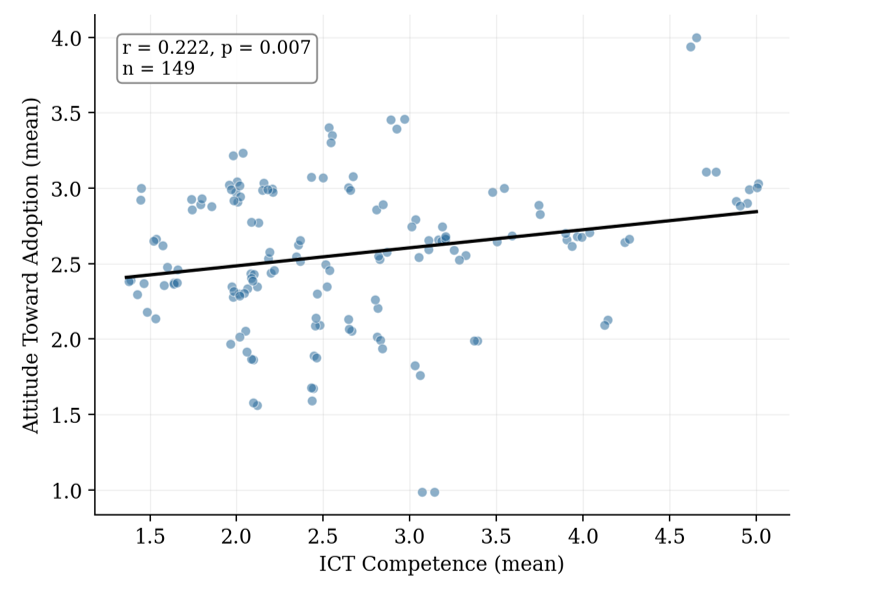
本研究探讨了尼日利亚西南部师范学院商业教育专业师范生在数字素养与对信息通信技术(ICT)应用态度之间的关系。将ICT融入教学取决于未来教师的素养和态度,但在资源匮乏的环境中,针对商业教育领域,这些构念之间的关联性鲜少被量化研究。 本研究基于技术接受模型和社会认知理论,采用相关性调查设计。149名师范生完成了结构化问卷,该问卷测量了数字素养、对采用ICT的态度以及对ICT的总体态度,其克朗巴赫α系数分别为0.84、0.80和0.85。 数据分析采用描述性统计、皮尔逊积差相关分析及多元线性回归。受访者报告的数字能力处于中等水平,态度也呈中度积极。数字能力与对采用信息通信技术的态度以及对信息通信技术的一般态度均存在显著正相关,而这两种态度维度之间也存在强烈关联。 能力与总体态度共同解释了采用态度变异量的36.1%,尽管在控制了态度因素后,能力不再是唯一的预测因子。研究得出结论:态度倾向,而非仅凭能力本身,才是采用行为更直接的相关因素,并建议教师培养应将能力建设与态度培养相结合。
RIS is compatible with Zotero, Mendeley, and EndNote. Immediate opening depends on the visitor's browser and reference-manager settings.
已发表文章中报告的声明
Author Contributions
Festus Oladimeji Olafare: Conceptualization, Methodology, Investigation, Formal Analysis, Data Curation, Writing – Original Draft, Writing – Review & Editing, Visualization, and Project Administration. As the sole author, Festus Oladimeji Olafare conceived the study, designed the methodology, collected and analysed the data, and prepared and approved the final manuscript.
Acknowledgments
The author wishes to thank the management and staff of the participating colleges of education for their cooperation during data collection.
View statement in PDF · PDF page 7Ethics Approval
The manuscript does not report a formal ethics committee approval, exemption determination, or protocol reference.
View statement in PDF · PDF page 7Informed Consent
Written informed consent was obtained from all participants before data collection.
View statement in PDF · PDF page 7Consent for Publication
Not applicable. The article contains no identifiable individual participant information.
Digital Competence and Attitude Towards ICT Adoption … (Festus Oladimeji Olafare, 2026)
资助
This research received no specific grant from any funding agency in the public, commercial, or notfor-profit sectors.
View statement in PDF · PDF page 8数据可用性
The data supporting the findings of this study are available from the corresponding author upon reasonable request, subject to applicable ethical and confidentiality restrictions.
View statement in PDF · PDF page 8利益冲突
The author declares no competing interests.
View statement in PDF · PDF page 8Generative AI Disclosure
During manuscript preparation and revision in 2026, the author used Claude (Anthropic) and ChatGPT (OpenAI) for language editing, structural refinement, and reference-format checking. These tools were not used to generate or modify the study data, statistical analyses, reported results, or conclusions. The author independently reviewed and revised all AI-assisted output, verified the references and substantive content, and accepts full responsibility for the accuracy, originality, analysis, and conclusions of the article.
View statement in PDF · PDF page 8参考
22 References[1] M. O. Yusuf, “Information and communication technology and education: Analysing the Nigerian national policy for information technology,” International Education Journal, vol. 6, no. 3, pp. 316–321, 2005.
[2] C. Buabeng-Andoh, “Factors influencing teachers’ adoption and integration of information and communication technology into teaching: A review of the literature,” International Journal of Education and Development using ICT, vol. 8, no. 1, pp. 136–155, 2012.
[3] F. D. Davis, “Perceived usefulness, perceived ease of use, and user acceptance of information technology,” MIS Quarterly, vol. 13, no. 3, pp. 319–340, 1989, doi: https://doi.org/10.2307/249008.
[4] D. R. Compeau and C. A. Higgins, “Computer self-efficacy: Development of a measure and initial test,” MIS Quarterly, vol. 19, no. 2, pp. 189–211, 1995, doi: https://doi.org/10.2307/249688.
[5] M. Fishbein and I. Ajzen, Belief, Attitude, Intention, and Behavior: An Introduction to Theory and Research. Reading, MA, USA: Addison-Wesley, 1975.
[6] T. Teo, “Modelling technology acceptance in education: A study of pre-service teachers,” Computers & Education, vol. 52, no. 2, pp. 302–312, 2009, doi: https://doi.org/10.1016/j.compedu.2008.08.006.
[7] T. Teo, “Factors influencing teachers’ intention to use technology: Model development and test,” Computers & Education, vol. 57, no. 4, pp. 2432–2440, 2011, doi: https://doi.org/10.1016/j.compedu.2011.06.008.
[8] A. Bandura, Social Foundations of Thought and Action: A Social Cognitive Theory. Englewood Cliffs, NJ, USA: Prentice-Hall, 1986.
[9] I. Ajzen, “The theory of planned behavior,” Organizational Behavior and Human Decision Processes, vol. 50, no. 2, pp. 179–211, 1991, doi: https://doi.org/10.1016/0749-5978(91)90020-T.
[10] V. Venkatesh, M. G. Morris, G. B. Davis, and F. D. Davis, “User acceptance of information technology: Toward a unified view,” MIS Quarterly, vol. 27, no. 3, pp. 425–478, 2003, doi: https://doi.org/10.2307/30036540.
[11] E. M. Rogers, Diffusion of Innovations, 5th ed. New York, NY, USA: Free Press, 2003.
[12] A. Albirini, “Teachers’ attitudes toward information and communication technologies: The case of Syrian EFL teachers,” Computers & Education, vol. 47, no. 4, pp. 373–398, 2006, doi: https://doi.org/10.1016/j.compedu.2004.10.013.
[13] M. O. Yusuf and M. R. Balogun, “Student-teachers’ competence and attitude towards information and communication technology: A case study in a Nigerian university,” Contemporary Educational Technology, vol. 2, no. 1, pp. 18–36, 2011, doi: https://doi.org/10.30935/cedtech/6041.
[14] G. Sang, M. Valcke, J. van Braak, and J. Tondeur, “Student teachers’ thinking processes and ICT integration: Predictors of prospective teaching behaviors with educational technology,” Computers & Education, vol. 54, no. 1, pp. 103–112, 2010, doi: https://doi.org/10.1016/j.compedu.2009.07.010.
[15] C. Player-Koro, “Factors influencing teachers’ use of ICT in education,” Education Inquiry, vol. 3, no. 1, pp. 93–108, 2012, doi: https://doi.org/10.3402/edui.v3i1.22015.
[16] A. Tella, A. Tella, O. M. Toyobo, L. O. Adika, and A. A. Adeyinka, “An assessment of secondary school teachers’ uses of ICTs: Implications for further development of ICT use in Nigerian secondary schools,” The Turkish Online Journal of Educational Technology, vol. 6, no. 3, pp. 5–17, 2007.
[17] J. C. Nunnally and I. H. Bernstein, Psychometric Theory, 3rd ed. New York, NY, USA: McGraw-Hill, 1994.
[18] J. Cohen, Statistical Power Analysis for the Behavioral Sciences, 2nd ed. Hillsdale, NJ, USA: Lawrence Erlbaum Associates, 1988.
[19] G. Falloon, “From digital literacy to digital competence: The teacher digital competency (TDC) framework,” Educational Technology Research and Development, vol. 68, no. 5, pp. 2449–2472, 2020, doi: https://doi.org/10.1007/s11423-020-09767-4.
[20] J. Tondeur, J. van Braak, G. Sang, J. Voogt, P. Fisser, and A. Ottenbreit-Leftwich, “Preparing pre-service teachers to integrate technology in education: A synthesis of qualitative evidence,” Computers & Education, vol. 59, no. 1, pp. 134–144, 2012, doi: https://doi.org/10.1016/j.compedu.2011.10.009.
[21] E. J. Instefjord and E. Munthe, “Educating digitally competent teachers: A study of integration of professional digital competence in teacher education,” Teaching and Teacher Education, vol. 67, pp. 37–45, 2017, doi: https://doi.org/10.1016/j.tate.2017.05.016.
[22] P. M. Podsakoff, S. B. MacKenzie, J.-Y. Lee, and N. P. Podsakoff, “Common method biases in behavioral research: A critical review of the literature and recommended remedies,” Journal of Applied Psychology, vol. 88, no. 5, pp. 879–903, 2003, doi: https://doi.org/10.1037/0021-9010.88.5.879.
Copyright and License

This work is licensed under a Creative Commons Attribution 4.0 International License.
Copyright (c) 2026 Olafare Festus Oladimeji