

Sustainable Development Goals
This article contributes to the following United Nations Sustainable Development Goals.

Palabras clave
Cómo citar




Resumen de la publicación

Próximo número
J-HyTEL welcomes original and rigorous scholarship advancing education, media technology, and computer science applications.
Rolling submissions are accepted throughout the year.
Resumen
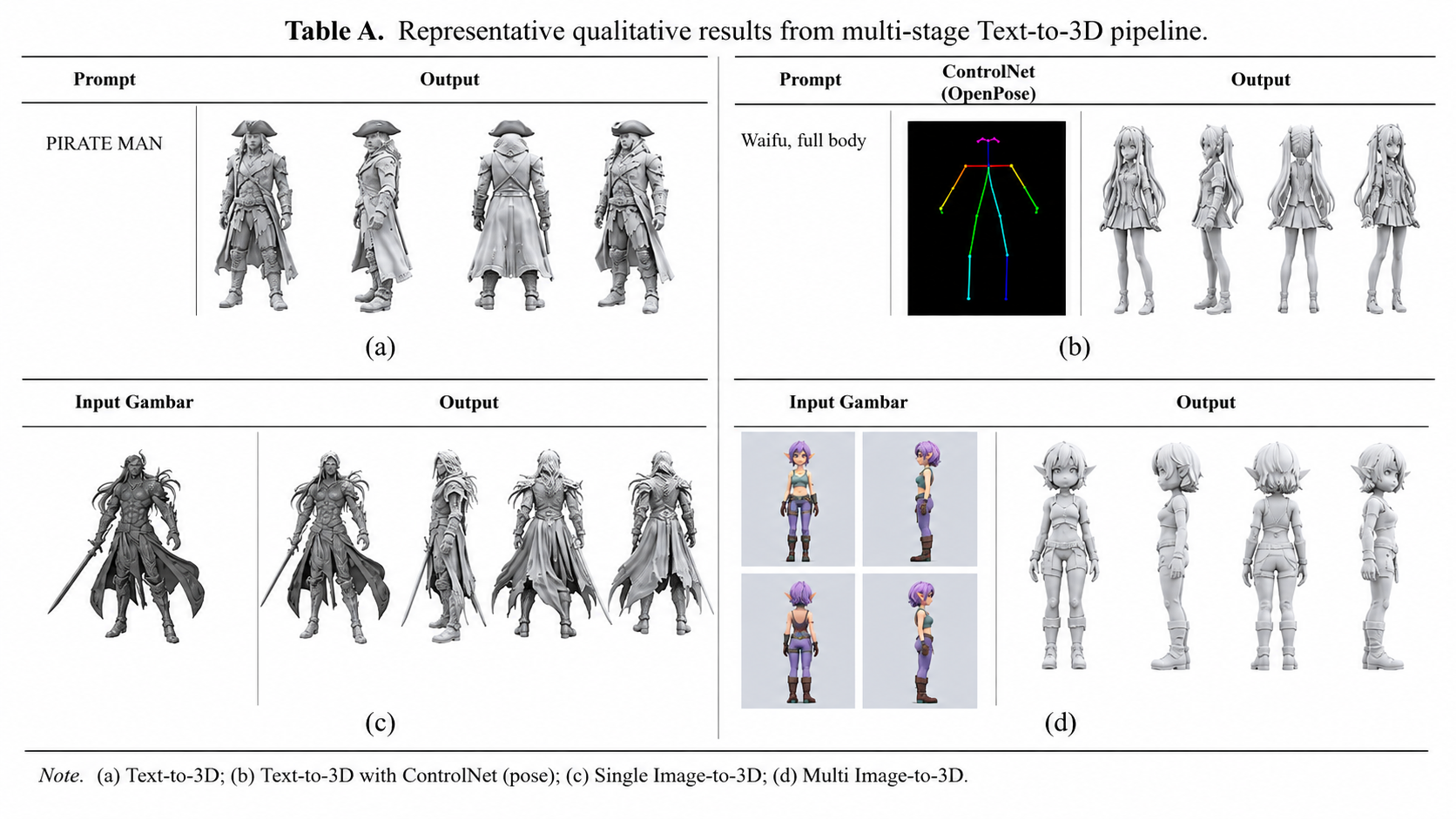
La generación 3D basada en indicaciones e imágenes puede reducir las barreras de interacción en la creación de activos digitales; sin embargo, los avances a nivel de modelos no permiten determinar si los no especialistas pueden llevar a cabo un flujo de trabajo completo de creación de contenidos. Este estudio diseñó y evaluó un prototipo web de interacción entre humanos e IA que integra una interfaz React, servicios FastAPI, la orquestación de flujos de trabajo con ComfyUI, el procesamiento asíncrono de tareas, el almacenamiento persistente de activos y la visualización 3D basada en navegador. Implementamos cuatro modos: «Texto a 3D», «Texto a 3D con ControlNet», «Imagen única a 3D» y «Varias imágenes a 3D». La evaluación combinó 14 escenarios de «caja negra» derivados de los requisitos, comprobaciones de compatibilidad GLB entre visores en tres entornos de visualización, 35 trabajos de generación completados, observación basada en tareas con siete participantes que completaron 84 ejecuciones de tareas, respuestas a la Escala de Usabilidad del Sistema (SUS) de un grupo independiente de 12 estudiantes y una evaluación por parte de un experto sobre la implementación y la calidad de los resultados. Los 14 escenarios funcionales produjeron los resultados esperados, y los resultados GLB probados se abrieron en el visor integrado, en Blender y en 3dviewer.net. El tiempo medio de respuesta del servidor fue de 66,15 s; una prueba exploratoria de Kruskal-Wallis indicó diferencias entre las distribuciones de la carga de trabajo observadas (H(3) = 10,52, p = 0,015, ε² = 0,243), pero no respaldó afirmaciones causales ni comparativas en cuanto a la velocidad. Todas las tareas observadas se completaron finalmente, pero solo 61 de las 84 ejecuciones (72,62 %) fueron independientes; las tareas 5 (acceder a Studio) y 10 (encontrar el modelo generado en «Mis proyectos») requirieron asistencia para cinco de los siete participantes en cada caso. La puntuación media en la escala SUS fue de 81,67 (DE = 9,25; IC del 95 % [75,79; 87,55]), mientras que la calidad del modelo generado recibió una puntuación de 3,50/5 por parte de un experto en diagnóstico. El estudio aporta una arquitectura de creación de contenido de extremo a extremo entre humanos e IA, así como una lógica de evaluación multidimensional que distingue entre conformidad funcional, tiempo de implementación, compatibilidad entre visores, interacción observada, usabilidad percibida y calidad del resultado. Los resultados respaldan la viabilidad de la creación generativa de contenido 3D accesible basada en la web, al tiempo que identifican limitaciones en cuanto a la facilidad de descubrimiento y la calidad geométrica.
RIS is compatible with Zotero, Mendeley, and EndNote. Immediate opening depends on the visitor's browser and reference-manager settings.
Declaraciones recogidas en el artículo publicado
Author Contributions
Ray Fadly Hadi: Conceptualization; Methodology; Software; Investigation; Data Curation; Formal Analysis; Visualization; Writing – Original Draft. Randi Proska Sandra: Supervision; Validation; Writing – Review & Editing. Sri Rejeki: Writing – Review & Editing. All authors have read and approved the final version of the manuscript.
Acknowledgments
The authors thank the expert for validation and the Informatics Study Program, Department of Electronics Engineering, Faculty of Engineering, Universitas Negeri Padang, for academic and technical support.
View statement in PDF · PDF page 14Financiación
This research received no specific grant from any funding agency in the public, commercial, or not-forprofit sectors.
View statement in PDF · PDF page 14Conflictos de Intereses
The authors declare no competing interests.
View statement in PDF · PDF page 14Ethics Approval
The study involved non-sensitive software-usability activities. According to the institutional requirements reported in the research record, formal ethical clearance was not required for this evaluation; participation was voluntary, and no medical, biological, or psychological intervention was conducted.
View statement in PDF · PDF page 14Informed Consent
Informed consent was obtained from all participants before task-based usability testing or completion of the System Usability Scale, as applicable.
View statement in PDF · PDF page 14Consent for Publication
Not applicable. The article does not report identifiable participant images or confidential personal records.
View statement in PDF · PDF page 14Disponibilidad de Datos
Aggregate evaluation results are reported in the article. The corresponding author may provide anonymized participant-level records, de-identified job measurements, and supporting system documentation upon reasonable request, subject to institutional and privacy requirements.
View statement in PDF · PDF page 14Generative AI Disclosure
During manuscript preparation, the authors used ChatGPT (OpenAI) and Claude (Anthropic) for language refinement. These tools were not used to generate, modify, or analyze the research data, usability scores, performance measurements, or expert assessments. All AI-assisted text was checked against the thesis record and cited sources, and the authors accept full responsibility for the final manuscript. Preprint and Prior Dissemination Statement This article is derived from the first author's undergraduate thesis and is not under consideration elsewhere.
View statement in PDF · PDF page 15Citas
36 References[1] B. Shneiderman, “Human-centered artificial intelligence: Reliable, safe & trustworthy,” Int. J. Hum.-Comput. Interact., vol. 36, no. 6, pp. 495–504, 2020, doi: https://doi.org/10.1080/10447318.2020.1741118.
[2] S. Amershi et al., “Guidelines for human–AI interaction,” in Proc. 2019 CHI Conf. Human Factors Comput. Syst., Glasgow, U.K., 2019, pp. 1–13, doi: https://doi.org/10.1145/3290605.3300233.
[3] Q. Yang, A. Steinfeld, C. Rosé, and J. Zimmerman, “Re-examining whether, why, and how human–AI interaction is uniquely difficult to design,” in Proc. 2020 CHI Conf. Human Factors Comput. Syst., Honolulu, HI, USA, 2020, pp. 1–13, doi: https://doi.org/10.1145/3313831.3376301.
[4] J. Ho, A. Jain, and P. Abbeel, “Denoising diffusion probabilistic models,” in Advances in Neural Information Processing Systems, vol. 33, pp. 6840–6851, 2020.
[5] R. Rombach, A. Blattmann, D. Lorenz, P. Esser, and B. Ommer, “High-resolution image synthesis with latent diffusion models,” in Proc. IEEE/CVF Conf. Comput. Vis. Pattern Recognit., New Orleans, LA, USA, 2022, pp. 10674–10685, doi: https://doi.org/10.1109/CVPR52688.2022.01042.
[6] A. Radford et al., “Learning transferable visual models from natural language supervision,” in Proc. 38th Int. Conf. Mach. Learn., vol. 139, pp. 8748–8763, 2021.
[7] B. Poole, A. Jain, J. T. Barron, and B. Mildenhall, “DreamFusion: Text-to-3D using 2D diffusion,” in Proc. Int. Conf. Learn. Representations, 2023.
[8] C.-H. Lin et al., “Magic3D: High-resolution text-to-3D content creation,” in Proc. IEEE/CVF Conf. Comput. Vis. Pattern Recognit., Vancouver, BC, Canada, 2023, pp. 300–309, doi: https://doi.org/10.1109/CVPR52729.2023.00037.
[9] Z. Wang et al., “ProlificDreamer: High-fidelity and diverse text-to-3D generation with variational score distillation,” in Advances in Neural Information Processing Systems, vol. 36, pp. 8406–8441, 2023, doi: https://doi.org/10.52202/075280-0368.
[10] Y. Chen, Y. Pan, H. Yang, T. Yao, and T. Mei, “VP3D: Unleashing 2D visual prompt for text-to-3D generation,” in Proc. IEEE/CVF Conf. Comput. Vis. Pattern Recognit. (CVPR), Seattle, WA, USA, 2024, pp. 4896–4905, doi: https://doi.org/10.1109/CVPR52733.2024.00468.
[11] R. Liu, R. Wu, B. Van Hoorick, P. Tokmakov, S. Zakharov, and C. Vondrick, “Zero-1-to-3: Zero-shot one image to 3D object,” in Proc. IEEE/CVF Int. Conf. Comput. Vis., Paris, France, 2023, pp. 9264–9275, doi: https://doi.org/10.1109/ICCV51070.2023.00853.
[12] A. Yu, V. Ye, M. Tancik, and A. Kanazawa, “pixelNeRF: Neural radiance fields from one or few images,” in Proc. IEEE/CVF Conf. Comput. Vis. Pattern Recognit., Nashville, TN, USA, 2021, pp. 4576–4585, doi: https://doi.org/10.1109/CVPR46437.2021.00455.
[13] S. Saito, Z. Huang, R. Natsume, S. Morishima, H. Li, and A. Kanazawa, “PIFu: Pixel-aligned implicit function for high-resolution clothed human digitization,” in Proc. IEEE/CVF Int. Conf. Comput. Vis., Seoul, South Korea, 2019, pp. 2304–2314, doi: https://doi.org/10.1109/ICCV.2019.00239.
[14] C. B. Choy, D. Xu, J. Y. Gwak, K. Chen, and S. Savarese, “3D-R2N2: A unified approach for single and multi-view 3D object reconstruction,” in Computer Vision – ECCV 2016, Cham, Switzerland: Springer, 2016, pp. 628–644, doi: https://doi.org/10.1007/978-3-319-46484-8_38.
[15] X. Long et al., “Wonder3D: Single image to 3D using cross-domain diffusion,” in Proc. IEEE/CVF Conf. Comput. Vis. Pattern Recognit., Seattle, WA, USA, 2024, pp. 9970–9980, doi: https://doi.org/10.1109/CVPR52733.2024.00951.
[16] L. Qiu et al., “RichDreamer: A generalizable normal-depth diffusion model for detail richness in text-to-3D,” in Proc. IEEE/CVF Conf. Comput. Vis. Pattern Recognit., Seattle, WA, USA, 2024, pp. 9914–9925, doi: https://doi.org/10.1109/CVPR52733.2024.00946.
[17] C. Volioti, V. Martsis, A. Ampatzoglou, E. Keramopoulos, and A. Chatzigeorgiou, “Codeless3D: Design and usability evaluation of a low-code tool for 3-D game generation,” IEEE Trans. Games, vol. 17, no. 2, pp. 296–307, 2025, doi: https://doi.org/10.1109/TG.2024.3424894.
[18] R. Kurai, T. Hiraki, Y. Hiroi, Y. Hirao, M. Perusquía-Hernández, H. Uchiyama, and K. Kiyokawa, “MagicCraft: Natural language-driven generation of dynamic and interactive 3D objects for commercial metaverse platforms,” IEEE Access, vol. 13, pp. 132459–132474, 2025, doi: https://doi.org/10.1109/ACCESS.2025.3587232.
[19] X. Xue, Z. Lu, D. Huang, Z. Wang, W. Ouyang, and L. Bai, “ComfyBench: Benchmarking LLM-based agents in ComfyUI for autonomously designing collaborative AI systems,” in Proc. IEEE/CVF Conf. Comput. Vis. Pattern Recognit., Nashville, TN, USA, 2025, pp. 24614–24624, doi: https://doi.org/10.1109/CVPR52734.2025.02292.
[20] R. S. Pressman and B. R. Maxim, Software Engineering: A Practitioner’s Approach, 8th ed. New York, NY, USA: McGraw-Hill Education, 2014.
[21] L. Zhang, A. Rao, and M. Agrawala, “Adding conditional control to text-to-image diffusion models,” in Proc. IEEE/CVF Int. Conf. Comput. Vis., Paris, France, 2023, pp. 3813–3824, doi: https://doi.org/10.1109/ICCV51070.2023.00355.
[22] L. Mescheder, M. Oechsle, M. Niemeyer, S. Nowozin, and A. Geiger, “Occupancy networks: Learning 3D reconstruction in function space,” in Proc. IEEE/CVF Conf. Comput. Vis. Pattern Recognit., Long Beach, CA, USA, 2019, pp. 4455–4465, doi: https://doi.org/10.1109/CVPR.2019.00459.
[23] J. J. Park, P. Florence, J. Straub, R. Newcombe, and S. Lovegrove, “DeepSDF: Learning continuous signed distance functions for shape representation,” in Proc. IEEE/CVF Conf. Comput. Vis. Pattern Recognit., Long Beach, CA, USA, 2019, pp. 165–174, doi: https://doi.org/10.1109/CVPR.2019.00025.
[24] M. Niemeyer, L. Mescheder, M. Oechsle, and A. Geiger, “Differentiable volumetric rendering: Learning implicit 3D representations without 3D supervision,” in Proc. IEEE/CVF Conf. Comput. Vis. Pattern Recognit., Seattle, WA, USA, 2020, pp. 3501–3512, doi: https://doi.org/10.1109/CVPR42600.2020.00356.
[25] M. Niemeyer, J. T. Barron, B. Mildenhall, M. S. M. Sajjadi, A. Geiger, and N. Radwan, “RegNeRF: Regularizing neural radiance fields for view synthesis from sparse inputs,” in Proc. IEEE/CVF Conf. Comput. Vis. Pattern Recognit., New Orleans, LA, USA, 2022, pp. 5470–5480, doi: https://doi.org/10.1109/CVPR52688.2022.00540.
[26] H. Kato, Y. Ushiku, and T. Harada, “Neural 3D mesh renderer,” in Proc. IEEE/CVF Conf. Comput. Vis. Pattern Recognit., Salt Lake City, UT, USA, 2018, pp. 3907–3916, doi: https://doi.org/10.1109/CVPR.2018.00411.
[27] T. Müller, A. Evans, C. Schied, and A. Keller, “Instant neural graphics primitives with a multiresolution hash encoding,” ACM Trans. Graph., vol. 41, no. 4, Art. no. 102, pp. 1–15, 2022, doi: https://doi.org/10.1145/3528223.3530127.
[28] S. Tulsiani, T. Zhou, A. A. Efros, and J. Malik, “Multi-view supervision for single-view reconstruction via differentiable ray consistency,” IEEE Trans. Pattern Anal. Mach. Intell., vol. 44, no. 12, pp. 8754–8765, 2022, doi: https://doi.org/10.1109/TPAMI.2019.2898859.
[29] R. A. Virzi, “Refining the test phase of usability evaluation: How many subjects is enough?,” Hum. Factors, vol. 34, no. 4, pp. 457–468, 1992, doi: https://doi.org/10.1177/001872089203400407.
[30] L. Faulkner, “Beyond the five-user assumption: Benefits of increased sample sizes in usability testing,” Behav. Res. Methods Instrum. Comput., vol. 35, no. 3, pp. 379–383, 2003, doi: https://doi.org/10.3758/BF03195514.
[31] J. Brooke, “SUS: A ‘quick and dirty’ usability scale,” in Usability Evaluation in Industry, P. W. Jordan, B. Thomas, B. A. Weerdmeester, and I. L. McClelland, Eds. London, U.K.: Taylor & Francis, 1996, pp. 189–194, doi: https://doi.org/10.1201/9781498710411-35.
[32] J. R. Lewis, “The System Usability Scale: Past, present, and future,” Int. J. Hum.-Comput. Interact., vol. 34, no. 7, pp. 577–590, 2018, doi: https://doi.org/10.1080/10447318.2018.1455307.
[33] Z. Li et al., “Neuralangelo: High-fidelity neural surface reconstruction,” in Proc. IEEE/CVF Conf. Comput. Vis. Pattern Recognit., Vancouver, BC, Canada, 2023, pp. 8456–8465, doi: https://doi.org/10.1109/CVPR52729.2023.00817.
[34] M. Oechsle, L. Mescheder, M. Niemeyer, T. Strauss, and A. Geiger, “Texture fields: Learning texture representations in function space,” in Proc. IEEE/CVF Int. Conf. Comput. Vis., Seoul, South Korea, 2019, pp. 4530–4539, doi: https://doi.org/10.1109/ICCV.2019.00463.
[35] P. Wang, L. Liu, Y. Liu, C. Theobalt, T. Komura, and W. Wang, “NeuS: Learning neural implicit surfaces by volume rendering for multi-view reconstruction,” in Advances in Neural Information Processing Systems, vol. 34, pp. 27171–27183, 2021.
[36] K. Schwarz, Y. Liao, M. Niemeyer, and A. Geiger, “GRAF: Generative radiance fields for 3D-aware image synthesis,” in Advances in Neural Information Processing Systems, vol. 33, pp. 20154–20166, 2020.
Copyright and License

Esta obra está bajo una licencia internacional Creative Commons Atribución 4.0.
Derechos de autor 2026 Ray Fadly Hadi, Randi Proska Sandra, Sri Rejeki