

Sustainable Development Goals
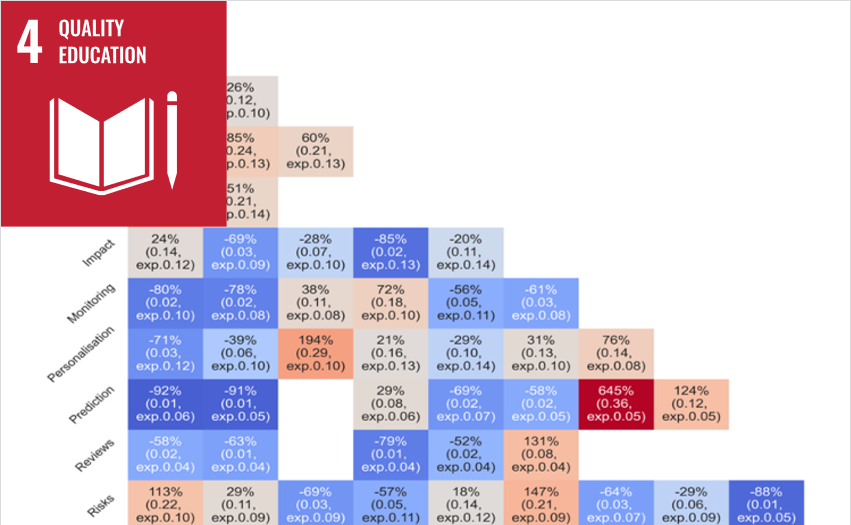
This article contributes to the following United Nations Sustainable Development Goals.

Palabras clave
Cómo citar




Resumen de la publicación
Próximo número
J-HyTEL welcomes original and rigorous scholarship advancing education, media technology, and computer science applications.
Rolling submissions are accepted throughout the year.
Resumen
La investigación sobre la inteligencia artificial (IA) en la educación se ha expandido a una velocidad sin precedentes, aunque su desarrollo sigue siendo fragmentado, impulsado por el bombo publicitario y distribuido de forma desigual entre disciplinas y regiones. Este artículo presenta uno de los mapeos más exhaustivos hasta la fecha, en el que se analizan 16 564 publicaciones (1990-2025) identificadas a través de Web of Science y seleccionadas hasta llegar a 4 626 contribuciones fundamentales mediante un método híbrido que combinaba el modelado computacional de temas, el filtrado asistido por IA y la validación humana. Para complementar este análisis a nivel macro, hemos llevado a cabo una revisión cualitativa de los artículos más citados en cada tema de investigación principal, lo que aporta una interpretación en profundidad sobre cómo los trabajos influyentes han dado forma a los debates sobre la adopción, la participación, la personalización, los chatbots, la evaluación, los riesgos, el seguimiento, las revisiones y la enseñanza de la IA. Los resultados revelan un crecimiento exponencial desde 2020, con importantes repuntes durante la pandemia de COVID-19 y tras el lanzamiento de ChatGPT, pero también una fragmentación persistente, un descenso de los estudios de evaluación y una saturación de las encuestas de actitud. Áreas prometedoras como la personalización, la enseñanza de la IA y la implicación han perdido visibilidad a pesar de su importancia a largo plazo, mientras que los riesgos y las cuestiones éticas siguen sin explorarse lo suficiente y están poco relacionadas con la investigación técnica. Los patrones de citas muestran, además, desequilibrios sistémicos, con artículos sobre educación citados de forma desproporcionada y trabajos de ingeniería infravalorados. Concluimos con una serie de recomendaciones para reforzar la interdisciplinariedad, abordar las áreas desatendidas, incluir perspectivas históricas y hacer frente a los retos sistémicos, con el fin de fomentar un campo más acumulativo, integrador y crítico.
RIS is compatible with Zotero, Mendeley, and EndNote. Immediate opening depends on the visitor's browser and reference-manager settings.
Declaraciones recogidas en el artículo publicado
Author Contributions
Constance de Saint Laurent: Conceptualization; Methodology; Investigation; Data Collection; Data Curation; Writing – Original Draft Preparation. Vlad Glaveanu: Theoretical Framework Development; Writing – Review & Editing. Ioana Literat: Theoretical Framework Development; Writing – Review & Editing. Ingunn Ness: Theoretical Framework Development; Writing – Review & Editing. All authors have read and approved the final version of the manuscript. All authors have read and approved the final version of the manuscript.
Acknowledgments
The authors would like to thank Natalie Robinson for her help formatting the final version of the paper.
View statement in PDF · PDF page 22Ethics Approval
This study was conducted in accordance with ethical standards.
View statement in PDF · PDF page 22Informed Consent
The study did not involve collecting empirical data from human participants.
View statement in PDF · PDF page 22Financiación
The authors declare that this research did not receive specific funding from any public, commercial, or not-for-profit agencies.
View statement in PDF · PDF page 22Disponibilidad de Datos
The data supporting this study’s findings are not publicly available. Summary data are included in the manuscript, and more detailed information can be requested from the corresponding author under strict confidentiality agreements.
View statement in PDF · PDF page 22Conflictos de Intereses
The authors declare that they have no competing interests related to the content of this article.
View statement in PDF · PDF page 22Generative AI Disclosure
During the preparation of this manuscript, the authors used AI (ChatGPT 4.0) to assist as part of the methodology of summarizing data, as explained in the manuscript. Whenever AI was used, the authors carefully reviewed and edited the content to ensure accuracy and integrity, and they take full responsibility for the published work.
View statement in PDF · PDF page 22Citas
41 References[1] V. Caputi and A. Garrido, “Student-oriented planning of e-learning contents for Moodle,” Journal of Network and Computer Applications, vol. 53, pp. 115–127, 2015, doi: https://doi.org/10.1016/j.jnca.2015.04.001
[2] H. S. Nwana, “Intelligent tutoring systems: An overview,” Artificial Intelligence Review, vol. 4, no. 4, pp. 251–277, 1990, doi: https://doi.org/10.1007/BF00168958
[3] H. Yu, C. Miao, C. Leung, and T. J. White, “Towards AI-powered personalization in MOOC learning,” npj Science of Learning, vol. 2, no. 1, Art. no. 15, 2017, doi: https://doi.org/10.1038/s41539-017-0016-3
[4] B. Cope, M. Kalantzis, and D. Searsmith, “Artificial intelligence for education: Knowledge and its assessment in AI-enabled learning ecologies,” Educational Philosophy and Theory, vol. 53, no. 12, pp. 1229–1245, 2021, doi: https://doi.org/10.1080/00131857.2020.1728732
[5] T. K. Chiu, Q. Xia, X. Zhou, C. S. Chai, and M. Cheng, “Systematic literature review on opportunities, challenges, and future research recommendations of artificial intelligence in education,” Computers and Education: Artificial Intelligence, vol. 4, Art. no. 100118, 2023, doi: https://doi.org/10.1016/j.caeai.2022.100118
[6] S. J. Lee and K. Kwon, “A systematic review of AI education in K-12 classrooms from 2018 to 2023: Topics, strategies, and learning outcomes,” Computers and Education: Artificial Intelligence, vol. 6, Art. no. 100211, 2024, doi: https://doi.org/10.1016/j.caeai.2024.100211
[7] F. Martin, M. Zhuang, and D. Schaefer, “Systematic review of research on artificial intelligence in K-12 education (2017–2022),” Computers and Education: Artificial Intelligence, vol. 6, Art. no. 100195, 2024, doi: https://doi.org/10.1016/j.caeai.2023.100195
[8] A. Tlili et al., “What if the devil is my guardian angel: ChatGPT as a case study of using chatbots in education,” Smart Learning Environments, vol. 10, no. 1, Art. no. 15, 2023, doi: https://doi.org/10.1186/s40561-023-00237-x
[9] F. J. Hinojo-Lucena, I. Aznar-Díaz, M. P. Cáceres-Reche, and J. M. Romero-Rodríguez, “Artificial intelligence in higher education: A bibliometric study on its impact in the scientific literature,” Education Sciences, vol. 9, no. 1, Art. no. 51, 2019, doi: https://doi.org/10.3390/educsci9010051
[10] O. Zawacki-Richter, V. I. Marín, M. Bond, and F. Gouverneur, “Systematic review of research on artificial intelligence applications in higher education—where are the educators?” International Journal of Educational Technology in Higher Education, vol. 16, no. 1, Art. no. 39, 2019, doi: https://doi.org/10.1186/s41239-019-0171-0
[11] A. Bozkurt, A. Karadeniz, D. Baneres, A. E. Guerrero-Roldán, and M. E. Rodríguez, “Artificial intelligence and reflections from educational landscape: A review of AI studies in half a century,” Sustainability, vol. 13, no. 2, Art. no. 800, 2021, doi: https://doi.org/10.3390/su13020800
[12] S. Guo, Y. Zheng, and X. Zhai, “Artificial intelligence in education research during 2013–2023: A review based on bibliometric analysis,” Education and Information Technologies, vol. 29, no. 13, pp. 16387–16409, 2024, doi: https://doi.org/10.1007/s10639-024-12491-8
[13] A. Gillespie, V. P. Glăveanu, and C. de Saint Laurent, Pragmatism and Methodology: Doing Research That Matters with Mixed Methods. Cambridge, U.K.: Cambridge University Press, 2024, doi: https://doi.org/10.1017/9781009031066
[14] C. Perrotta and N. Selwyn, “Deep learning goes to school: Toward a relational understanding of AI in education,” Learning, Media and Technology, vol. 45, no. 3, pp. 251–269, 2020, doi: https://doi.org/10.1080/17439884.2020.1686017
[15] M. C. Wijanto, I. Widiastuti, and H. S. Yong, “Topic modeling for scientific articles: Exploring optimal hyperparameter tuning in BERT,” International Journal on Advanced Science, Engineering and Information Technology, vol. 14, no. 3, pp. 912–919, 2024, doi: https://doi.org/10.18517/ijaseit.14.3.19347
[16] G. Piao, “Scholarly text classification with sentence BERT and entity embeddings,” in Trends and Applications in Knowledge Discovery and Data Mining, Cham, Switzerland: Springer, 2021, pp. 79–87, doi: https://doi.org/10.1007/978-3-030-75015-2_8
[17] S. Selva Birunda and R. Kanniga Devi, “A review on word embedding techniques for text classification,” in Innovative Data Communication Technologies and Application, Singapore: Springer, 2021, pp. 267–281, doi: https://doi.org/10.1007/978-981-15-9651-3_23
[18] R. Chocarro, M. Cortiñas, and G. Marcos-Matás, “Teachers’ attitudes towards chatbots in education: A technology acceptance model approach considering the effect of social language, bot proactiveness, and users’ characteristics,” Educational Studies, vol. 49, no. 2, pp. 295–313, 2023, doi: https://doi.org/10.1080/03055698.2020.1850426
[19] J. E. Raffaghelli, M. E. Rodríguez, A. E. Guerrero-Roldán, and D. Bañeres, “Applying the UTAUT model to explain the students’ acceptance of an early warning system in higher education,” Computers & Education, vol. 182, Art. no. 104468, 2022, doi: https://doi.org/10.1016/j.compedu.2022.104468
[20] M. Farrokhnia, S. K. Banihashem, O. Noroozi, and A. Wals, “A SWOT analysis of ChatGPT: Implications for educational practice and research,” Innovations in Education and Teaching International, vol. 61, no. 3, pp. 460–474, 2024, doi: https://doi.org/10.1080/14703297.2023.2195846
[21] J. Garzón, E. Patiño, and C. Marulanda, “Systematic review of artificial intelligence in education: Trends, benefits, and challenges,” Multimodal Technologies and Interaction, vol. 9, no. 8, Art. no. 84, 2025, doi: https://doi.org/10.3390/mti9080084
[22] M. Lan and X. Zhou, “A qualitative systematic review on AI empowered self-regulated learning in higher education,” npj Science of Learning, vol. 10, no. 1, Art. no. 21, 2025, doi: https://doi.org/10.1038/s41539-025-00319-0
[23] M. Mohammadi, E. Tajik, R. Martinez-Maldonado, S. Sadiq, and W. Tomaszewski, “Artificial intelligence in multimodal learning analytics: A systematic literature review,” Computers and Education: Artificial Intelligence, vol. 8, Art. no. 100426, 2025, doi: https://doi.org/10.1016/j.caeai.2025.100426
[24] A. Gouseti, F. James, L. Fallin, and K. Burden, “The ethics of using AI in K-12 education: A systematic literature review,” Technology, Pedagogy and Education, vol. 34, no. 2, pp. 161–182, 2025, doi: https://doi.org/10.1080/1475939X.2024.2428601
[25] J. García-López and L. Trujillo-Liñán, “Ethical and regulatory challenges of generative AI in education: A systematic review,” Frontiers in Education, vol. 10, Art. no. 1565938, 2025, doi: https://doi.org/10.3389/feduc.2025.1565938
[26] C. Y. Chang, G. J. Hwang, and M. L. Gau, “Promoting students’ learning achievement and self-efficacy: A mobile chatbot approach for nursing training,” British Journal of Educational Technology, vol. 53, no. 1, pp. 171–188, 2022, doi: https://doi.org/10.1111/bjet.13158
[27] J. Jeon and S. Lee, “Large language models in education: A focus on the complementary relationship between human teachers and ChatGPT,” Education and Information Technologies, vol. 28, no. 12, pp. 15873–15892, 2023, doi: https://doi.org/10.1007/s10639-023-11834-1
[28] S. Fergus, M. Botha, and M. Ostovar, “Evaluating academic answers generated using ChatGPT,” Journal of Chemical Education, vol. 100, no. 4, pp. 1672–1675, 2023, doi: https://doi.org/10.1021/acs.jchemed.3c00087
[29] C. Kooli, “Chatbots in education and research: A critical examination of ethical implications and solutions,” Sustainability, vol. 15, no. 7, Art. no. 5614, 2023, doi: https://doi.org/10.3390/su15075614
[30] D. Yan, “Impact of ChatGPT on learners in a L2 writing practicum: An exploratory investigation,” Education and Information Technologies, vol. 28, no. 11, pp. 13943–13967, 2023, doi: https://doi.org/10.1007/s10639-023-11742-4
[31] J. Bernard, T. W. Chang, E. Popescu, and S. Graf, “Learning style identifier: Improving the precision of learning style identification through computational intelligence algorithms,” Expert Systems with Applications, vol. 75, pp. 94–108, 2017, doi: https://doi.org/10.1016/j.eswa.2017.01.021
[32] K. Sharma, Z. Papamitsiou, and M. Giannakos, “Building pipelines for educational data using AI and multimodal analytics: A ‘grey-box’ approach,” British Journal of Educational Technology, vol. 50, no. 6, pp. 3004–3031, 2019, doi: https://doi.org/10.1111/bjet.12854
[33] B. Berendt, A. Littlejohn, and M. Blakemore, “AI in education: Learner choice and fundamental rights,” Learning, Media and Technology, vol. 45, no. 3, pp. 312–324, 2020, doi: https://doi.org/10.1080/17439884.2020.1786399
[34] E. Dixon-Román, T. P. Nichols, and A. Nyame-Mensah, “The racializing forces of/in AI educational technologies,” Learning, Media and Technology, vol. 45, no. 3, pp. 236–250, 2020, doi: https://doi.org/10.1080/17439884.2020.1667825
[35] D. Schiff, “Out of the laboratory and into the classroom: The future of artificial intelligence in education,” AI & Society, vol. 36, no. 1, pp. 331–348, 2021, doi: https://doi.org/10.1007/s00146-020-01033-8
[36] D. Hooshyar et al., “Towards responsible AI for education: Hybrid human-AI to confront the elephant in the room,” Computers and Education: Artificial Intelligence, vol. 9, Art. no. 100524, 2025, doi: https://doi.org/10.1016/j.caeai.2025.100524
[37] C. S. Chai, X. Wang, and C. Xu, “An extended theory of planned behavior for the modelling of Chinese secondary school students’ intention to learn artificial intelligence,” Mathematics, vol. 8, no. 11, Art. no. 2089, 2020, doi: https://doi.org/10.3390/math8112089
[38] P. Song and X. Wang, “A bibliometric analysis of worldwide educational artificial intelligence research development in recent twenty years,” Asia Pacific Education Review, vol. 21, no. 3, pp. 473–486, 2020, doi: https://doi.org/10.1007/s12564-020-09640-2
[39] Q. Xia, T. K. Chiu, M. Lee, I. T. Sanusi, Y. Dai, and C. S. Chai, “A self-determination theory (SDT) design approach for inclusive and diverse artificial intelligence (AI) education,” Computers & Education, vol. 189, Art. no. 104582, 2022, doi: https://doi.org/10.1016/j.compedu.2022.104582
[40] V. Liu, E. Latif, and X. Zhai, “Advancing education through tutoring systems: A systematic literature review,” arXiv:2503.09748, 2025, doi: https://doi.org/10.48550/arXiv.2503.09748. [Online]. Available: https://arxiv.org/abs/2503.09748
[41] M. Georgieva and J. Stuart, “Ethics is the edge: The future of AI in higher education,” EDUCAUSE Review, Jun. 24, 2025. [Online]. Available: https://er.educause.edu/articles/2025/6/ethics-is-the-edge-the-future-of-ai-in-higher-education
Copyright and License

Esta obra está bajo una licencia internacional Creative Commons Atribución 4.0.
Derechos de autor 2026 Constance de Saint Laurent, Vlad Glaveanu, Ioana Literat, Ingunn Ness