

Sustainable Development Goals
This article contributes to the following United Nations Sustainable Development Goals.


Kata Kunci
Cara Mengutip




Ringkasan Publikasi
Edisi Mendatang
J-HyTEL welcomes original and rigorous scholarship advancing education, media technology, and computer science applications.
Rolling submissions are accepted throughout the year.
Abstrak
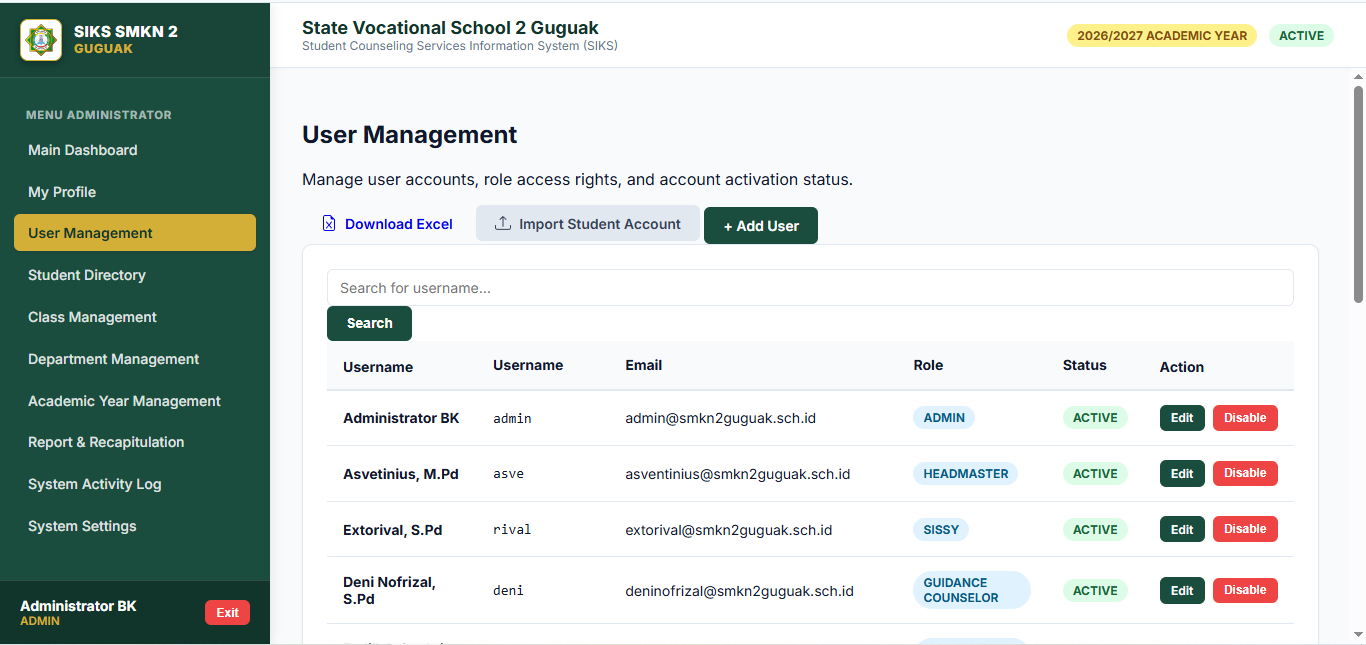
Catatan bimbingan konseling sekolah yang terfragmentasi dapat mengaburkan riwayat kasus, mengganggu tindak lanjut, dan melemahkan komunikasi dengan keluarga. Penelitian ini mengembangkan dan mengevaluasi secara formatif SiKS, sebuah sistem informasi bimbingan konseling siswa berbasis web terintegrasi yang menghubungkan kegiatan bimbingan melalui akses berbasis peran dan pemberitahuan WhatsApp otomatis. Persyaratan dikumpulkan melalui wawancara dengan Wakil Kepala Sekolah Bidang Kemahasiswaan dan seorang Konselor Sekolah di sebuah sekolah menengah kejuruan di Indonesia, dilengkapi dengan analisis alur kerja yang ada. Dikembangkan menggunakan model Waterfall, Laravel, dan MySQL, prototipe ini menghubungkan permintaan janji temu, penjadwalan, catatan konseling, tindakan tindak lanjut, panggilan orang tua, pelaporan, dan log notifikasi di antara enam peran pengguna. Evaluasi mencakup 50 skenario black-box yang disusun berdasarkan persyaratan serta pengujian penerimaan pengguna dengan 20 responden yang mewakili masing-masing peran setelah sesi panduan penggunaan. Tiga validator meninjau instrumen yang terdiri dari 15 item, memberikan skor 211 dari 225 poin yang mungkin (93,78%). Semua 50 skenario fungsional yang dijalankan menghasilkan keluaran yang diharapkan. Skor penerimaan pengguna mencapai 1.336 dari 1.500 poin (89,07%), dengan skor per item berkisar antara 82% hingga 96%. Daya tarik antarmuka, kesesuaian untuk penggunaan di sekolah, aksesibilitas menu, dan persepsi kerahasiaan dalam akses berbasis peran memperoleh penilaian tertinggi; sedangkan kejelasan laporan, pencetakan dan pengunduhan, serta layanan pemberitahuan memperoleh penilaian yang relatif lebih rendah. Studi ini menyajikan desain yang spesifik konteks yang menghubungkan kesinambungan kasus, akses yang dibedakan, dan komunikasi yang dipicu peristiwa dalam satu alur kerja konseling. Temuan ini mendukung kesesuaian fungsional dalam kondisi yang diuji serta persepsi awal pengguna yang positif. Pengujian yang dipimpin oleh pengembang, pengaturan di satu sekolah saja, dan paparan yang dipandu membatasi kesimpulan mengenai penggunaan mandiri, adopsi berkelanjutan, perlindungan privasi, dan hasil konseling.
RIS is compatible with Zotero, Mendeley, and EndNote. Immediate opening depends on the visitor's browser and reference-manager settings.
Pernyataan yang dilaporkan dalam artikel yang diterbitkan
Author Contributions
Welly Aryatama: Conceptualization; Methodology; Software; Investigation; Data Curation; Writing – original draft. Syukhri: Conceptualization; Supervision; Validation; Writing – review & editing. Khairi Budayawan: Validation; Writing – review & editing. Delvi Asmara: Validation; Writing – review & editing. Dean Collin Langeveldt: Writing – review & editing. All authors have read and approved the final version of the manuscript.
Acknowledgments
The authors thank the staff of SMKN 2 Guguak in Ampang Gadang, Guguak District, Lima Puluh Kota Regency, West Sumatra, for their cooperation during the system requirements analysis and for providing information about the school's operational context. The authors are also grateful to the Department of Informatics Engineering Education, Universitas Negeri Padang, for the academic support provided throughout this research.
View statement in PDF · PDF page 16Ethics Approval
This study was conducted as an undergraduate software development and formative usability project at SMKN 2 Guguak with formal authorization from the school and the Principal's approval. The study involved no clinical or therapeutic intervention, used trial data only, and did not access or process real student counseling records or identifiable sensitive case information.
View statement in PDF · PDF page 16Informed Consent
Participation was voluntary, and all participants were informed of the purpose and procedures of the evaluation before taking part. The school-based evaluation was conducted with written authorization from SMKN 2 Guguak and approval from the Principal. Verbal informed consent was obtained from each participant. For student participants who were minors, written parental or guardian consent was obtained, along with the students’ voluntary agreement to participate. The evaluation used trial data only and did not involve real counseling records or identifiable sensitive case information. All names, telephone numbers, addresses, and other personal details shown in the manuscript figures are fictitious.
View statement in PDF · PDF page 16Pendanaan
This research received no specific grant from any funding agency in the public, commercial, or not-forprofit sectors. It was conducted as part of the first author's undergraduate thesis at Universitas Negeri Padang.
View statement in PDF · PDF page 17Ketersediaan Data
Aggregated functional-testing and UAT results are reported in the manuscript and appendices. Additional de-identified supporting records may be available from the corresponding author upon reasonable request, subject to institutional and confidentiality requirements.
View statement in PDF · PDF page 17Konflik Kepentingan
The authors declare that there are no competing interests related to this article.
View statement in PDF · PDF page 17Generative AI Disclosure
During manuscript preparation and revision, the authors used generative AI tools, including ChatGPT, Claude, and Gemini, solely to edit language and improve clarity. These tools were not used to generate, fabricate, or modify empirical data, analyses, or reported results. The authors reviewed and verified all AI-assisted content against the original research records and cited sources. They take full responsibility for the accuracy, integrity, and final content of the manuscript. Preprint and Prior Dissemination This article is derived from the first author's undergraduate thesis and is not under consideration for publication elsewhere.
View statement in PDF · PDF page 17Referensi
33 References[1] T. Q. A. Ho et al., “Barriers to and facilitators of user engagement with web-based mental health interventions in young people: A systematic review,” Eur. Child Adolesc. Psychiatry, vol. 34, no. 1, pp. 83–100, 2025, doi: https://doi.org/10.1007/s00787-024-02386-x.
[2] S. Liverpool et al., “Updates on digital mental health interventions for children and young people: Systematic overview of reviews,” Eur. Child Adolesc. Psychiatry, vol. 34, no. 10, pp. 2961–2974, 2025, doi: https://doi.org/10.1007/s00787-025-02722-9.
[3] M. Wright, F. Reitegger, H. Cela, A. Papst, and B. Gasteiger-Klicpera, “Interventions with digital tools for mental health promotion among 11–18 year olds: A systematic review and meta-analysis,” J. Youth Adolesc., vol. 52, no. 4, pp. 754–779, 2023, doi: https://doi.org/10.1007/s10964-023-01735-4.
[4] Republic of Indonesia, “Undang-Undang Republik Indonesia Nomor 20 Tahun 2003 tentang Sistem Pendidikan Nasional,” Lembaran Negara Republik Indonesia Tahun 2003 Nomor 78, Tambahan Lembaran Negara Republik Indonesia Nomor 4301, Jul. 8, 2003.
[5] S. Siraj, S. Nasrah, and T. Trisfayani, “The system approach in the perspective of Law Number 20 of 2003 concerning the National Education System,” Int. J. Educ. Vocat. Stud., vol. 1, no. 1, pp. 47–52, 2019, doi: https://doi.org/10.29103/ijevs.v1i1.1465.
[6] R. Muhammad and Patriana, “Analisis implementasi Permendikbud Nomor 111 Tahun 2014 tentang bimbingan dan konseling,” J. Ilm. Edukatif, vol. 7, no. 1, pp. 53–65, 2021, doi: https://doi.org/10.37567/jie.v7i1.518.
[7] D. Parveen and S. Akhtar, “The role of guidance and counselling in schools: A literature review,” Int. J. Indian Psychol., vol. 11, no. 2, pp. 558–568, 2023, doi: https://doi.org/10.25215/1102.058.
[8] N. Daulay, S. T. Sumanti, F. Faisal, and M. F. S. Siregar, “The urgence of counseling guidance in developing student discipline in junior high school Muhammadiyah Tebing Tinggi,” KONSELI: J. Bimbingan dan Konseling (E-Journal), vol. 8, no. 2, pp. 251–256, 2021, doi: https://doi.org/10.24042/kons.v8i2.10424.
[9] E. Ahyani and E. M. Dhuhani, “Transformasi digital dalam manajemen perkantoran pendidikan: Sebuah kajian literatur,” J. Visionary: Penelit. dan Pengemb. dibidang Adm. Pendidik., vol. 12, no. 1, pp. 205–215, 2024, doi: https://doi.org/10.33394/vis.v12i1.10785.
[10] W. H. DeLone and E. R. McLean, “The DeLone and McLean model of information systems success: A ten-year update,” J. Manag. Inf. Syst., vol. 19, no. 4, pp. 9–30, 2003, doi: https://doi.org/10.1080/07421222.2003.11045748.
[11] M. A. de Carvalho Junior and P. Bandiera-Paiva, “Health information system role-based access control current security trends and challenges,” J. Healthc. Eng., vol. 2018, Art. no. 6510249, 2018, doi: https://doi.org/10.1155/2018/6510249.
[12] D. Robotham, S. Satkunanathan, J. Reynolds, D. Stahl, and T. Wykes, “Using digital notifications to improve attendance in clinic: Systematic review and meta-analysis,” BMJ Open, vol. 6, no. 10, Art. no. e012116, 2016, doi: https://doi.org/10.1136/bmjopen-2016-012116.
[13] W. Atika, Susanti, and A. B. Permadi, “Perancangan sistem informasi e-konseling berbasis web pada SMKs Siti Banun Sumatera Utara,” Indonesian J. Informatic Res. Softw. Eng. (IJIRSE), vol. 2, no. 2, pp. 147–158, 2022, doi: https://doi.org/10.57152/ijirse.v2i2.433.
[14] V. Marisa, S. A. Wijaya, and N. Tsabitah, “Penerapan model prototype rancang bangun sistem bimbingan konseling berbasis web pada SMK Muhammadiyah 3 Pekanbaru,” J. Ilmu Komput. dan Sist. Inf. (JIKOMSI), vol. 7, no. 1, pp. 254–263, 2024, doi: https://doi.org/10.55338/jikomsi.v7i1.2925.
[15] N. M. N. F. Yanti, A. A. I. I. Paramitha, and E. G. A. Dewi, “Rancang bangun sistem informasi bimbingan konseling pada SMA Negeri 1 Baturiti dengan metode Waterfall,” Kumpul. Artik. Mhs. Pendidik. Tek. Inform., vol. 13, no. 3, pp. 117–128, 2024, doi: https://doi.org/10.23887/karmapati.v13i3.87662.
[16] H. Wulandari and G. Farell, “Rancang bangun sistem informasi poin pelanggaran siswa berbasis web di SMK Negeri 1 Painan,” ELEKTIF J. Elektron. Inform., vol. 2, no. 2, pp. 126–140, 2024, doi: https://doi.org/10.24036/elektif.v2i2.62.
[17] E. Mariati, C. C. Scorpiono, and Kristanto, “Perancangan sistem informasi bimbingan konseling untuk SMK Santa Monika Sungai Raya,” TECHBUS (Technology, Business and Entrepreneurship), vol. 3, no. 1, pp. 19–30, 2025, doi: https://doi.org/10.61245/techbus.v3i1.48.
[18] H. J. S. Putranto and J. J. C. Tambotoh, “Perancangan sistem informasi layanan pengaduan dan konseling siswa Teman Konseling berbasis web,” Jutisi J. Ilm. Tek. Inform. dan Sist. Inf., vol. 14, no. 2, pp. 1290–1303, 2025, doi: https://doi.org/10.35889/jutisi.v14i2.2980.
[19] Ruspisah and C. E. Suharyanto, “Implementasi sistem informasi pendataan siswa berbasis web dengan fitur dynamic reporting dan auto-grouping kelas di Sekolah Globe National Plus 2 Batam,” J. Teknol. Digit. dan Sist. Inf., vol. 3, no. 1, pp. 84–92, 2026, doi: https://doi.org/10.47024/jutekdisi.v3i1.1329.
[20] E. Proctor et al., “Outcomes for implementation research: Conceptual distinctions, measurement challenges, and research agenda,” Adm. Policy Ment. Health, vol. 38, pp. 65–76, 2011, doi: https://doi.org/10.1007/s10488-010-0319-7.
[21] L. J. Damschroder, C. M. Reardon, M. A. O. Widerquist, and J. Lowery, “The updated Consolidated Framework for Implementation Research based on user feedback,” Implement. Sci., vol. 17, Art. no. 75, 2022, doi: https://doi.org/10.1186/s13012-022-01245-0.
[22] F. T. Zany, A. Sujud, and J. Nurgaza, “Pengembangan sistem manajemen WhatsApp API (Application Programming Interface) dengan menggunakan WhatsApp-Web.js,” J. Informatics Comput. Sci., vol. 10, no. 2, pp. 140–153, 2024, doi: https://doi.org/10.33143/jics.v10i2.4761.
[23] S. Aprilia, “Sistem informasi absensi berbasis website menggunakan API WhatsApp dengan metodologi incremental (Studi kasus: SMP Negeri 29 Pekanbaru),” J. Appl. Informatics Comput., vol. 4, no. 1, pp. 38–44, 2020, doi: https://doi.org/10.30871/jaic.v4i1.1966.
[24] S. V. Yulianto, L. D. Setia, and A. P. Atmaja, “The use of WhatsApp Gateway for automatic notification system,” J. Phys.: Conf. Ser., vol. 1845, no. 1, Art. no. 012014, 2021, doi: https://doi.org/10.1088/1742-6596/1845/1/012014.
[25] A. B. Nasution, A. Y. N. Hrp, Y. Yudi, and M. Fauzi, “Implementation of OTP code as application login verification via Whatsapp,” Indonesian J. Appl. Ind. Sci. (ESA), vol. 3, no. 4, pp. 395–402, 2024, doi: https://doi.org/10.55927/esa.v3i4.10225.
[26] Uminingsih, M. N. Ichsanudin, M. Yusuf, and Suraya, “Pengujian fungsional perangkat lunak sistem informasi perpustakaan dengan metode Black Box Testing bagi pemula,” STORAGE J. Ilm. Tek. dan Ilmu Komput., vol. 1, no. 2, pp. 1–8, 2022, doi: https://doi.org/10.55123/storage.v1i2.270.
[27] A. Wibowo and I. Darwati, “Perancangan sistem informasi pengelolaan sarana dan prasarana dengan pengujian User Acceptance Testing,” Reputasi: J. Rekayasa Perangkat Lunak, vol. 3, no. 1, pp. 1–6, 2022, doi: https://doi.org/10.31294/reputasi.v3i1.1200.
[28] W. Harjono and K. J. Tute, “Perancangan sistem informasi perpustakaan berbasis web menggunakan metode Waterfall,” SATESI J. Sains Teknol. dan Sist. Inf., vol. 2, no. 1, pp. 47–51, 2022, doi: https://doi.org/10.54259/satesi.v2i1.773.
[29] M. Demba, “Algorithm for relational database normalization up to 3NF,” Int. J. Database Manag. Syst., vol. 5, no. 3, pp. 39–51, 2013, doi: https://doi.org/10.5121/ijdms.2013.5303.
[30] M. Hardini, V. Agarwal, D. Apriani, I. A. Widjaya, E. Setiawaty, and Nurasiah, “Application of database normalization in increasing data storage efficiency,” Int. Trans. Artif. Intell. (ITALIC), vol. 3, no. 2, pp. 201–211, 2025, doi: https://doi.org/10.33050/italic.v3i2.799.
[31] K. ’Afiifah, Z. F. Azzahra, and A. D. Anggoro, “Analisis teknik Entity-Relationship Diagram dalam perancangan database: Sebuah literature review,” INTECH, vol. 3, no. 2, pp. 70–74, 2022, doi: https://doi.org/10.54895/intech.v3i2.1682.
[32] M. Sumiati, R. Abdillah, and A. Cahyo, “Pemodelan UML untuk sistem informasi persewaan alat pesta,” J. FASILKOM, vol. 11, no. 2, pp. 79–86, 2021, doi: https://doi.org/10.37859/jf.v11i2.2673.
[33] M. R. Wayahdi and F. Ruziq, “Pemodelan sistem penerimaan anggota baru dengan Unified Modeling Language (UML) (Studi kasus: Programmer Association of Battuta),” J. Minfo Polgan, vol. 12, no. 1, pp. 1514–1521, 2023, doi: https://doi.org/10.33395/jmp.v12i1.12870.
Copyright and License

Artikel ini berlisensi Creative Commons Attribution 4.0 International License.
Hak Cipta (c) 2026 Welly Aryatama, Syukhri, Khairi Budayawan, Delvi Asmara, Dean Collin Langeveldt