

Sustainable Development Goals
This article contributes to the following United Nations Sustainable Development Goals.
키워드
인용 방법




출판물 개요

차기호
J-HyTEL welcomes original and rigorous scholarship advancing education, media technology, and computer science applications.
Rolling submissions are accepted throughout the year.
초록
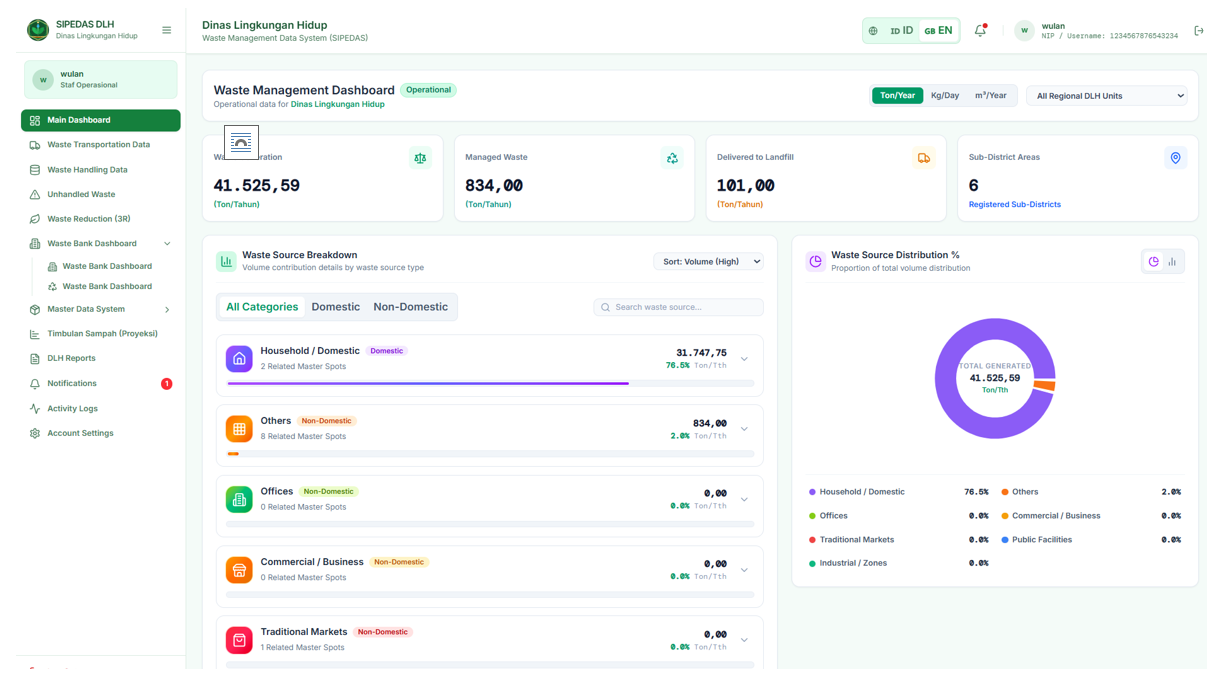
많은 지방 자치단체에서 도시 폐기물 관리는 종종 분산된 기록, 서로 연계되지 않은 보고 관행, 조직 단위 간 제한된 추적성으로 인해 제약을 받습니다. 본 연구는 분산된 행정 프로세스를 중앙 집중식이며 역할 기반이고 감사 가능한 디지털 워크플로우로 통합하는 방법을 검토하고, 그 기능성과 사용 편의성을 평가합니다. 인도네시아 파당 파리암안(Padang Pariaman) 군 환경사무소에서 17개 소지구의 폐기물 관리 활동을 대상으로 단일 현장 설계 및 평가 사례가 수행되었다. SIPEDAS는 Laravel RESTful API, React/TypeScript 인터페이스, 중앙 집중식 MySQL 데이터베이스를 통해 운영 기록, 마스터 데이터, 보고, 역할 기반 접근 제어 및 활동 로깅을 통합합니다. 평가에서는 요구사항에서 도출된 25개의 블랙박스 시나리오를 시스템 사용성 척도(SUS)와 결합하여 수행했다. 실행된 25개의 기능 테스트 시나리오 모두 사전 정의된 승인 기준을 충족했다. 10건의 완전한 참가자 수준 SUS 기록은 평균 점수 68.25(표준편차 = 11.37; 중앙값 = 71.25; 범위 = 50–80)를 기록했으며, 이는 널리 인용되는 벤치마크에 근접했으나 참가자 간 상당한 편차가 있었습니다. 요구사항 도출, 테스터의 독립성, SUS 시행에 대한 기록이 불완전하여 재현성이 제한되고 응답자 간 차이의 해석에도 한계가 있습니다. 이번 연구 결과는 SIPEDAS가 추적 가능한 낭비 데이터 관리의 기능적 토대임을 뒷받침하지만, 결함의 부재, 조직적 효율성 향상, 또는 검증된 보안, 신뢰성 및 성능을 입증하지는 않는다. 이 연구의 주요 기여점은 구현된 통제 사항, 실행된 기능적 적합성, 인식된 사용성, 실제 사용 및 조직적 결과를 구분하여 요구사항과 평가 증거를 연계하는 접근 방식을 제시한 점이다.
RIS is compatible with Zotero, Mendeley, and EndNote. Immediate opening depends on the visitor's browser and reference-manager settings.
게재된 논문에 보고된 선언 사항
Author Contributions
Wulan Ainiyyah Puteri: Conceptualization; Methodology; Software; Investigation; Writing – Original Draft. Syafrijon: Data Curation; Writing – Review & Editing; Supervision. All authors have read and approved the final version of the manuscript.
Acknowledgments
The authors would like to thank the management and operational staff of the Environmental Office (Dinas Lingkungan Hidup) of Padang Pariaman Regency, West Sumatra, for their cooperation and provision of operational context, as well as the Department of Electronics Engineering, Universitas Negeri Padang, for their academic support.
View statement in PDF · PDF page 16연구비 지원
This research received no specific grant from any funding agency.
View statement in PDF · PDF page 16이해 상충
The authors declare no competing interests.
View statement in PDF · PDF page 16Ethics Approval
The study involved non-invasive software evaluation and an adult professional-user usability questionnaire. Institutional operational permission from the Environmental Office of Padang Pariaman Regency and informed consent from participants were documented. However, the retained study record contains no formal ethics-committee approval, exemption, or waiver determination. Institutional operational permission is therefore not presented as equivalent to research-ethics review.
View statement in PDF · PDF page 16Informed Consent
Informed consent was obtained from all participants before completion of the usability questionnaire.
View statement in PDF · PDF page 16데이터 가용성
The data supporting the reported functional testing and usability results, together with system documentation and database schemas, are available from the corresponding author upon reasonable request, subject to institutional data-governance requirements.
View statement in PDF · PDF page 16Generative AI Disclosure
During manuscript preparation in July 2026, the authors used ChatGPT (OpenAI; GPT-5-series models) for language editing. All final wording was critically checked and revised by the human authors, who retain full responsibility for the accuracy, originality, and integrity of the manuscript.
View statement in PDF · PDF page 16References
26 References[1] Z. Zhang, Z. Chen, J. Zhang, Y. Liu, L. Chen, M. Yang, A. I. Osman, M. Farghali, E. Liu, D. Hassan, I. Ihara, K. Lu, D. W. Rooney, and P.-S. Yap, “Municipal solid waste management challenges in developing regions: A comprehensive review and future perspectives for Asia and Africa,” Sci. Total Environ., vol. 930, Art. no. 172794, 2024, doi: https://doi.org/10.1016/j.scitotenv.2024.172794
[2] D. C. Wilson, L. Rodic, M. J. Cowing, C. A. Velis, A. D. Whiteman, A. Scheinberg, R. Vilches, D. Masterson, J. Stretz, and B. Oelz, “‘Wasteaware’ benchmark indicators for integrated sustainable waste management in cities,” Waste Manag., vol. 35, pp. 329–342, 2015, doi: https://doi.org/10.1016/j.wasman.2014.10.006
[3] Y. A. Fatimah, K. Govindan, R. Murniningsih, and A. Setiawan, “Industry 4.0 based sustainable circular economy approach for smart waste management system to achieve sustainable development goals: A case study of Indonesia,” J. Clean. Prod., vol. 269, Art. no. 122263, 2020, doi: https://doi.org/10.1016/j.jclepro.2020.122263
[4] D. Kannan, S. Khademolqorani, N. Janatyan, and S. Alavi, “Smart waste management 4.0: The transition from a systematic review to an integrated framework,” Waste Manag., vol. 174, pp. 1–14, 2024, doi: https://doi.org/10.1016/j.wasman.2023.08.041
[5] I. Mergel, N. Edelmann, and N. Haug, “Defining digital transformation: Results from expert interviews,” Gov. Inf. Q., vol. 36, no. 4, Art. no. 101385, 2019, doi: https://doi.org/10.1016/j.giq.2019.06.002
[6] J. J. Pittaway and A. R. Montazemi, “Know-how to lead digital transformation: The case of local governments,” Gov. Inf. Q., vol. 37, no. 4, Art. no. 101474, 2020, doi: https://doi.org/10.1016/j.giq.2020.101474
[7] L. Tangi, M. Janssen, M. Benedetti, and G. Noci, “Digital government transformation: A structural equation modelling analysis of driving and impeding factors,” Int. J. Inf. Manag., vol. 60, Art. no. 102356, 2021, doi: https://doi.org/10.1016/j.ijinfomgt.2021.102356
[8] Dinas Lingkungan Hidup, Perumahan, Kawasan Permukiman dan Pertanahan Kabupaten Padang Pariaman, “Data and administrative records on waste management and 2024 regional waste performance,” unpublished internal institutional records, Padang Pariaman, Indonesia, 2025.
[9] Pemerintah Kabupaten Padang Pariaman, Dokumen Perencanaan Teknis dan Manajemen Persampahan (PTMP) Kabupaten Padang Pariaman. Padang Pariaman, Indonesia, 2016.
[10] T.-D. Bui, J.-W. Tseng, M.-L. Tseng, K.-J. Wu, and M. K. Lim, “Municipal solid waste management technological barriers: A hierarchical structure approach in Taiwan,” Resour. Conserv. Recycl., vol. 190, Art. no. 106842, 2023, doi: https://doi.org/10.1016/j.resconrec.2022.106842
[11] I. Giraldo-Almario, G. Rueda-Saa, and J. R. Uribe-Ceballos, “Wasteaware adaptation to the context of a Latin American country: Evaluation of the municipal solid waste management in Cali, Colombia,” J. Mater. Cycles Waste Manag., vol. 26, pp. 908–922, 2024, doi: https://doi.org/10.1007/s10163-023-01868-5
[12] L. Mersico, S. Aureli, and E. Foschi, “Exploring the role of digital platforms in promoting value co-creation: Evidence from the Italian municipal solid waste management system,” Sustain. Account. Manag. Policy J., vol. 17, no. 1, pp. 233–266, 2026, doi: https://doi.org/10.1108/SAMPJ-03-2024-0317
[13] C. Wang, J. Qin, C. Qu, X. Ran, C. Liu, and B. Chen, “A smart municipal waste management system based on deep-learning and Internet of Things,” Waste Manag., vol. 135, pp. 20–29, 2021, doi: https://doi.org/10.1016/j.wasman.2021.08.028
[14] D. Yulianto and A. Febrianto, “Sistem Informasi Pengelolaan Sampah Kabupaten Bantul Berbasis Website Menggunakan Model Modified Waterfall,” Technomedia J., vol. 9, no. 3, pp. 309–320, 2025, doi: https://doi.org/10.33050/tmj.v9i3.2168
[15] I. Sommerville, Software Engineering, 9th ed. Boston, MA, USA: Addison-Wesley, 2011.
[16] R. S. Sandhu, E. J. Coyne, H. L. Feinstein, and C. E. Youman, “Role-based access control models,” Computer, vol. 29, no. 2, pp. 38–47, 1996, doi: https://doi.org/10.1109/2.485845
[17] A. Lawi, B. L. E. Panggabean, and T. Yoshida, “Evaluating GraphQL and REST API services performance in a massive and intensive accessible information system,” Computers, vol. 10, no. 11, Art. no. 138, 2021, doi: https://doi.org/10.3390/computers10110138
[18] J. R. Lewis, “The System Usability Scale: Past, present, and future,” Int. J. Hum.-Comput. Interact., vol. 34, no. 7, pp. 577–590, 2018, doi: https://doi.org/10.1080/10447318.2018.1455307
[19] J. Brooke, “SUS: A ‘quick and dirty’ usability scale,” in Usability Evaluation in Industry, P. W. Jordan, B. Thomas, B. A. Weerdmeester, and I. L. McClelland, Eds. London, U.K.: Taylor & Francis, 1996, pp. 189–194, doi: https://doi.org/10.1201/9781498710411-35
[20] A. Bangor, P. T. Kortum, and J. T. Miller, “Determining what individual SUS scores mean: Adding an adjective rating scale,” J. Usability Stud., vol. 4, no. 3, pp. 114–123, 2009.
[21] G. Baxter and I. Sommerville, “Socio-technical systems: From design methods to systems engineering,” Interact. Comput., vol. 23, no. 1, pp. 4–17, Jan. 2011, doi: https://doi.org/10.1016/j.intcom.2010.07.003
[22] W. H. DeLone and E. R. McLean, “The DeLone and McLean model of information systems success: A ten-year update,” J. Manage. Inf. Syst., vol. 19, no. 4, pp. 9–30, 2003, doi: https://doi.org/10.1080/07421222.2003.11045748
[23] O. M. Hassan, “Integrated digital, biological, and human capital innovations for circular and sustainable waste management: A critical review,” Discov. Appl. Sci., vol. 7, Art. no. 1289, 2025, doi: https://doi.org/10.1007/s42452-025-07904-3
[24] V. Mogha and N. Tebourbi, “Digital platform to scale initiatives for community engagement and social impact: A case study in the Indian plastic recycling industry,” J. Asia Bus. Stud., vol. 19, no. 3, pp. 586–605, 2025, doi: https://doi.org/10.1108/JABS-07-2024-0389
[25] J. A. Nielsen, K. T. Elmholdt, and M. S. Noesgaard, “Leading digital transformation: A narrative perspective,” Public Adm. Rev., vol. 84, no. 4, pp. 589–603, 2024, doi: https://doi.org/10.1111/puar.13721
[26] V. Siwawa, “Effect of the ICT-enabled reclaimer system on the informal waste recycling system in Cape Town, South Africa: The Regenize model,” Electron. J. Inf. Syst. Dev. Ctries., vol. 91, no. 1, Art. no. e12345, 2025, doi: https://doi.org/10.1002/isd2.12345
Copyright and License

This work is licensed under a Creative Commons Attribution 4.0 International License.
Copyright (c) 2026 Wulan Ainiyyah Puteri, Syafrijon