

Palabras clave
Cómo citar




Resumen de la publicación

Próximo número
J-HyTEL welcomes original and rigorous scholarship advancing education, media technology, and computer science applications.
Rolling submissions are accepted throughout the year.
Resumen
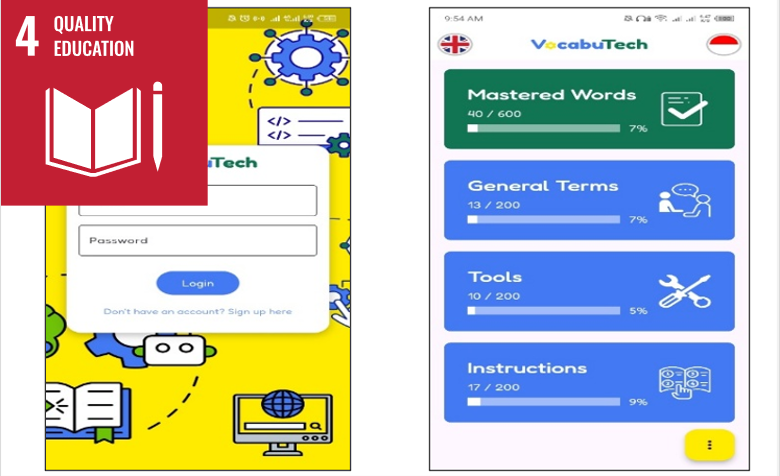
Los estudiantes de ingeniería suelen tener dificultades para dominar el vocabulario técnico en inglés debido a su carácter contextual y especializado. Para abordar este problema, este estudio ha desarrollado una aplicación móvil que facilita el aprendizaje autónomo de vocabulario específico del ámbito mediante actividades gamificadas. La aplicación se diseñó utilizando el marco Flutter y se integró con Firebase para la gestión de datos en tiempo real y el seguimiento de los usuarios. Cuenta con dos juegos interactivos:Palabra adivinada y Coincidencia de palabras—así como la función de conversión de texto a voz, un sistema de pistas limitado y el seguimiento visual del progreso mediante recuentos de dominio y barras de progreso. Los elementos de vocabulario se organizan en tres categorías temáticas: Términos generales, Herramientas e Instrucciones, cada una de ellas estructurada mediante una gestión de datos basada en JSON para garantizar la escalabilidad y facilitar el mantenimiento. Las evaluaciones empíricas, que incluyeron la revisión de expertos, arrojaron una puntuación de validez elevada (M = 4,6/5), lo que confirma la solidez pedagógica y la estabilidad técnica de la aplicación. La integración de la gamificación y la visualización del progreso mejoró significativamente la motivación, la autonomía y la implicación de los alumnos. Este estudio aporta un modelo replicable para combinar el desarrollo con Flutter y Firebase con los principios del diseño instruccional, con el fin de impulsar el aprendizaje de idiomas potenciado por la tecnología en la formación en ingeniería.
RIS is compatible with Zotero, Mendeley, and EndNote. Immediate opening depends on the visitor's browser and reference-manager settings.
Declaraciones recogidas en el artículo publicado
Author Contributions
Anita Nursi: Conceptualization, Methodology, Software Development (Flutter), Investigation, Writing – Original Draft, Writing – Review & Editing. Resmi Darni: Supervision, Validation, Formal Analysis, Evaluation of Pedagogical Soundness, Writing – Review & Editing. Dony Novaliendry: Supervision, Validation, Data Curation (Firebase integration), Empirical Evaluation, Writing – Review & Editing. All authors have read and approved the final version of this manuscript.
Acknowledgments
The authors would like to thank all individuals, institutions, and external collaborators who contributed their expertise and support during the design, development, and evaluation of the mobile application.
View statement in PDF · PDF page 18Ethics Approval
This study involved human participants only in the form of expert review for evaluating the mobile application. All experts provided informed consent before participation.
View statement in PDF · PDF page 18Financiación
The authors declare that this research received no external funding. All aspects of the study, including app development (using Flutter and Firebase), gamification design, and expert validation, were conducted independently without financial support from any organization.
View statement in PDF · PDF page 18Conflictos de Intereses
The authors declare that they have no conflicts of interest.
View statement in PDF · PDF page 18Generative AI Disclosure
During the preparation of this manuscript, the authors utilized ChatGPT-4o and Grammarly to improve clarity, readability, and coherence. ChatGPT-4o assisted in refining explanations related to instructional design, gamification, and empirical evaluation, while Grammarly helped identify and correct grammar, punctuation, and style issues. All content, interpretations, and conclusions were independently verified and manually edited by the authors.
View statement in PDF · PDF page 18Citas
32 References[1] R. Fithriani, “The Utilization of Mobile-assisted Gamification for Vocabulary Learning: Its Efficacy and Perceived Benefits,” Computer-Assisted Language Learning Electronic Journal, vol. 22, no. 3, pp. 146–163, 2024. [Online]. Available: https://callej.org/index.php/journal/article/view/357
[2] Y. Lai, N. Saab, and W. Admiraal, “University students’ use of mobile technology in self-directed language learning: Using the integrative model of behavior prediction,” Computers & Education, vol. 179, p. 104413, Apr. 2022, [Online]. Available: https://doi.org/10.1016/j.compedu.2021.104413
[3] Z. J. Zhang, “Exploring the effects of different gamified learning conditions on L2 learners’ vocabulary acquisition using Quizlet,” in Proc. Int. CALL Research Conf., 2024, pp. 339–344, [Online]. Available: https://doi.org/10.29140/9780648184485-51
[4] B. Maraza-Quispe et al., “Impact of the Use of Gamified Online Tools: A Study with Kahoot and Quizizz in the Educational Context,” Int. J. Inf. Educ. Technol., vol. 14, no. 1, pp. 132–140, 2024, [Online]. Available: https://doi.org/10.18178/ijiet.2024.14.1.2033
[5] I. Maryani et al., “Gamified Mobile-Based Learning Approach: Efforts to Improve Students’ Engagement and Learning Quality in Remote Schools in Indonesia,” Educational Process: International Journal, vol. 15, e2025179, Apr. 2025, [Online]. Available: https://doi.org/10.22521/edupij.2025.15.179
[6] E. Bjarnason, F. Lang, and A. Mjöberg, “An empirically based model of software prototyping: A mapping study and a multi-case study,” Empirical Software Engineering, vol. 28, no. 115, 2023, [Online]. Available: https://doi.org/10.1007/s10664-023-10331-w
[7] B. Kang, N. Crilly, W. Ning, and P. O. Kristensson, “Prototyping to elicit user requirements for product development: Using head-mounted augmented reality when designing interactive devices,” Design Studies, vol. 84, p. 101147, 2023, [Online]. Available: https://doi.org/10.1016/j.destud.2022.101147
[8] “Flutter architectural overview,” Flutter Documentation. [Online]. Available: https://docs.flutter.dev/resources/architectural-overview
[9] “Creating beautiful mobile applications using Flutter and Firebase,” Google Developer Forum Discussion, 2022.
[10] D. Mryrr, “A Modular Software Architecture for Embedded Systems,” IFAC Proc. Vol., vol. 39, no. 21, pp. 101–105, Feb. 2006, [Online]. Available: https://doi.org/10.1016/S1474-6670(17)30166-0
[11] M. Shortt, S. Tilak, I. Kuznetcova, B. Martens, and B. Akinkuolie, “Gamification in mobile-assisted language learning: A systematic review of Duolingo literature from public release of 2012 to early 2020,” Computer Assisted Language Learning, vol. 36, no. 3, pp. 517–554, 2023, [Online]. Available: https://doi.org/10.1080/09588221.2021.1933540
[12] H. Puspitasari, R. F. Maharani, W. H. Setyawan, and Y. Primasari, "Android-based mobile application for vocabulary learning," Jurnal Pendidikan dan Pembelajaran (JPP), vol. 55, no. 3, pp. 469–479, Dec. 2022, [Online]. Available: https://doi.org/10.23887/jpp.v55i3.40661
[13] M. D. Gall, J. P. Gall, and W. R. Borg, Educational Research: An Introduction, 8th ed. Boston, MA, USA: Pearson, 2007.
[14] M. Kukulska-Hulme and L. Shield, “An overview of mobile assisted language learning: From content delivery to supported collaboration and interaction,” ReCALL, vol. 20, no. 3, pp. 271–289, 2008, [Online]. Available: https://doi.org/10.1017/S0958344008000335
[15] G. Rangel-de Lazaro and J. M. Duart, "Moving learning: A systematic review of mobile learning applications for online higher education," Journal of New Approaches in Educational Research, vol. 12, pp. 198–224, 2023, [Online]. Available: https://doi.org/10.7821/naer.2023.7.1287
[16] P. Gou, "Teaching English using mobile applications to improve academic performance and language proficiency of college students," Education and Information Technologies, vol. 28, pp. 16935–16949, 2023, [Online]. Available: https://doi.org/10.1007/s10639-023-11864-9
[17] R. M. Ryan and E. L. Deci, "Intrinsic and extrinsic motivation from a self-determination theory perspective: Definitions, theory, practices, and future directions," Contemporary Educational Psychology, vol. 61, p. 101860, 2020, [Online]. Available: https://doi.org/10.1016/j.cedpsych.2020.101860
[18] R. E. Mayer, Multimedia Learning, 3rd ed. Cambridge, UK: Cambridge University Press, 2021, [Online]. Available: https://doi.org/10.1017/9781108894333
[19] S. Deterding, D. Dixon, R. Khaled, and L. Nacke, “From game design elements to gamefulness: Defining ‘gamification’,” in Proc. 15th Int. Acad. MindTrek Conf., 2011, pp. 9–15, [Online]. Available: https://doi.org/10.1145/2181037.2181040
[20] K. M. Kapp, The Gamification of Learning and Instruction: Game-Based Methods and Strategies for Training and Education. San Francisco, CA, USA: Pfeiffer, 2012.
[21] A. Hamari, J. Koivisto, and H. Sarsa, “Does gamification work?—A literature review of empirical studies on gamification,” in Proc. 47th Hawaii Int. Conf. Syst. Sci., 2014, pp. 3025–3034, [Online]. Available: https://doi.org/10.1109/HICSS.2014.377
[22] S. Tzima, G. Styliaras, and A. Bassounas, "Augmented reality applications in education: Teachers point of view," Education Sciences, vol. 9, no. 2, art. no. 99, 2019, [Online]. Available: https://doi.org/10.3390/educsci9020099
[23] H.-Y. Chang, T. Binali, J.-C. Liang, G.-L. Chiou, K.-H. Cheng, S. W.-Y. Lee, and C.-C. Tsai, "Ten years of augmented reality in education: A meta-analysis of (quasi-) experimental studies to investigate the impact," Computers & Education, vol. 191, p. 104641, Dec. 2022, [Online]. Available: https://doi.org/10.1016/j.compedu.2022.104641
[24] Y. Tiantian, A. B. Razali, N. N. Zulkifli, and J. J. Jeyaraj, "The effects of collaborative mobile learning approach on academic performance: The mediating role of social interaction, and learning motivation," Journal of Pedagogical Research, vol. 8, no. 3, pp. 209–229, 2024, [Online]. Available: https://doi.org/10.33902/JPR.202426264
[25] R. Teymouri, "Recent developments in mobile-assisted vocabulary learning: A mini review of published studies focusing on digital flashcards," Frontiers in Education, vol. 9, art. no. 1496578, 2024, [Online]. Available: https://doi.org/10.3389/feduc.2024.1496578
[26] T. Dudley-Evans and M. St. John, Developments in English for Specific Purposes: A Multi-Disciplinary Approach. Cambridge, UK: Cambridge University Press, 1998.
[27] K. Kishore, S. Khare, V. Uniyal and S. Verma, "Performance and stability Comparison of React and Flutter: Cross-platform Application Development," 2022 International Conference on Cyber Resilience (ICCR), Dubai, United Arab Emirates, 2022, pp. 1-4, [Online]. Available: https://doi.org/10.1109/ICCR56254.2022.9996039
[28] R. Mallik, A. P. Hazarika, S. Ghosh Dastidar, et al., "Development of an Android application for viewing Covid-19 containment zones and monitoring violators who are trespassing into it using Firebase and geofencing," Transactions of the Indian National Academy of Engineering, vol. 5, pp. 163–179, 2020, [Online]. Available: https://doi.org/10.1007/s41403-020-00137-3
[29] C. Garrison and H. Kanuka, “Blended learning: Uncovering its transformative potential in higher education,” The Internet and Higher Education, vol. 7, no. 2, pp. 95–105, 2004, [Online]. Available: https://doi.org/10.1016/j.iheduc.2004.02.001
[30] M. C. Laupichler, A. Aster, and T. Raupach, "Delphi study for the development and preliminary validation of an item set for the assessment of non-experts' AI literacy," Computers and Education: Artificial Intelligence, vol. 4, p. 100126, 2023, [Online]. Available: https://doi.org/10.1016/j.caeai.2023.100126
[31] M. Holmes, A. Bialik, and C. Fadel, Artificial Intelligence in Education: Promises and Implications for Teaching and Learning. Boston, MA, USA: Center for Curriculum Redesign, 2019.
[32] R. Pressman and B. Maxim, Software Engineering: A Practitioner’s Approach, 9th ed. New York, NY, USA: McGraw-Hill Education, 2020.
Copyright and License

Esta obra está bajo una licencia internacional Creative Commons Atribución 4.0.
Derechos de autor 2025 Anita Nursi, Resmi Darni, Dony Novaliendry