

Sustainable Development Goals
This article contributes to the following United Nations Sustainable Development Goals.


키워드
인용 방법




출판물 개요

차기호
J-HyTEL welcomes original and rigorous scholarship advancing education, media technology, and computer science applications.
Rolling submissions are accepted throughout the year.
초록
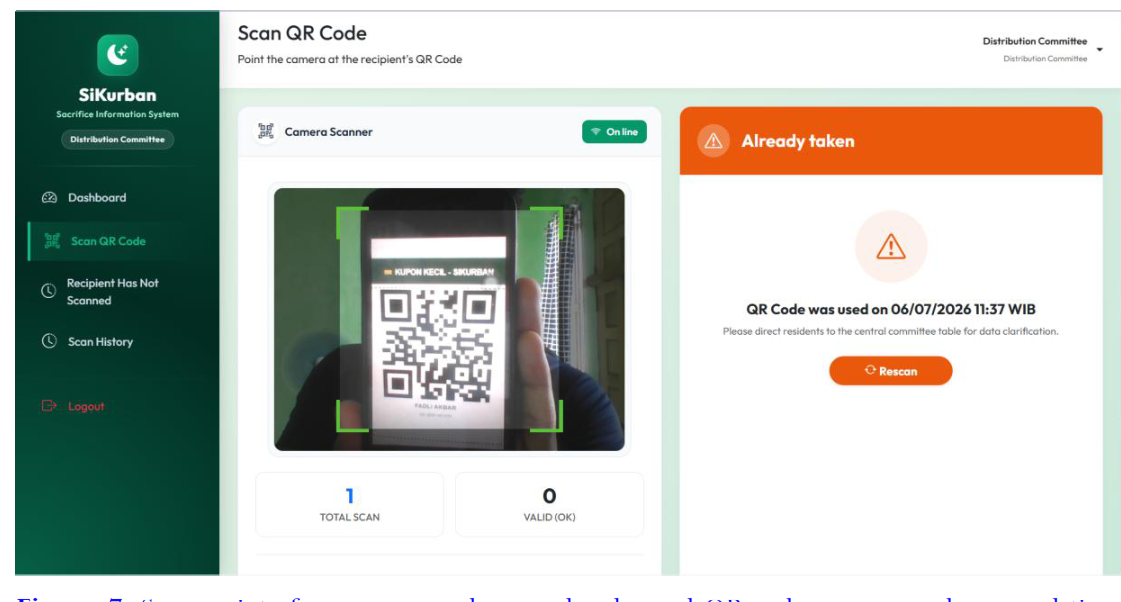
쿠르반(이슬람식 동물 제사) 고기 배분에 사용되는 종이 쿠폰은 분실, 물리적 손상, 위조 및 중복 사용의 위험이 있다. 서수마트라 파당에 위치한 수라우 쿠망고 파사 가당(Surau Kumango Pasa Gadang)에서 2025년에 진행된 이 과정에는 448장의 쿠폰, 56명의 참가자, 8마리의 가축, 20명의 위원회 위원들이 참여했다. 본 연구에서는 종이 기반 인증 방식을 일회용 QR 코드와 실시간 중복 청구 방지 기능으로 대체한 웹 애플리케이션인 ‘SiKurban’을 설계하고 기능적 평가를 수행했다. 개발은 Laravel과 MySQL을 사용하여 워터폴(Waterfall) 모델을 따랐습니다. 초기 토큰 값은 Numerical Recipes 매개변수(a = 1,664,525; c = 1,013,904,223; m = 2³²)을 사용하여 선형 합동 생성기(LCG)로 생성되었으며, 데이터베이스에서 고유성을 확인한 후 HMAC-SHA256으로 서명되었습니다. 스캔 과정에서 애플리케이션은 토큰과 그 상태를 검증한 후, 단일 잠금 데이터베이스 트랜잭션 내에서 배포 기록, 스캔 로그 및 “사용됨” 상태로의 되돌릴 수 없는 전환을 커밋했습니다. 2026년 7월 1일에 개발자가 수행한 블랙박스 테스트는 33가지 시나리오(28개의 정상 사례 및 5개의 비정상 또는 경계 사례)를 다루었습니다. 모든 시나리오에서 재사용되거나 미등록된 코드의 거부 등을 포함하여 지정된 결과가 산출되었습니다. 이 결과는 지정된 테스트 조건 하에서 개발자가 검증한 이 단일 사이트 프로토타입의 기능적 적합성을 입증한 것이지만, 독립적인 검증이나 현장 효과성을 입증하는 것은 아닙니다. 13개의 비기능적 요구사항, 사용성, 사용자 수용도, 보안 저항성, 확장성, 비용 및 불안정한 연결 환경에서의 성능에 대해서는 향후 실제 운영 또는 고충실도 배포 단계에서 위원회 위원이나 독립적인 테스터에 의해 평가되어야 합니다.
RIS is compatible with Zotero, Mendeley, and EndNote. Immediate opening depends on the visitor's browser and reference-manager settings.
References
40 References[1] M. S. Apriantoro, R. A. Zaky, and V. D. Febrianti, “Participatory planning assistance for the qurban savings and joint-purchase program to increase interest in qurban during the pandemic,” Jurnal Pengabdian kepada Masyarakat, vol. 2, no. 1, pp. 29–39, 2022, doi: https://doi.org/10.35870/ajad.v2i1.27
[2] Y. Purwanto, A. N. Fitriani, Syachrial, and A. Aziz, “The influence of innovation in sacrificial worship services and digital marketing on millennial and Gen Z donation tendencies,” Journal of Islamic Philanthropy & Social Finance, vol. 6, no. 1, pp. 83–93, 2024, doi: https://doi.org/10.24191/JIPSF/v6n12024
[3] B. Ardianto, Jaroji, and M. A. Subandri, “Development of the SIMASJID application using the extreme programming method,” Jurnal Penelitian Rumpun Ilmu Teknik, vol. 3, no. 3, pp. 187–202, 2024, doi: https://doi.org/10.55606/juprit.v3i3.4249
[4] S. N. Wahab, N. M. Sayuti, M. L. Mohaini, and H. Ismail, “Examining efficiency and hygiene in qurban meat packaging and distribution,” Environment-Behaviour Proceedings Journal, vol. 10, no. 33, pp. 29–31, 2025, doi: https://doi.org/10.21834/e-bpj.v10i33.7276
[5] D. Effendi, R. P. Dhaniawaty, M. Fitriawati, D. Cancerina, and A. Ramadhan, “Design and development of a qurban service information system using the research and development method,” Journal of Engineering Science and Technology, vol. 19, no. 5, pp. 1588–1599, 2024.
[6] I. Lewenusa, “Implementation of a barcode-based queue system for qurban meat distribution at Musala Nurul Iman, South Jakarta,” Jurnal Serina Abdimas, vol. 2, no. 3, pp. 1084–1091, 2024, doi: https://doi.org/10.24912/jsa.v2i3.32080
[7] J. Han, Y. Son, and H. Eom, “A secure e-coupon service based on blockchain systems,” IEEE Access, vol. 10, pp. 21836–21846, 2022, doi: https://doi.org/10.1109/ACCESS.2022.3152765
[8] A. M. Laksono, “Development of a digital qurban meat coupon authenticity verification system using AES encryption,” undergraduate thesis, Universitas Muhammadiyah Yogyakarta, Yogyakarta, Indonesia, 2025
[9] Ministry of Administrative and Bureaucratic Reform of the Republic of Indonesia, “Addressing the risk of data loss and leakage, the governments of Indonesia and the Republic of Korea develop verifiable credentials,” 2025. [Online]. Available: https://www.menpan.go.id/site/berita-terkini/atasi-risiko-kehilangan-dan-kebocoran-data-pemerintah-indonesia-dan-republik-korea-kembangkan-verifiable-credentials. [Accessed: Jul. 20, 2026]
[10] O. K. Durrani, M. S. Ali, D. S. Makandar, H. T. P., G. Bano, and D. Begum, “Performance analysis of linear congruential random generator algorithms using Python and Java languages,” Journal of Advances in Mathematics and Computer Science, vol. 40, no. 2, pp. 40–52, 2025, doi: https://doi.org/10.9734/jamcs/2025/v40i21968
[11] Takyudin, “Optimizing digital-based qurban management through community service at Masjid Al-Jauhar,” Jurnal Pengabdian kepada Masyarakat, vol. 5, no. 1, pp. 27–31, 2025
[12] W. N. A. Wan Mohamed Salleh, S. Z. Abdul Rasid, and R. Basiruddin, “Optimising digital technology in managing zakat,” International Journal of Academic Research in Business and Social Sciences, vol. 12, no. 8, pp. 698–711, 2022, doi: https://doi.org/10.6007/IJARBSS/v12-i8/14355
[13] K. Erwansyah, M. Zunaidi, F. Taufik, Tugiono, and Hafizah, “Implementation of a barcode system for Eid al-Adha 1446 H qurban meat distribution coupons at Musholla An-Nur, Marindal I Village, Patumbak, Deli Serdang,” Jurnal Abdimas TGD, vol. 5, no. 2, pp. 196–204, 2025
[14] Heldiansyah, N. Shintia, Rustaniah, and M. Salim, “A web-based meat distribution information system model for qurban worship committees,” Jurnal Ilmiah Teknik Informatika dan Sistem Informasi, vol. 11, no. 1, p. 241, 2022, doi: https://doi.org/10.35889/jutisi.v11i1.801
[15] N. Ruhyana, A. O. Sari, T. Mardiana, A. Bayhaqy, A. A. Riyadi, and Setiaji, “Design and development of a qurban distribution management information system,” Inti Nusa Mandiri, vol. 20, no. 1, pp. 11–17, 2025, doi: https://doi.org/10.33480/inti.v20i1.6945
[16] R. Andika and K. Haryono, “Qurban management information system to improve the administrative governance of qurban implementation,” Prosiding Automata, vol. 3, no. 2, 2022. [Online]. Available: https://journal.uii.ac.id/AUTOMATA/article/view/24230. [Accessed: Jul. 20, 2026].
[17] J. Maulindar, Y. Bahtiar, T. M. Diva, and S. Umar, “Web-based qurban management system at Masjid Al-Falah, Kebak Wirun, Mojolaban,” Jurnal Manajemen Informatika & Sistem Informasi, vol. 5, pp. 140–150, 2022
[18] S. A. Azzahra and A. Wicaksono, “Digital transformation in web-based qurban animal data management at Masjid Baiturahhman,” Jurnal Sains dan Teknologi, vol. 3, no. 1, pp. 45–54, 2024, doi: https://doi.org/10.58169/saintek.v3i1.542
[19] A. Saravanos and M. X. Curinga, “Simulating the software development lifecycle: The waterfall model,” Applied System Innovation, vol. 6, no. 6, Art. no. 108, 2023, doi: https://doi.org/10.3390/asi6060108
[20] Z. Subecz, “Web development with the Laravel framework,” Gradus, vol. 8, no. 1, pp. 211–218, 2021, doi: https://doi.org/10.47833/2021.1.csc.006
[21] T. S. Huynh, D. T. Tran, Q. H. Vu, and L. A. T. Nguyen, “Design and implementation of a web application based on MVC Laravel architecture,” European Journal of Electrical Engineering and Computer Science, vol. 6, no. 4, pp. 37–42, 2021, doi: https://doi.org/10.24018/ejece.2021.6.4.448
[22] O. Ekhlakov, “PHP: Methodology for configuring third-party Composer packages,” The American Journal of Engineering and Technology, vol. 7, no. 6, pp. 56–65, 2025, doi: https://doi.org/10.37547/tajet/volume07issue06-06
[23] N. D. Kulkarni and S. Bansal, “System analysis to UML—Restaurant case study,” Journal of Artificial Intelligence & Cloud Computing, vol. 1, no. 1, 2022, doi: https://doi.org/10.47363/JAICC/2022(1)196
[24] S. M. Pulungan, R. Febrianti, T. Lestari, N. Gurning, and N. Fitriana, “Analysis of the entity-relationship diagram technique in database design,” Jurnal Ekonomi Manajemen dan Bisnis, vol. 1, no. 2, pp. 98–102, 2023, doi: https://doi.org/10.47233/jemb.v1i2.533
[25] M. Rana, A. Pandey, A. Mishra, and V. Kandu, “Enhancing data security: A comprehensive study on the efficacy of JSON Web Token and HMAC-SHA-256 algorithm for web application security,” International Journal of Recent Innovation and Trends in Computing and Communication, vol. 11, no. 9, pp. 4409–4416, 2023, doi: https://doi.org/10.17762/ijritcc.v11i9.9930
[26] Z. M. Alshamaa and N. N. Saleem, “Black-box software testing techniques: A literature review,” Passer Journal of Basic and Applied Sciences, vol. 7, no. 2, pp. 1001–1011, 2025, doi: https://doi.org/10.24271/PSR.2025.508216.1963
[27] S. A. Alsuhibany, “Innovative QR code system for tamper-proof generation and fraud-resistant verification,” Sensors, vol. 25, no. 13, Art. no. 3855, 2025, doi: https://doi.org/10.3390/s25133855
[28] A. Prakarsa, A. A. Sunarto, and Prajoko, “An online high-school examination randomization model using the linear congruential generator and Fisher–Yates methods,” Jurnal Ilmiah Komputer, vol. 16, no. 2, pp. 133–142, 2020, doi: https://doi.org/10.35889/progresif.v16i2.519
[29] R. D. Tjahjono, N. A. Prasita, and A. A. Widodo, “Implementation of a unique nominal-transfer code using the linear congruential generator method for order deposits,” Jurnal Informatika Merdeka Pasuruan, vol. 1, no. 3, pp. 39–52, 2016.
[30] T. M. Zulfikar and L. Tanti, “Design of a TOEFL simulation quiz application using the linear congruential generator algorithm on Android,” Jurnal Info Digit, vol. 2, no. 1, pp. 18–31, 2024.
[31] B. A. Hameedi, A. A. Hattab, and M. M. Laftah, “A pseudorandom number generator based on a new hybrid LFSR and LCG algorithm,” Iraqi Journal of Science, vol. 63, no. 5, pp. 2230–2242, 2022, doi: https://doi.org/10.24996/ijs.2022.63.5.35
[32] T. E. Hull and A. R. Dobell, “Random number generators,” SIAM Review, vol. 4, no. 3, pp. 230–254, 1962, doi: https://doi.org/10.1137/1004061
[33] P. L’Ecuyer, “Tables of linear congruential generators of different sizes and good lattice structure,” Mathematics of Computation, vol. 68, no. 225, pp. 249–260, 1999, doi: https://doi.org/10.1090/S0025-5718-99-00996-5
[34] S. K. Park and K. W. Miller, “Random number generators: Good ones are hard to find,” Communications of the ACM, vol. 31, no. 10, pp. 1192–1201, 1988, doi: https://doi.org/10.1145/63039.63042
[35] M. Bellare, R. Canetti, and H. Krawczyk, “Keying hash functions for message authentication,” in Advances in Cryptology—CRYPTO ’96, Berlin, Germany: Springer, 1996, pp. 1–15, doi: https://doi.org/10.1007/3-540-68697-5_1
[36] H. Berenson, P. Bernstein, J. Gray, J. Melton, E. O’Neil, and P. O’Neil, “A critique of ANSI SQL isolation levels,” in Proceedings of the 1995 ACM SIGMOD International Conference on Management of Data, 1995, pp. 1–10, doi: https://doi.org/10.1145/223784.223785
[37] R. Focardi, F. L. Luccio, and H. A. M. Wahsheh, “Usable security for QR codes,” Journal of Information Security and Applications, vol. 48, Art. no. 102369, 2019, doi: https://doi.org/10.1016/j.jisa.2019.102369
[38] W. H. DeLone and E. R. McLean, “The DeLone and McLean model of information systems success: A ten-year update,” Journal of Management Information Systems, vol. 19, no. 4, pp. 9–30, 2003, doi: https://doi.org/10.1080/07421222.2003.11045748
[39] I. Otaduy and O. Diaz, “User acceptance testing for Agile-developed web-based applications: Empowering customers through wikis and mind maps,” Journal of Systems and Software, vol. 133, pp. 212–229, 2017, doi: https://doi.org/10.1016/j.jss.2017.01.002
[40] A. Scheerder, A. van Deursen, and J. van Dijk, “Determinants of Internet skills, uses, and outcomes: A systematic review of the second- and third-level digital divide,” Telematics and Informatics, vol. 34, no. 8, pp. 1607–1624, 2017, doi: https://doi.org/10.1016/j.tele.2017.07.007
Copyright and License

This work is licensed under a Creative Commons Attribution 4.0 International License.
Copyright (c) 2026 Farras Fathin Naufal, Dedy Irfan, Delvi Asmara